

How to Help a Teen Who Won’t Open Up
Trying to reach a teen who won’t talk can feel heartbreaking. Whether you are a parent, caregiver, teacher, foster parent, or counselor, it is hard to know when to give space and when to lean in. The good news is that there are gentle, practical ways to build trust, support emotional safety, and help teens feel ready to share in their own time.
When a teen pulls away, stops talking, or answers every question with “fine,” the silence can feel louder than words. Adults often worry that they are doing something wrong, missing something important, or losing connection altogether. And honestly, that fear makes sense. Adolescence is a complex season of life. Teens are dealing with identity, pressure, friendships, school stress, family dynamics, social media, body changes, and mental health challenges, sometimes all at once.
So, what can you do when a young person shuts down?
Learning how to help a teen who won’t open up starts with understanding one important truth: silence is often communication. A teen may not have the words for what they feel. They may worry about being judged, misunderstood, punished, or dismissed. They may want support but not know how to ask for it. In many cases, their withdrawal is not rejection. It is protection.
That is why a compassionate, mental health-informed approach matters so much. Instead of pushing harder, the goal is to create emotional safety. Instead of demanding answers, the goal is to build trust. Over time, that steady and calm presence can make all the difference.
In this guide, we will explore why teens stop opening up, how adults can respond in ways that help rather than hurt, and what practical steps can strengthen connection across home, school, and support settings.
Why Teens Shut Down in the First Place
Before jumping into solutions, it helps to understand why teens become quiet. Not every teen shuts down for the same reason, and not every quiet teen is in crisis. Still, silence often has roots that deserve attention.
Here are some common reasons teens may stop opening up:
They feel overwhelmed and do not know where to begin.
They fear disappointing adults.
They worry their privacy will not be respected.
They expect lectures instead of listening.
They are struggling with anxiety, depression, trauma, or stress.
They feel ashamed of what they are going through.
They are trying to figure things out on their own.
They have opened up before and felt dismissed or misunderstood.
For some teens, talking about emotions feels uncomfortable because they have never been taught how. For others, staying silent may be a coping strategy. Either way, shutting down is often less about defiance and more about self-protection.
That perspective changes everything. When adults stop seeing silence as disrespect and start seeing it as a signal, they can respond with more empathy and less frustration.
Watch for the Difference Between Privacy and Distress
Every teen needs privacy. Wanting space does not automatically mean something is wrong. Still, there is a difference between normal independence and signs of emotional distress.
A teen may simply need space if they:
Want more time alone but still engage sometimes
Keep up with school, friendships, or routines
Show typical mood changes without major disruptions
Respond better after they have had time to cool off
A deeper issue may be present if they:
Withdraw from everyone for long periods
Lose interest in things they once enjoyed
Show major sleep or appetite changes
Seem persistently sad, numb, angry, or anxious
Talk about hopelessness, worthlessness, or self-harm
Struggle noticeably at school or at home
Use substances or engage in risky behavior
If these signs show up, it is wise to take them seriously. A mental health-informed response does not mean assuming the worst. It means paying attention, staying steady, and getting support when needed.
Start With Connection, Not Interrogation
One of the biggest mistakes adults make is trying to force a conversation before trust is in place. It is understandable. When you are worried, you want answers now. But teens tend to open up more when they feel emotionally safe, not emotionally cornered.
Instead of asking a rapid-fire list of questions, focus on connection first.
Try these approaches:
Sit with them during a quiet moment without pressure
Talk while doing something together, like driving, cooking, or walking
Use gentle observations instead of direct demands
Keep your tone calm and open
For example, instead of saying, “Why won’t you talk to me?” you might say:
“I’ve noticed you seem quieter than usual lately. I care about you, and I’m here when you’re ready.”
That small shift matters. It lowers pressure and shows care without forcing disclosure.
Validate Feelings Without Trying to Fix Everything
When teens do begin to share, adults often jump into problem-solving mode. Again, the intention is good. You want to help. But moving too quickly into advice can make a teen feel unseen.
Sometimes what a teen needs most is not a solution right away. They need validation.
Validation sounds like:
“That sounds really hard.”
“I can see why you’d feel that way.”
“Thanks for telling me.”
“You don’t have to figure this out alone.”
“It makes sense that you’re overwhelmed.”
Validation does not mean agreeing with every choice or emotion. It simply means acknowledging that their experience is real. That can help lower defensiveness and build trust.
In mental health support, feeling understood is often the first step toward feeling safe.
Pick the Right Time to Talk
Timing can make or break a conversation. Asking deep emotional questions right after an argument, before school, or in front of others usually backfires.
Instead, look for low-pressure opportunities:
During a car ride
Late in the evening when things are quieter
While doing chores side by side
After sharing a meal
During a walk
Many teens open up more easily when eye contact is not constant and the setting feels natural. A side-by-side moment can feel less intense than a face-to-face talk.
Also, do not expect one big breakthrough conversation. Most meaningful communication with teens happens in small pieces over time.
Use Gentle Language That Opens Doors
Words matter. Some questions feel like invitations. Others feel like traps.
Here are better ways to start:
Instead of:
“What is wrong with you?”
Try:
“You seem like you’ve been carrying a lot lately.”
Instead of:
“Why are you acting like this?”
Try:
“Something feels off, and I want to understand.”
Instead of:
“You need to tell me what’s going on.”
Try:
“I’m here to listen whenever you feel ready.”
Instead of:
“Are you being dramatic?”
Try:
“It sounds like this is really affecting you.”
That is a huge part of how to help a teen who won’t open up. Your tone can either create safety or shut the door even more.
Respect Their Pace
This part can be tough, especially for adults who feel responsible for keeping a teen safe. But pacing matters. Pushing too hard can make a teen retreat further.
Respecting pace means:
Not demanding immediate answers
Not forcing emotional conversations in the heat of the moment
Letting silence happen without panicking
Returning to the topic gently later
Accepting partial sharing instead of expecting everything at once
A teen may test whether you can handle small truths before trusting you with bigger ones. If every small disclosure leads to overreaction, they may decide it is safer to stay quiet.
Patience is not passive. It is active trust-building.
Build Trust in Everyday Moments
Sometimes adults focus so much on getting teens to talk that they forget the value of simple connection. Trust is not built only in serious conversations. It grows in regular, ordinary moments.
Try to:
Show interest in their hobbies without taking over
Remember things they care about
Follow through on your promises
Respect reasonable boundaries
Share light moments and humor
Be emotionally predictable
Teens notice consistency. They pay attention to whether adults stay calm, keep their word, and show up without conditions. Over time, those everyday interactions create a foundation for deeper communication.
Do Not Take Their Silence Personally
This one stings, but it is important. A teen’s silence is not always about you. Even when you care deeply, they may still choose not to talk. That does not mean you have failed.
Teens often pull away as part of development. They are trying to form identity, independence, and control. Sometimes they talk more to a teacher, coach, counselor, sibling, or friend than to a parent or caregiver. That can feel painful, sure, but it can also be a good sign. It means they are reaching for support somewhere.
The real goal is not to be the only trusted person. It is to help the teen have trusted people.
Be Aware of Mental Health Warning Signs
Because you asked for mental health framing, this needs to be said clearly: sometimes a teen’s silence is tied to depression, anxiety, trauma, grief, or another mental health concern.
Watch for patterns such as:
Ongoing irritability or sadness
Panic, dread, or physical signs of anxiety
Frequent headaches or stomachaches with no clear cause
A drop in grades or motivation
Self-isolation
Extreme sensitivity to criticism
Changes in hygiene or appearance
Talking about feeling like a burden
Mentioning self-harm or death
If you notice these warning signs, reach out to a licensed mental health professional. A therapist, school counselor, pediatrician, or community mental health provider can help assess what is going on and what support makes sense.
If a teen talks about harming themselves or others, or you believe they may be in immediate danger, seek emergency help right away.
Offer Support, Not Control
Teens are more likely to accept help when they still feel some sense of agency. Rather than taking over every decision, offer choices when appropriate.
For example:
“Would you rather talk here or go for a drive?”
“Would it help to text me instead of talking?”
“Would you rather see the school counselor or an outside therapist?”
“Do you want advice right now, or do you just want me to listen?”
Choices give teens a sense of dignity. That can be especially important when they already feel emotionally overwhelmed.
Normalize Getting Help
Some teens stay silent because they think they should be able to handle everything on their own. Others worry that needing help means something is wrong with them. Adults can reduce this shame by normalizing support.
You might say:
“Everybody needs support sometimes.”
“Talking to someone can help sort out what feels tangled.”
“Mental health care is part of health care.”
“You don’t have to wait until things get worse.”
That message matters for parents, foster parents, caregivers, teachers, and counselors alike. When adults treat emotional support as normal, teens are less likely to see it as failure.
For helpful mental health information, organizations like the National Institute of Mental Health, Mental Health America, and The Trevor Project offer resources for young people and adults who support them.
What Parents and Caregivers Can Do at Home
Home is often where a teen feels safest, but it can also be where emotions spill out hardest. That does not always mean home is the problem. It often means home is where the teen finally lets the mask drop.
At home, try to:
Keep routines steady and predictable
Reduce unnecessary criticism
Create regular one-on-one time
Apologize when you get it wrong
Avoid turning every check-in into a lecture
Model healthy emotional language
Saying, “I got frustrated earlier, and I wish I had handled that better,” teaches accountability. It also shows teens that relationships can repair after tension.
What Teachers and School Staff Can Do
Teachers, counselors, coaches, and school staff often notice shifts before anyone else does. A teen who does not talk at home may still communicate through behavior, writing, attendance patterns, or classroom engagement.
Helpful school-based strategies include:
Greeting the teen warmly and consistently
Noticing changes without shaming them
Offering private check-ins
Providing calm structure
Referring to school mental health support when needed
Coordinating with caregivers appropriately and ethically
Sometimes a teen opens up because one adult in the school environment made them feel seen. Never underestimate that.
What Foster Parents and Other Caregivers Should Keep in Mind
For foster parents and non-parent caregivers, trust may be even more layered. A teen with a history of instability, trauma, or disrupted relationships may take longer to open up. That is not resistance. It may be survival.
In these situations:
Be especially consistent
Avoid making trust a requirement for care
Let actions speak loudly
Keep expectations clear and calm
Understand that closeness may feel risky for them
Trauma-informed care reminds us that behavior often has a story behind it. Compassion does not erase boundaries, but it does change how boundaries are offered.
What Not to Do
Sometimes the best way to improve connection is to stop doing the things that shut it down.
Avoid:
Pressuring them to talk before they are ready
Using shame, guilt, or sarcasm
Comparing them to siblings or peers
Threatening punishment for not sharing
Minimizing their feelings
Breaking confidence unless safety is at risk
Turning their vulnerability into a lecture
A teen who feels judged will likely go quiet again. A teen who feels respected may come back.
Small Phrases That Can Make a Big Difference
Here are a few simple phrases that can help:
“I’m here, no pressure.”
“You matter to me.”
“You don’t have to say everything all at once.”
“Thanks for telling me that.”
“We can figure this out together.”
“It’s okay not to have the words yet.”
“Would it help if I just stayed with you?”
These phrases are gentle, steady, and emotionally safe. And that is often what teens need most.
FAQs About How to Help a Teen Who Won’t Open Up
Is it normal for teens not to talk much?
Yes, to a degree. Many teens become more private as they grow. That is part of development. The concern rises when silence is paired with distress, withdrawal, hopelessness, or major behavior changes.
How do I help without making things worse?
Stay calm, listen more than you talk, validate feelings, and avoid pushing too hard. Focus on emotional safety instead of immediate answers. That is central to how to help a teen who won’t open up.
Should I force my teen to go to therapy?
Sometimes adults need to make supportive decisions, especially when safety or serious distress is involved. But whenever possible, involve the teen in the process so they feel some ownership and control.
What if they talk to everyone except me?
That can hurt, but it does not mean you are failing. It may simply mean they feel safer starting elsewhere. Encourage healthy support connections while continuing to show up with patience.
How long should I wait before getting professional help?
If signs of depression, anxiety, trauma, self-harm, hopelessness, or major functioning changes appear, do not wait too long. Early support often helps prevent things from getting worse.
Final Thoughts
Learning how to help a teen who won’t open up is not about finding the perfect words. It is about becoming a safe presence. A calm voice. A steady relationship. A person who can handle truth without panic and pain without judgment.
Some teens open up quickly. Others take time. Some speak in full sentences. Others communicate in fragments, moods, or silence. The work is to stay available, pay attention, and respond with compassion.
Whether you are a parent, foster parent, caregiver, teacher, or counselor, your presence matters more than you may realize. You do not need all the answers. You just need to keep showing the teen, again and again, that they do not have to carry hard things alone.
And when silence points to something deeper, reaching for mental health support is not overreacting. It is caring wisely.
In the end, trust is built one moment at a time. A soft question. A patient pause. A nonjudgmental response. A steady return. Little by little, those moments can open doors that pressure never will.
What It Means to Feel “Stuck” Emotionally
Feeling stuck emotionally can be frustrating, confusing, and honestly a little exhausting. You may look fine on the outside but feel like something inside has stopped moving. Maybe you keep circling the same thoughts, carrying the same pain, shutting down in the same situations, or feeling like you cannot fully connect to yourself anymore. This article explores what it means to feel “stuck” emotionally, why it happens, how it shows up in everyday life, and what can help you begin moving forward again with more honesty, support, and self-compassion.
There are seasons when life feels hard in obvious ways. Something big happens, and you know exactly why you feel off.
Then there are other seasons that feel harder to explain.
You are functioning, technically. You are answering messages, showing up where you need to, doing your best to keep life moving. But inside, something feels jammed. Heavy. Repetitive. Like your emotions are caught in the same place and cannot quite move through.
That is what feeling stuck emotionally can be like.
It is not always dramatic. It is not always a breakdown. Sometimes it is quieter than that. Sometimes it feels like going through the motions while carrying a low-grade ache you cannot fully name. Sometimes it looks like overthinking the same issue, shutting down every time you get close to your feelings, or staying trapped in patterns you know are not helping but cannot seem to break.
And honestly, one of the hardest parts is how isolating it can feel.
Because when you are emotionally stuck, you may start wondering:
“Why am I still affected by this?”
“Why can’t I just move on?”
“Why do I keep reacting this way?”
“Why do I feel numb one day and overwhelmed the next?”
“What is wrong with me?”
Usually, the answer is not that something is wrong with you.
Usually, something inside you needs care, understanding, and space to move.
Let’s talk about what emotional stuckness actually means, why it happens, and how to begin finding your way forward.
What does it mean to feel stuck emotionally?
Feeling stuck emotionally usually means you are having trouble processing, releasing, or moving through what you feel.
It can mean an emotion has been sitting in your system for a long time without enough space, safety, or support to move. It can mean unresolved pain is still shaping the way you think, react, connect, or cope. It can also mean you are so emotionally overloaded that your mind and body have gone into a kind of pause mode.
In simple terms, emotional stuckness can feel like:
being unable to move past something
reacting to the same triggers over and over
feeling emotionally numb or shut down
circling the same thoughts without relief
feeling disconnected from yourself
knowing something is wrong but not knowing how to shift it
This does not mean you are broken. It usually means your inner world is carrying more than it knows how to process right now.
Emotional stuckness does not always look dramatic
This is important because a lot of people miss it.
When people imagine emotional struggle, they often picture visible sadness, crying, or some kind of obvious crisis. But emotional stuckness is often much subtler than that.
It can look like:
doing everything you need to do but feeling flat
replaying the same conversation in your head for weeks
feeling irritated all the time but not knowing why
avoiding certain topics because they instantly overwhelm you
staying busy so you do not have to feel
feeling disconnected in relationships
saying “I’m fine” because you genuinely do not know how to explain what is happening
From the outside, you may still seem okay. But inside, there is a sense of being emotionally pinned in place.
Why people get stuck emotionally
There is no single reason this happens. Emotional stuckness can come from a lot of different places, and sometimes more than one at the same time.
Unprocessed pain
One of the biggest reasons people feel emotionally stuck is that something painful happened and never got fully processed.
Maybe you had to keep going too quickly. Maybe no one made space for what you felt. Maybe you minimized it. Maybe you did not feel safe enough to be honest about how much it affected you.
So the pain never really left. It just got stored.
That can happen with:
grief
heartbreak
betrayal
trauma
rejection
childhood wounds
disappointment
emotional neglect
burnout
major life changes
When pain is not processed, it does not always disappear. Sometimes it just sits there and keeps shaping things quietly.
Emotional suppression
A lot of people were taught to push emotions down instead of work through them.
They learned to stay strong, stay quiet, not make a fuss, not cry, not be dramatic, not burden anyone, not slow down. Over time, that can create a habit of emotional suppression.
The problem is, suppressed emotions do not vanish. They often show up later as anxiety, irritability, numbness, shutdown, overthinking, or feeling stuck in a way you cannot explain.
Fear of feeling too much
Sometimes people get emotionally stuck because part of them is afraid of what will happen if they really let themselves feel.
That fear makes sense, especially if you have lived through trauma, instability, intense grief, or seasons where emotions felt overwhelming and unsupported. Your system may believe that if you fully open the door, everything will come crashing in.
So instead, you stay half-numb, half-aware, somewhere in between.
That can feel safer in the short term, but it can also keep you stuck.
Burnout and overload
You do not have to be deeply traumatized to feel emotionally stuck. Sometimes you are just emotionally flooded.
If you have been under stress for a long time, carrying too much, supporting everyone else, running on empty, and never really resting, your system may stop processing things clearly. Everything starts to feel foggy, heavy, or flat.
This is especially common in people who are always in survival mode.
Repeated patterns and old wounds
Sometimes emotional stuckness comes from repeating the same internal story over and over.
Maybe you keep ending up in relationships that wound the same part of you. Maybe you keep chasing approval. Maybe you keep abandoning your own needs. Maybe you keep telling yourself the same painful story:
“I’m not enough.”
“People always leave.”
“I have to earn love.”
“I can’t trust myself.”
“If I slow down, I’ll fall apart.”
Those patterns can create a stuck feeling because every new experience keeps getting filtered through the same old wound.
What emotional stuckness can look like in everyday life
This is where it gets really real. Emotional stuckness is not just a concept. It shows up in daily life in ways people often do not immediately connect.
You keep thinking about the same thing
Maybe your mind keeps returning to the same hurt, the same loss, the same conversation, the same regret, or the same unanswered question.
You are not thinking about it because you enjoy it. You are thinking about it because some part of you still feels unresolved.
You feel numb more often than not
Emotional stuckness can look like numbness.
You are not necessarily crying or falling apart. You just do not feel fully alive either. Things that used to move you do not hit the same. Joy feels muted. Connection feels harder. You are there, but not all the way there.
You shut down when emotions come up
Any time something starts to feel too vulnerable, too painful, or too intense, you go blank. You change the subject. You distract yourself. You get tired suddenly. You avoid the conversation. You pull away.
That shutdown can be a sign that your system is protecting you from something it does not yet know how to handle safely.
You keep reacting bigger than the moment
Sometimes feeling stuck emotionally looks like strong reactions that seem out of proportion to the current situation.
A small conflict feels huge. A delayed reply feels crushing. Mild criticism feels unbearable. It is often a clue that the present moment is touching something older and deeper.
You feel like you cannot move forward
You may want to move on. You may want to feel better. You may even know logically what you “should” do. But emotionally, you feel frozen in place.
That can be one of the most frustrating parts. You know you do not want to stay here, but you do not know how to unstick yourself.
Feeling stuck emotionally is not the same as being lazy or weak
This needs to be said clearly.
A lot of people shame themselves for emotional stuckness. They tell themselves they are weak, dramatic, too sensitive, lazy, or just not trying hard enough.
But emotional stuckness is usually not about lack of effort.
It is often about:
pain that has not been processed
emotions that do not yet feel safe to feel
a nervous system that is overloaded
protective patterns that once made sense
grief that needs space
wounds that are still tender
survival responses that stayed longer than necessary
That is very different from weakness.
If anything, many emotionally stuck people have been strong for too long in ways that cost them something.
Why trying to “just move on” usually does not work
This is where a lot of people get more frustrated.
They tell themselves to move on. Stay positive. Stop thinking about it. Get over it. Focus on the future. Be grateful. Push through.
Sometimes those messages sound practical, but often they skip the part where real healing happens.
You cannot always rush your way out of emotional stuckness.
Why? Because emotions usually move through honesty, not pressure. They move through safety, not shame. They move through processing, not pretending.
Telling yourself to “just move on” when something is still alive inside you often creates even more stuckness. Now you are not only hurting, you are also judging yourself for hurting.
That makes everything heavier.
What can help you begin moving again emotionally
Now for the part that matters most: what actually helps?
There is no single magic fix, but there are real things that can help you begin loosening what feels stuck.
1. Tell yourself the truth about where you are
This is the starting point.
Try saying:
“I am not as okay as I’ve been pretending.”
“Something in me still feels unresolved.”
“I think I’ve been carrying this longer than I realized.”
“I feel emotionally stuck, and I need to take that seriously.”
That honesty matters because you cannot care for what you keep denying.
2. Stop rushing yourself
Healing and emotional movement do not usually happen on command.
If you keep pressuring yourself to “be over it already,” you create more tension around the very thing that needs gentleness.
Try replacing pressure with curiosity:
“What is still hurting here?”
“What feels unfinished?”
“What am I afraid to feel?”
“What might this stuckness be protecting me from?”
That shift can open a door.
3. Name what you are actually feeling
A lot of emotional stuckness stays vague because people never slow down enough to identify what is really happening inside them.
Try getting more specific.
Maybe you are not just “off.” Maybe you feel:
disappointed
ashamed
abandoned
scared
angry
lonely
emotionally exhausted
numb
resentful
grief-stricken
Naming emotions does not fix everything, but it helps make your inner world less foggy.
4. Give your emotions somewhere to go
Stuck emotions need expression.
That might look like:
journaling honestly
talking to someone safe
crying
praying
making art or music
walking while you think
saying out loud what hurts
writing a letter you never send
The goal is not perfect emotional release. The goal is movement.
5. Notice the patterns, not just the pain
Ask yourself:
When do I shut down?
What situations trigger the same emotional loop?
What do I keep avoiding?
What story do I keep telling myself?
What need keeps going unmet?
Patterns are often where the deeper understanding lives.
6. Let your body be part of the process
Emotional stuckness is not only mental. It is often physical too.
Your body may be carrying tension, grief, fear, or exhaustion in ways your mind has not fully caught up with. So movement can help.
That might mean:
walking
stretching
deep breathing
resting
shaking out tension
sitting quietly and noticing where you feel things physically
Sometimes the body starts releasing what words could not yet touch.
7. Reach for support instead of isolation
This matters a lot.
Emotional stuckness often thrives in isolation. Not because people want to isolate, but because they do not know how to explain what is happening.
Still, healing usually moves better in safe connection.
Talk to:
a trusted friend
a counselor or therapist
a mentor
a pastor
a safe family member
a support group
You do not have to carry everything alone just because you do not fully understand it yet.
When feeling stuck emotionally may need professional support
Sometimes emotional stuckness is tied to something deeper that really deserves professional care.
If you feel:
emotionally numb for long stretches
unable to function well
trapped in the same painful patterns
deeply overwhelmed by old wounds
stuck in grief, trauma, or depression
constantly disconnected from yourself
unsafe with your thoughts or emotions
then therapy or counseling may be a really important next step.
That is not weakness. That is wisdom.
Sometimes what feels “stuck” is actually trauma, depression, unresolved grief, or nervous system dysregulation that needs more support than self-help can provide.
A gentler way to understand yourself
Maybe one of the most healing things you can remember is this:
Feeling stuck emotionally does not mean you are failing at life.
It may mean you have been carrying something heavy for too long.
It may mean your heart is trying to catch up to what your life has been through.
It may mean some part of you is still waiting for safety, understanding, or release.
It may mean you need care, not criticism.
That shift in perspective can change a lot.
Because when you stop treating your stuckness like a character flaw, you can start responding to it like something that needs compassion, attention, and honest support.
And that is often where movement begins.
FAQ
What does it mean to feel stuck emotionally?
It usually means you are having trouble processing, releasing, or moving through emotions. You may feel numb, overwhelmed, repetitive in your thoughts, or unable to move forward emotionally.
Why do I feel emotionally stuck?
Emotional stuckness can come from unprocessed pain, trauma, burnout, emotional suppression, unresolved grief, fear of feeling too much, or repeated patterns connected to old wounds.
Is feeling emotionally stuck a sign of depression?
Sometimes it can be. Emotional stuckness can overlap with depression, grief, anxiety, burnout, or trauma, but it does not always mean the same thing. If it feels intense or long-lasting, professional support can help clarify what is going on.
How does emotional stuckness show up in daily life?
It can show up as overthinking, numbness, irritability, shutdown, feeling disconnected, repeating the same patterns, avoiding feelings, or feeling like you cannot move past something.
Can you become emotionally stuck after trauma or heartbreak?
Yes. Trauma, heartbreak, loss, betrayal, and major life stress can all leave emotions feeling unresolved or frozen if they were not fully processed.
How can I start moving forward emotionally?
Start with honesty, self-awareness, naming what you feel, expressing emotions safely, noticing patterns, supporting your body, and reaching out for safe support.
Should I get therapy if I feel emotionally stuck?
Therapy can be very helpful, especially if your stuckness feels long-lasting, intense, tied to trauma or depression, or is affecting your daily life and relationships.
Final thoughts
What does it mean to feel stuck emotionally?
It means something inside you may still be waiting to be understood.
It means your emotions may need more space, more safety, or more support than they have been getting.
It means you may be carrying something that has not fully moved yet.
But it does not mean you are broken.
Emotional stuckness is frustrating, yes. Confusing too. But it can also be information. A signal. A sign that part of you needs gentleness, honesty, and a different kind of care than pressure can provide.
And with the right support, emotional movement can come back.
Maybe slowly.
Maybe in layers.
Maybe through tears, truth, rest, and real conversations.
But it can come.
How to Rebuild Confidence After Hard Times
Hard times can do more than disrupt your life. They can quietly change the way you see yourself. After loss, burnout, heartbreak, trauma, depression, failure, or a long stretch of survival mode, confidence often feels shaky. You may second-guess your choices, question your worth, or feel like the version of you that once felt strong has gone missing. This article explores how to rebuild confidence after hard times in a real, compassionate, and practical way so you can begin trusting yourself again without pretending the hard season never happened.
Hard times have a way of changing you.
Sometimes the change is obvious. A breakup, job loss, depression, burnout, grief, betrayal, trauma, or major disappointment can leave a clear mark. Other times, the change is quieter. You just notice that you do not feel like yourself anymore. You hesitate more. You overthink simple decisions. You compare yourself to who you used to be. You stop trusting your instincts. You shrink a little without meaning to.
That is often what happens to confidence after a hard season.
It does not always disappear in one dramatic moment. Sometimes it fades slowly. A little after each disappointment. A little after each loss. A little after each time life knocks the wind out of you and you keep going, but not without cost.
And honestly, that can be deeply discouraging.
Because when people talk about confidence, they often talk about it like it is just mindset. Just think better. Stand taller. Believe in yourself more. But rebuilding confidence after hard times is usually deeper than that. It is not just about thinking positively. It is about learning how to trust yourself again after life has shaken you.
That takes more than motivation.
It takes honesty.
It takes patience.
It takes healing.
And it takes a willingness to stop measuring yourself only by what you lost in the process.
The good news is this: confidence can be rebuilt.
Not always in the exact form it had before. But often in a stronger, more honest, more grounded way than before.
Let’s talk about how.
Why hard times damage confidence so deeply
Confidence is not only about how you look or how bold you seem. Real confidence is closely tied to self-trust.
It is the sense that you can handle life. That you know who you are. That your voice matters. That your choices mean something. That even when things are hard, you are still someone you can rely on.
Hard times can shake that foundation.
After a painful season, you may start asking yourself things like:
“What happened to me?”
“Why didn’t I see this coming?”
“Can I trust my judgment anymore?”
“What if I fail again?”
“What if I’m not who I thought I was?”
“What if I’ll never feel strong again?”
These questions are not shallow. They often come from real pain.
A breakup can make you question your worth.
Failure can make you question your ability.
Trauma can make you question your safety.
Burnout can make you question your capacity.
Depression can make you question your identity.
Grief can make you question your footing in the world.
So yes, hard times can absolutely damage confidence. Not because you are weak, but because painful experiences often hit the exact places where self-trust lives.
Confidence often leaves quietly
This is worth saying because a lot of people do not notice it happening at first.
You may not wake up one morning thinking, “I have lost confidence.”
Instead, it may look like:
overexplaining yourself
apologizing more than usual
putting off decisions
assuming you will fail
shrinking in conversations
feeling intimidated by things you used to handle well
needing more reassurance than usual
comparing yourself constantly
avoiding risks because you are tired of being hurt
feeling like everyone else is moving forward except you
These are often signs that confidence has been shaken.
And here is the hard part: when confidence drops, people often become harsher with themselves instead of more compassionate. They judge their hesitation. They shame their slowness. They criticize the very version of themselves that most needs care.
That only makes rebuilding harder.
Rebuilding confidence starts with understanding what happened
Before you can rebuild confidence, it helps to understand what actually knocked it down.
A lot of people try to rebuild too quickly without naming the damage. They want to feel strong again right away, but they have not stopped long enough to understand why they feel shaky in the first place.
Ask yourself:
What happened that made me stop trusting myself?
What experience left me doubting my worth, ability, or judgment?
Am I reacting to the present, or am I still carrying the weight of an old wound?
Did I lose confidence, or did I lose a version of myself that could only exist before this season happened?
That last question matters.
Sometimes you are not just trying to rebuild confidence. Sometimes you are grieving who you were before the hard thing happened. The version of you that felt lighter, clearer, bolder, more certain.
And that grief deserves acknowledgment too.
Because rebuilding confidence is not always about “getting back” to who you were. Sometimes it is about becoming someone new with more depth, more wisdom, and a different kind of strength.
Stop using your hardest season as your identity
This is a major turning point.
A lot of people go through something painful and then unconsciously build their identity around it.
They start seeing themselves primarily as:
the one who failed
the one who got left
the one who broke down
the one who lost everything
the one who could not keep it together
the one who is not as strong as they used to be
That identity can become sticky. And once it does, confidence struggles to grow because every new step gets filtered through an old wound.
Supporting yourself through this means learning to say:
“That happened to me, but it is not the whole of me.”
“That season affected me, but it does not define my entire future.”
“I am more than what broke me.”
“I am more than what I lost.”
“I am more than the worst thing I went through.”
That shift matters because confidence needs room to breathe. It needs a story bigger than your pain.
Rebuild self-trust before you chase big confidence
A lot of people think confidence starts with boldness.
But after hard times, confidence usually starts smaller than that. It often starts with self-trust.
Self-trust is what says:
I can listen to myself again.
I can make a decision without hating myself if it is imperfect.
I can respond to difficulty without abandoning myself.
I can survive uncertainty without losing my whole identity.
I can be kind to myself even while I’m rebuilding.
This is important because when your confidence has been shaken, trying to force giant confidence moves too soon can feel fake. But rebuilding self-trust? That is doable.
You rebuild self-trust by keeping small promises to yourself.
That may look like:
getting up when you said you would
taking a walk you promised yourself you needed
sending the email you have been avoiding
resting when you know you are exhausted
speaking honestly in one conversation
setting one boundary and honoring it
following through on something small
Confidence grows when your mind starts to believe, “I am someone who shows up for myself.”
Let small wins matter again
This part is huge, especially after a painful season.
When confidence is low, people often dismiss progress that is not dramatic. They only count the big things. The major comeback. The visible success. The huge achievement. Everything else feels too small to matter.
But rebuilding confidence often happens through small wins first.
Things like:
getting through a hard week
making a decision without spiraling
speaking up once
leaving the house when depression made that hard
trying again after disappointment
going to therapy
applying for the job
finishing one task
saying no when you used to people-please
doing something scared
These things count. A lot.
Confidence does not usually return in one giant wave. It comes back in evidence. Small, repeated moments where you prove to yourself that you are not as helpless, broken, or incapable as fear keeps telling you.
Stop waiting to feel fully ready
This one stings a little, but it matters.
After hard times, it is easy to wait for a feeling of total readiness before you begin again. You tell yourself:
“Once I feel stronger, I’ll try.”
“Once I stop doubting myself, I’ll go for it.”
“Once I’m fully healed, I’ll speak up.”
“Once I feel confident, I’ll start.”
But confidence often grows through action, not before it.
Not reckless action. Not pressure-filled action. Just honest, manageable action.
Sometimes you rebuild confidence by doing the thing while still shaky.
Speaking while your voice trembles.
Showing up while still unsure.
Trying again while still healing.
Letting courage be messy instead of polished.
A lot of confidence is built by discovering, “I can do hard things even when I do not feel completely ready.”
That realization changes people.
Be careful what you compare yourself to
Comparison can wreck rebuilding fast.
After hard times, you may compare yourself to:
who you were before the pain
people who seem to be doing better than you
a timeline you thought your life would follow
a version of success that no longer fits who you are
And every one of those comparisons can make you feel like you are behind, damaged, or failing.
But comparison rarely tells the full story.
You do not know what other people are carrying.
You are not the same person you were before this season, and that is not automatically bad.
And your timeline does not have to look neat to be meaningful.
Rebuilding confidence means learning to work with your real life, your real healing, and your real pace.
Not someone else’s highlight reel.
Not your pre-trauma self.
Not an imaginary version of recovery that never included setbacks.
Just you, honestly and steadily, from where you are.
Speak to yourself with respect while you rebuild
The inner voice matters more than people think.
If every time you struggle you say things like:
“I’m pathetic.”
“I should be over this.”
“What is wrong with me?”
“I can’t do anything right.”
“I used to be better than this.”
then you are trying to rebuild confidence in a hostile environment.
Confidence cannot grow well in constant self-contempt.
Try a different tone:
“This season has been hard on me, but I’m still rebuilding.”
“I am not weak for being affected by what happened.”
“I’m learning how to trust myself again.”
“I do not need to be perfect to be growing.”
“I can be patient with this process.”
That is not cheesy. It is necessary.
Because confidence is not only built through external success. It is also built through the way you relate to yourself when success feels far away.
Do things that remind you who you are
Hard times can make you forget yourself.
You get so focused on surviving, healing, coping, or holding things together that you lose touch with parts of yourself that once felt alive. Your interests. Your voice. Your creativity. Your preferences. Your strengths. Your joy.
One way to rebuild confidence is to reconnect with those parts on purpose.
Do things that remind you of your aliveness.
That could be:
writing
exercising
dressing in a way that feels like you
creating something
returning to a hobby
spending time with people who bring out your real self
being in spaces where you feel grounded
revisiting something you used to love before life got heavy
These things are not shallow. They help rebuild identity.
And identity matters because confidence grows faster when you remember you are more than a recovery project. You are still a full person.
Set one boundary that honors your worth
Boundaries can be a huge confidence builder.
Why? Because when you set a boundary, you send yourself a message:
My needs matter. My peace matters. My limits matter. I matter.
After hard times, many people lose confidence partly because they keep staying in situations that reinforce their powerlessness. They keep overgiving. Overexplaining. Overaccommodating. Shrinking. Tolerating what hurts them because they do not feel strong enough to choose differently.
Setting even one boundary can begin to change that.
It might sound like:
“I can’t take that on right now.”
“That doesn’t work for me.”
“I need some space.”
“Please don’t speak to me like that.”
“I’m not available for this conversation today.”
At first, this may feel uncomfortable. Maybe even terrifying.
But boundaries often rebuild confidence because they reconnect you to agency. And agency is a huge part of self-trust.
Let healing and confidence work together
Sometimes people think they need to finish healing before they can feel confident again.
Not true.
Healing and confidence often rebuild side by side.
The more you heal, the easier it is to trust yourself.
The more you trust yourself, the easier it is to make choices that support healing.
They feed each other.
So if you are in therapy, processing grief, learning emotional regulation, unpacking trauma, or simply trying to survive depression with more honesty, that work is not separate from confidence. It is part of it.
You are rebuilding from the inside, even if it does not look flashy yet.
That matters.
Stop calling yourself weak for needing time
This one is for the people who are frustrated with their own pace.
Hard times can make even strong people feel slow, uncertain, emotional, tired, or unlike themselves. That does not mean they are weak. It means they are healing.
Confidence does not always come back quickly because pain does not always leave quickly.
You may need time to:
trust your judgment again
feel safe in your body again
believe in your voice again
take risks again
stop bracing for disappointment
imagine a future again
That time is not wasted.
Supporting yourself means refusing to shame the pace of your rebuilding.
You are not late.
You are not failing.
You are not weak because this mattered to you.
You are recovering from something real.
Do one thing that scares you a little
Not something reckless. Not something huge that overwhelms you.
Just one thing that stretches you.
Confidence grows when you collect proof that fear does not always get the final say.
That might be:
speaking in the meeting
applying for the opportunity
posting the thing you created
introducing yourself
going somewhere alone
having the honest conversation
trying something new
saying yes to a healthy risk
These moments matter because each one quietly says:
I am still capable of movement. I am still capable of growth. I am still here.
That is how confidence begins to return. Not all at once, but in moments of brave participation.
Surround yourself with voices that do not shrink you
The environment around you matters.
If you are rebuilding confidence while surrounded by people who criticize, dismiss, belittle, manipulate, or constantly remind you of your lowest season, it gets much harder to heal.
Confidence often grows better in relationships that feel safe, respectful, and life-giving.
Pay attention to who makes you feel:
small
overly self-conscious
constantly wrong
emotionally unsafe
like you have to earn your right to exist
Then pay attention to who makes you feel:
grounded
seen
encouraged
respected
more like yourself
This is not about needing constant praise. It is about needing environments where your rebuilding is not being stepped on all the time.
Let your confidence be different now
This might be one of the deepest parts of the whole process.
The confidence you rebuild after hard times may not look like the confidence you had before. And honestly, that may not be a bad thing.
Before, maybe your confidence was based on control.
Or performance.
Or being needed.
Or never failing.
Or always being the strong one.
But life happened. And now you may be invited into a different kind of confidence.
A quieter one.
A steadier one.
A more honest one.
A confidence that says:
I do not have to be untouched by pain to trust myself.
I do not have to know everything to take the next step.
I do not have to be fearless to be brave.
I do not have to go back to who I was to become strong again.
That kind of confidence has depth.
And depth is powerful.
When confidence needs more support
Sometimes low confidence is not just a rough patch. Sometimes it is tied to depression, trauma, anxiety, abuse, grief, or long-term emotional wounds that need more than self-help.
If you feel deeply stuck, chronically worthless, unable to function, constantly terrified of failure, or like your self-doubt is rooted in something much heavier, it may help to talk with a therapist or counselor.
That is not weakness. That is wisdom.
Sometimes professional support helps people untangle the deeper reasons they stopped trusting themselves. And once that work begins, confidence often has a much better chance of growing in healthy ways.
A stronger, kinder way forward
Rebuilding confidence after hard times is not about pretending the pain never happened.
It is not about becoming loud, fearless, or impressive overnight.
It is about something deeper.
It is about learning that even after loss, disappointment, heartbreak, burnout, trauma, or failure, you are still someone worth trusting. Still someone worth listening to. Still someone worth investing in. Still someone capable of growth.
That is real confidence.
Not perfection.
Not image.
Not performance.
Just a steadier relationship with yourself.
One where you no longer need to be untouched to believe you are valuable.
One where you no longer need to be certain to take a step.
One where you no longer define yourself only by what knocked you down.
That kind of confidence is not flimsy. It is earned.
FAQ
How do hard times affect confidence?
Hard times can shake self-trust, increase self-doubt, and make people question their worth, judgment, identity, or ability to handle life. Confidence often drops after grief, trauma, burnout, failure, or heartbreak.
How do I rebuild confidence after a difficult season?
Start by being honest about what affected you, rebuilding self-trust through small actions, speaking to yourself with more respect, setting boundaries, and taking manageable steps that remind you of your strength.
Why do I feel like I am not myself after hard times?
Difficult experiences can change your energy, emotions, identity, and sense of safety. You may be grieving who you were before the hard season while learning who you are now.
Can confidence come back after trauma or failure?
Yes. Confidence can come back, though it may look different than before. It often returns gradually through healing, self-trust, small wins, and supportive relationships.
What is the difference between confidence and self-trust?
Confidence is often how secure and capable you feel. Self-trust is the deeper belief that you can listen to yourself, make choices, and respond to life without abandoning yourself. After hard times, rebuilding self-trust often comes first.
Why do small wins matter when rebuilding confidence?
Small wins create evidence that you are capable, resilient, and moving forward. Confidence often grows through repeated proof, not one big breakthrough.
Should I get therapy if hard times destroyed my confidence?
If your self-doubt feels overwhelming, long-lasting, or tied to deeper pain like trauma, depression, or anxiety, therapy can be a very helpful part of rebuilding confidence.
Final thoughts
How do you rebuild confidence after hard times?
Not by pretending nothing happened.
Not by shaming yourself for being changed.
Not by waiting until fear disappears completely.
You rebuild it by telling the truth.
By keeping small promises to yourself.
By letting healing count.
By taking one brave step at a time.
By protecting your peace.
By speaking to yourself with respect.
By remembering that what hurt you is not all that you are.
Hard times may have shaken your confidence. That is real.
But they do not get to decide that it is gone for good.
You can trust yourself again.
Maybe slowly.
Maybe differently.
But genuinely.
And that kind of rebuilding is powerful.

How to Support Yourself During Difficult Times
Difficult times can change the way everything feels. Simple tasks become heavy. Rest feels complicated. Emotions hit harder. Even getting through the day can take more energy than usual. In those seasons, supporting yourself is not selfish, dramatic, or optional. It is necessary. This article explores how to support yourself during difficult times in a deep, honest, and practical way so you can care for your mind, body, and heart without abandoning yourself in the process.
There are seasons in life that do not need much explanation because your body already understands them.
The kind of season where everything feels heavier than it should. Where getting out of bed takes more effort. Where small things feel strangely hard. Where your mind is tired, your heart is tender, and even normal tasks seem to ask too much from you.
Difficult times do that.
Sometimes the hard season has a clear reason. Grief. Loss. Burnout. Depression. Family stress. Financial pressure. A breakup. Health issues. A major disappointment. A season of uncertainty that just will not let up. Other times, it is harder to name. You just know that life feels off, heavy, overwhelming, or emotionally expensive in a way that is hard to explain.
And when that happens, one of the most important things you can learn is this:
You need support, including from yourself.
That may sound obvious, but it really is not. A lot of people are surprisingly unkind to themselves when life gets hard. They become harsher, more demanding, less patient, more self-critical. They expect themselves to function at full capacity while carrying invisible weight. They minimize what they feel. They compare their pain. They push through until they are numb, angry, exhausted, or completely disconnected from themselves.
But difficult times are not the moment to abandon yourself.
They are the moment to come closer.
This is what supporting yourself during difficult times really means. Not fixing everything overnight. Not pretending to be okay. Not forcing positivity. It means learning how to stay with yourself honestly, gently, and wisely while life feels hard.
That matters more than people realize.
Why self-support matters so much during hard seasons
When life gets difficult, people often look outward first. They want answers, solutions, reassurance, structure, clarity, relief. And yes, outside support absolutely matters. Friends matter. Therapy matters. Community matters. Rest matters. Professional help matters.
But your relationship with yourself matters too.
Because you are the one waking up in your own mind every day.
You are the one carrying your thoughts.
You are the one hearing your inner voice.
You are the one deciding whether to push yourself cruelly or care for yourself honestly.
During difficult times, that inner relationship becomes impossible to ignore.
If your inner voice is constantly saying things like:
“You should be over this by now.”
“Why are you so weak?”
“Other people handle worse.”
“You need to get it together.”
“You do not have time to fall apart.”
then the hard season gets even harder.
Self-support is what interrupts that pattern. It helps create steadiness when life feels shaky. It gives you somewhere safe to land internally, even if everything around you feels uncertain.
And honestly, that kind of inner support can be life-changing.
Supporting yourself starts with telling the truth
This is the first step, and it is a big one.
A lot of people make difficult times worse by refusing to admit they are in one.
They tell themselves they are fine. They keep performing normal. They minimize what hurts. They stay busy enough to avoid feeling anything clearly. They keep saying “it’s not that bad” while their body, mood, sleep, and energy are all clearly saying otherwise.
But self-support starts with honesty.
Not drama.
Not hopelessness.
Just honesty.
That might sound like:
“I’m really struggling right now.”
“This season is affecting me more than I wanted to admit.”
“I’m not functioning at my usual level, and that makes sense.”
“I’m carrying more than I’ve been acknowledging.”
“I need more care right now, not less.”
There is something powerful about telling yourself the truth with compassion. It stops the exhausting game of pretending. And once you are honest about what is happening, you can actually begin responding to it in a healthier way.
Stop expecting yourself to function like nothing is wrong
This one is huge.
One of the most damaging things people do during difficult times is expect themselves to operate as if they are not going through anything at all.
They expect peak productivity during heartbreak.
Perfect patience during burnout.
Normal focus during grief.
High energy during depression.
Sharp decision-making during emotional overload.
And when they cannot do those things, they shame themselves.
But difficult seasons often change your capacity. That does not make you lazy. It makes you human.
Supporting yourself means adjusting your expectations to match reality.
That may mean:
doing less than usual without calling yourself a failure
postponing nonessential tasks
accepting that your energy is limited right now
choosing what truly matters instead of trying to do everything
understanding that survival seasons are not performance seasons
That shift matters.
Because sometimes the kindest thing you can do is stop measuring yourself against a version of you who is not carrying what you are carrying right now.
Talk to yourself like someone worth caring for
Let’s be honest. The way many people speak to themselves during hard times is brutal.
They become their own worst critic right when they most need comfort.
If a friend came to you exhausted, heartbroken, anxious, or overwhelmed, you probably would not say:
“Get over it.”
“You’re being dramatic.”
“You should be handling this better.”
“Why can’t you just be normal?”
“You’re falling behind.”
But so many people say versions of that to themselves all day long.
Supporting yourself means changing that voice.
Try:
“This is hard, and I’m doing my best.”
“I don’t need to have everything figured out today.”
“I’m allowed to need rest.”
“It makes sense that I feel overwhelmed.”
“I can be gentle with myself while I move through this.”
“I do not have to earn compassion.”
That is not weakness. It is emotional maturity.
A kinder inner voice does not make life instantly easy, but it does make it less violent inside your own head.
Let small acts of care count
During difficult times, people often think self-support has to be big, impressive, or deeply transformative.
It does not.
Sometimes self-support is incredibly basic.
Sometimes it looks like:
taking a shower
drinking water
eating something nourishing
getting out of bed
opening the blinds
answering one message
taking a short walk
washing your face
turning your phone off for a while
going to sleep earlier
putting your hand on your chest and breathing deeply
When you are overwhelmed, small acts of care are not small. They are stabilizing.
They send a message to your nervous system:
I am still here. I am still taking care of you.
That matters.
Do not underestimate the power of simple, repeatable acts of care during heavy seasons. Sometimes those are the exact things that keep you from slipping further away from yourself.
Support your body, not just your mind
Hard times are not only mental or emotional. They are physical too.
Stress, grief, anxiety, depression, and burnout often show up in the body first or at least very loudly. Tight chest. Tense jaw. Exhaustion. Headaches. Poor sleep. No appetite. Too much appetite. Restlessness. Heavy limbs. Shallow breathing. Brain fog.
That is why self-support needs to include the body.
This might mean:
resting more than you think you “should”
stretching or walking to release tension
eating regular meals even if they are simple
reducing caffeine if your body is already anxious
sleeping when you can
taking breaks from overstimulation
breathing slowly when you feel flooded
letting your body be tired without moralizing it
Your body is not inconvenient for reacting to hard things. It is telling the truth about your experience.
Listening to it is part of self-respect.
Give your emotions somewhere to go
One of the hardest parts of difficult times is emotional buildup.
Feelings pile up when they have nowhere to go. Sadness, anger, fear, grief, shame, confusion, disappointment, loneliness, exhaustion, all of it can start stacking until you either explode, shut down, or go emotionally numb.
Supporting yourself means helping those emotions move instead of forcing them to stay trapped.
That may look like:
journaling honestly
crying without apologizing for it
talking to someone safe
praying
voice-noting your thoughts to yourself
taking a long walk and letting yourself think
making art, music, or writing
sitting quietly and naming what you feel
You do not have to process everything perfectly. But you do need outlets that help your feelings move through you instead of staying locked inside.
Because emotions that are ignored do not disappear. They usually just show up in other ways.
Protect your peace without feeling guilty for it
Difficult times often reveal just how much noise, pressure, or emotional strain you have been tolerating.
Supporting yourself may mean protecting your peace more seriously.
That could include:
saying no to things you do not have capacity for
muting conversations that drain you
stepping back from people who only add pressure
reducing time on social media
taking a break from constant news or chaos
spending less time explaining yourself
choosing quiet over obligation sometimes
A lot of people feel guilty when they start protecting their peace. They worry they are being selfish, distant, unhelpful, or disappointing.
But boundaries are often one of the most loving things you can offer yourself during difficult times.
They say:
I am already carrying a lot. I do not need to carry avoidable harm too.
That is wisdom, not selfishness.
Let yourself be supported by other people too
Supporting yourself does not mean doing everything alone.
In fact, sometimes supporting yourself means being wise enough to reach out.
That may be one of the bravest forms of self-support there is.
It can look like:
texting a friend and saying, “I’m having a hard time”
asking someone to sit with you
telling your partner you need more tenderness right now
reaching out to a counselor or therapist
asking your family for practical help
letting someone know you are not okay
calling a crisis line if things feel unsafe
A lot of people think self-support should make them more independent. But healthy self-support often makes people more honest about needing connection.
You are not failing if you need people. You are human.
Stop comparing your pain
This one quietly does a lot of damage.
When people are going through difficult times, they often minimize their own pain by comparing it to someone else’s.
“Other people have it worse.”
“This should not be affecting me this much.”
“It’s not serious enough to be this hard.”
“I should be grateful, so why am I struggling?”
Gratitude has its place. Perspective has its place. But comparison is a terrible comfort.
Pain does not need to win some competition before it deserves care.
If it is hurting you, it matters.
If it is affecting your capacity, it matters.
If it is changing the way you sleep, think, function, or cope, it matters.
Supporting yourself means letting your pain count without needing outside permission.
Create a smaller world when life feels too big
When life is overwhelming, everything can start to feel like too much at once. The future, the pressure, the unanswered questions, the uncertainty, the decisions, the responsibilities, all of it can blur together into one giant emotional wall.
During those times, it helps to make your world smaller.
Not forever. Just for now.
Focus on:
today, not six months from now
this meal, not your whole life plan
one phone call, not every unresolved problem
one task, not the entire mountain
one hour, not forever
This is not avoidance. It is regulation.
Supporting yourself sometimes means refusing to carry the full emotional weight of your entire life at once. It means coming back to what is manageable in this moment.
And in really difficult times, that can be the difference between spiraling and staying grounded.
Rest without making rest a reward
A lot of people only allow themselves rest after they have “earned” it.
But difficult times do not usually work like that. When you are emotionally exhausted, mentally overloaded, grieving, or burned out, rest is not a luxury prize. It is part of what keeps you functioning at all.
Supporting yourself means changing your relationship with rest.
Rest is not laziness.
Rest is not giving up.
Rest is not weakness.
Rest is often repair.
That might mean:
going to bed earlier
cancelling something unnecessary
spending one evening offline
taking a nap without guilt
sitting in silence
choosing a slow morning
doing less on purpose
Sometimes rest is not what you do after life gets easier. Sometimes rest is one of the things that helps life become survivable again.
Notice what makes things worse
Self-support is not only about adding helpful things. It is also about noticing what deepens your distress.
Ask yourself:
What drains me fast right now?
What conversations leave me feeling worse?
What habits make my anxiety spike?
What places, people, or routines increase my overwhelm?
What am I consuming that is making this season heavier?
Maybe it is doom-scrolling.
Maybe it is isolating too much.
Maybe it is arguing with people online.
Maybe it is skipping meals.
Maybe it is pretending to be okay around people who do not feel safe.
Maybe it is overcommitting because guilt makes no feel impossible.
Supporting yourself means being honest about what adds weight and then reducing it where you can.
That is not always easy, but it is often necessary.
Let meaning matter, even when life feels hard
During difficult times, people often look only for relief. That makes sense. Relief matters.
But meaning matters too.
What still feels grounding?
What still reminds you who you are?
What still feels sacred, beautiful, comforting, or true?
That might be:
faith
music
writing
being outside
a trusted friend
serving others in a sustainable way
a creative practice
your children
a long walk
prayer
remembering what you are still living for
Difficult times can shrink life down to pain if you let them. Meaning helps widen it again, even a little.
It reminds you that this season is heavy, but it is not the whole story.
Be patient with the version of you that shows up in survival mode
This one deserves tenderness.
When people are under pressure, grief, stress, trauma, or emotional overwhelm, they often do not like the version of themselves that shows up. Maybe they are more forgetful, more withdrawn, more reactive, less social, less productive, more emotional, more tired, or less available than usual.
And then they judge themselves for it.
But difficult times often bring survival mode to the surface. And survival mode is rarely polished.
Supporting yourself means meeting that version of you with understanding.
Not excusing harmful behavior, of course. But understanding the context.
You are not failing because you are slower right now.
You are not broken because you need more care.
You are not weak because your nervous system is tired.
You are not disappointing because you cannot carry everything beautifully.
You are living through something hard.
That perspective matters.
Ask yourself what support actually looks like for you
Not everybody is supported by the same things.
Some people need space. Others need connection. Some need practical help. Others need emotional honesty. Some need quiet. Others need movement. Some need therapy. Others need sleep, boundaries, or structure before anything else.
So ask yourself:
What genuinely helps me feel steadier?
What makes me feel less alone?
What kind of care am I actually craving?
What am I needing that I keep telling myself I should not need?
That question can open a lot.
Maybe what you need is not more advice. Maybe it is more rest.
Maybe it is not motivation. Maybe it is less pressure.
Maybe it is not a solution. Maybe it is someone safe.
Maybe it is not a bigger plan. Maybe it is one honest conversation.
Self-support gets better when it becomes specific.
When the difficult time is too heavy to carry alone
Sometimes a hard season becomes more than a season. Or it becomes so intense that your usual coping tools are not enough.
If you are feeling deeply hopeless, unable to function, constantly overwhelmed, emotionally numb for long stretches, unsafe with yourself, or like you are disappearing under the weight of things, professional support may be an important next step.
That is not an overreaction. That is wisdom.
Therapists, counselors, doctors, support groups, pastors, crisis resources, trusted mentors, these are not signs that you have failed to support yourself well enough. Sometimes using those resources is how you support yourself.
And if you are in immediate danger or might act on thoughts of self-harm, contact emergency services or a crisis line right away.
A softer way to carry yourself through hard times
Maybe the deepest truth here is this:
You do not need to be impressive while you are hurting.
You do not need to be inspiring while you are exhausted.
You do not need to be endlessly strong while life is heavy.
You just need to stay with yourself in a way that is honest and kind.
That is real self-support.
It is saying:
“I will not abandon myself because life is hard.”
“I will not speak to myself with cruelty right when I most need care.”
“I will let my needs count.”
“I will ask for help when I need it.”
“I will take this one day at a time if I have to.”
“I will not measure my worth by how well I perform pain.”
That kind of support is quiet, but powerful.
FAQ
How can I support myself during difficult times?
Support yourself by being honest about what you are going through, adjusting your expectations, resting, caring for your body, processing emotions, setting boundaries, and reaching out for help when needed.
Why is it so hard to care for yourself when life gets difficult?
Many people were taught to push through pain instead of respond to it with compassion. Stress, grief, burnout, and overwhelm can also reduce your capacity and make basic self-care feel harder than usual.
What are small ways to support yourself emotionally?
Small ways include journaling, talking to someone safe, crying, taking a walk, resting, eating regularly, breathing deeply, turning down overstimulation, and using kinder self-talk.
Is resting during hard times lazy?
No. Rest is often necessary during difficult times. It helps your mind and body recover from emotional strain, stress, grief, or burnout.
How do I know if I need more than self-help?
If you feel hopeless, unsafe, unable to function, deeply overwhelmed, or stuck in painful patterns that are worsening, professional support may be an important next step.
Can supporting yourself include asking others for help?
Yes. Reaching out for support is often one of the healthiest ways to support yourself during hard seasons.
What if I feel guilty for needing more care right now?
Needing more care during difficult times is normal. It does not mean you are weak or failing. It means you are human and responding to real emotional strain.
Final thoughts
How do you support yourself during difficult times?
Not by pretending you are okay when you are not.
Not by pushing yourself harder just because life hurts.
Not by abandoning your needs and calling it strength.
You support yourself by telling the truth.
By softening your inner voice.
By letting small acts of care matter.
By adjusting your expectations.
By resting.
By setting boundaries.
By letting other people help.
By refusing to disappear from your own life just because this season is hard.
Difficult times can take a lot out of you. That is real.
But they can also teach you how to become a safer place for yourself. And honestly, that kind of inner steadiness is one of the most powerful forms of healing there is.

The Power of Choosing Yourself: What Rap Songs Can Teach Us About Self-Worth
Choosing yourself is not always flashy. Sometimes it looks like walking away, protecting your peace, setting boundaries, healing from pain, or finally deciding you matter too. Rap music has a powerful way of telling the truth about struggle, pressure, identity, and survival, which is exactly why it connects so deeply to this topic. This article explores The Power of Choosing Yourself through rap songs that reflect self-worth, resilience, pain, healing, and personal growth.
Let’s be real for a second.
Choosing yourself can feel uncomfortable.
A lot of us were taught to be available, be loyal, be strong, keep grinding, keep giving, keep showing up, and keep swallowing whatever pain came with it. We were taught how to endure. But actually choosing ourselves? Protecting our peace? Walking away from what is draining us? Saying, “Nah, I matter too”? That can feel almost rebellious.
And honestly, that is one reason this topic hits so hard in rap.
Rap has always had a way of telling the truth without dressing it up too pretty. It talks about pain, pressure, betrayal, survival, pride, trauma, ambition, and identity in a way that feels raw and human. At its best, rap is not just entertainment. It is confession. It is resistance. It is self-definition. It is somebody saying, “This is what I’ve been through, and this is who I’m trying to become.”
That is exactly why rap lines up so naturally with the idea of choosing yourself.
Because choosing yourself is not just self-care in the soft, trendy sense. Sometimes it is survival. Sometimes it is the decision not to let pain, people, pressure, or the past keep making your choices for you. Sometimes it is the decision to stop betraying yourself just to keep other people comfortable.
And if you really listen, a lot of rap songs are wrestling with that exact tension.
What does it actually mean to choose yourself?
Before getting into the music, let’s clear this part up.
Choosing yourself does not mean becoming selfish, arrogant, or heartless. It does not mean you stop caring about other people. It means you stop abandoning yourself in the process of caring about everybody else.
Choosing yourself can look like:
Setting boundaries
Walking away from unhealthy relationships
Taking your mental health seriously
Being honest about what hurts
Saying no without drowning in guilt
Protecting your peace
Healing instead of performing strength
Believing your life matters
Refusing self-destruction
Deciding you deserve better than survival mode
That is a powerful thing. And rap, more than almost any genre, captures how hard-won that kind of self-worth can be.
Tupac’s “Keep Ya Head Up” and choosing yourself through dignity
If we are talking about the power of choosing yourself, Tupac has to be in the conversation.
“Keep Ya Head Up” is one of those songs that feels bigger than music. It speaks directly to pain, struggle, and respect, especially in the way it centers dignity for women who are often forced to carry more than people see. The message is not just “stay strong.” It is deeper than that. It is about worth. About refusing to let a hard world decide your value.
That is what choosing yourself often begins with: dignity.
Not ego. Not image. Dignity.
There is something powerful about hearing a song that says your pain is real, your struggle is seen, and your life still has value. Sometimes choosing yourself starts there. Not with confidence. Not with perfect healing. Just with the quiet decision to believe you are worth protecting.
That is why songs like this land. They remind people that self-worth is not fluff. It is foundational.
Kendrick Lamar’s “i” and the fight to choose yourself from the inside out
Now this one? This is almost the theme song for the topic.
Kendrick Lamar’s “i” is such a strong example of what it sounds like to choose yourself in a world that constantly gives you reasons not to. The song pushes back against shame, against despair, against inner destruction. It is not pretending life is easy. It is not ignoring pain. It is choosing self-love in the middle of struggle.
And that is what makes it powerful.
Because a lot of people think self-love is supposed to feel smooth and natural. But for many people, especially people who have been through trauma, rejection, depression, violence, or self-hatred, choosing yourself is not soft background music. It is a fight.
Sometimes saying “I choose me” is a battle cry.
Kendrick captures that tension so well. The song feels like resistance against everything trying to pull a person under. That is what choosing yourself often is. It is not about pretending the darkness is not there. It is about refusing to let it own your identity.
J. Cole’s “Love Yourz” and the power of choosing your life as it is
This song deserves a whole paragraph by itself.
“Love Yourz” by J. Cole speaks to something a lot of people are quietly losing themselves in: comparison. The feeling that life will finally matter when you have more money, more attention, more success, more validation, more whatever.
But the song cuts right through that illusion.
Its message is basically this: if you cannot value your life now, no external win is going to fix that emptiness for long.
And wow, does that connect to choosing yourself.
Because sometimes choosing yourself means choosing your actual life instead of constantly chasing some imaginary version of worth. It means valuing your peace, your people, your healing, your current breath, your real story, not just the version of you that looks impressive to everybody else.
A lot of self-betrayal starts with comparison.
A lot of emotional exhaustion starts there too.
So when a song reminds you that there is no life better than yours if you cannot see the value in your own, that is not just motivational. That is deeply emotional. It is a reminder to come back home to yourself.
DMX’s music and choosing yourself when life has been brutal
DMX brought a kind of pain to music that was hard to ignore.
His songs often carried anger, hunger, hurt, faith, trauma, inner war, and a very raw struggle between destruction and redemption. That is one reason so many people connected with him. He did not sound polished in his pain. He sounded real in it.
And honestly, choosing yourself does not always look polished either.
Sometimes it looks like knowing you are at war inside. Knowing you have patterns that hurt you. Knowing your past still has a grip on you. Knowing you are angry, wounded, tired, or spiritually conflicted. And still, somewhere in the middle of all that, reaching for something better.
That is what DMX’s catalog often feels like: a man wrestling with whether he will be consumed by his pain or keep fighting for his soul.
That is part of choosing yourself too.
Not the clean version. The gritty version.
The version where you are still a mess.
Still struggling.
Still flawed.
Still trying.
Sometimes choosing yourself is not “I have healed.”
Sometimes it is “I am not giving up on myself yet.”
Nipsey Hussle’s “Grinding All My Life” and choosing long-term growth
Nipsey Hussle’s music carried vision.
There was hustle, sure, but there was also purpose, ownership, self-respect, and patience. “Grinding All My Life” is not just about working hard. It is about endurance, believing in your own path, and betting on yourself when the odds are not friendly.
That connects to choosing yourself in a major way.
Because choosing yourself is not only emotional. Sometimes it is practical. Sometimes it means building the kind of life that honors your future instead of feeding your self-doubt. It means making long-term decisions, not just short-term reactions. It means investing in your growth, your discipline, your healing, your purpose, even when nobody is clapping yet.
That is what makes Nipsey’s message so powerful here. Choosing yourself is not always dramatic. Sometimes it looks like consistency. Like staying committed to the version of you that is still being built.
And honestly, that kind of self-respect is powerful.
Jay-Z’s “Song Cry” and the difficulty of emotional honesty
Choosing yourself also means telling yourself the truth.
That is why “Song Cry” is such an interesting comparison point. The song is full of emotional complexity, regret, pride, and the struggle to actually own what is happening inside. It is not a neat, healed song. It is a song about what happens when emotional avoidance, ego, and damaged communication start costing you something real.
And that matters for this topic.
Because sometimes not choosing yourself looks like this:
Hiding behind pride
Refusing vulnerability
Performing strength
Running from emotion
Letting ego make decisions your heart has to live with later
Choosing yourself means more than saying “I matter.” It also means being honest about how your habits are hurting you. It means facing what you feel instead of letting pride keep wrecking your peace.
That is one thing rap often captures really well: how expensive emotional avoidance can be.
Lauryn Hill and choosing yourself without shrinking your soul
Lauryn Hill deserves a place in this conversation because so much of her music speaks to identity, self-respect, emotional truth, and spiritual grounding.
Songs like “Doo Wop (That Thing)” do more than give advice. They challenge people not to sell themselves out for attention, relationships, image, or temporary validation. That is a huge part of choosing yourself.
Because let’s be honest, a lot of people do not lose themselves in one giant moment. They lose themselves slowly. In who they chase. In what they tolerate. In how much of themselves they trade away just to feel wanted.
Lauryn’s music pushes back against that.
It says, in its own way: know your worth. Protect your core. Do not hand your value over so cheaply.
That message still hits because it is timeless.
Meek Mill’s “Dreams and Nightmares” and the inner split between pain and purpose
This might be one of the most dramatic examples, but it works.
“Dreams and Nightmares” captures the emotional swing between triumph and pressure, ambition and memory, confidence and chaos. There is a reason people connect to it so strongly. It sounds like someone who has seen both the pain and the possibility.
And honestly, that is what choosing yourself often feels like.
You are trying to move toward purpose, but pain is still in the room.
You are chasing growth, but the past is still loud.
You want peace, but you are still carrying pressure.
Choosing yourself is often about learning not to let the nightmares run the whole story. Not pretending they do not exist. Just not surrendering your whole identity to them.
That is why songs like this resonate. They sound like the emotional conflict a lot of people live with daily.
Kid Cudi and choosing yourself when your mind is heavy
Even though Kid Cudi moves across styles, his place in conversations about emotional honesty is undeniable.
Songs like “Pursuit of Happiness” and other parts of his catalog touch that restless, lonely, mentally heavy place a lot of people know well. The ache underneath the confidence. The emptiness underneath the escape. The search for peace when your own mind feels like a difficult place to live.
And that is exactly why his music matters for this topic.
Choosing yourself sometimes means recognizing that numbing out is not the same as healing. Escaping is not the same as peace. Distracting yourself is not the same as dealing with what hurts.
A lot of people are not destroying themselves because they hate life. Sometimes they are just trying to get relief. But eventually, choosing yourself means deciding relief is not enough. You want healing too.
That is a powerful shift.
Rap often tells the truth about self-destruction and self-preservation
This might be the biggest connection of all.
So many rap songs live right in that tension between self-destruction and self-preservation.
That is why the genre feels so relevant to mental health, healing, and self-worth. It does not usually talk about pain in abstract, sanitized language. It talks about what pain does. What betrayal does. What trauma does. What pressure does. What poverty, violence, pride, loss, addiction, ego, love, and loneliness do to a person.
And somewhere in all that, there is often a choice.
Do I keep going down this road?
Do I keep betraying myself?
Do I keep numbing this?
Do I keep performing strength?
Do I keep chasing things that leave me emptier?
Or do I choose a different direction?
That is what makes The Power of Choosing Yourself such a strong theme to connect with rap. A lot of rap is not really about flexing at all. Underneath it, a lot of it is about survival, identity, and the cost of losing yourself.
What choosing yourself can look like in real life
Let’s bring this out of the music for a second.
If these songs teach us anything, it is that choosing yourself is not one-size-fits-all. Sometimes it looks different depending on what you are up against.
It might look like:
Leaving a relationship that keeps breaking you
Going to therapy instead of staying silent
Turning your pain into purpose
Protecting your mind from constant chaos
Being honest about depression, anger, or trauma
Stopping the habit of proving your worth to people who do not value you
Letting go of comparison
Building a life that respects your future
Learning to love yourself when that does not come naturally
Staying alive through a season that tried to take you out
That last one matters a lot.
Sometimes choosing yourself is not glamorous at all. Sometimes it is deeply private. Sometimes it is just deciding, quietly, “I am not giving up on me.”
That is powerful. And a whole lot of rap songs, in different ways, know exactly what that kind of fight sounds like.
Why this message matters so much right now
We are living in a time where a lot of people look confident and feel empty. They look connected and feel alone. They look successful and feel exhausted. They look strong and are barely holding it together.
That is why the message of choosing yourself matters so much.
People need more than surface-level motivation. They need real permission to protect their peace, care for their minds, tell the truth, and stop abandoning themselves. They need language for self-worth that is not corny, fake, or detached from real life.
Rap can offer some of that language.
Not because every rap song is healthy. Obviously not. But because the genre often captures the real emotional stakes of identity, pain, pride, healing, and survival. It understands that self-worth is not abstract when life has really tested you. It is a decision. Sometimes a daily one.
A stronger way to hear these songs
Maybe that is the best takeaway here.
A lot of these songs are not just tracks to throw on in the car or at the gym. They are reflections of what it means to wrestle with your own worth in a world that can harden you, use you, or make you forget yourself.
So when you hear songs about:
pain
pressure
healing
identity
betrayal
growth
survival
self-respect
you are often hearing some version of this question:
Will I keep losing myself, or will I finally choose me?
That is what makes the music hit deeper.
FAQ
What does “The Power of Choosing Yourself” mean?
It means valuing your mental health, peace, boundaries, healing, and self-worth instead of constantly abandoning yourself to please others or survive unhealthy situations.
Why does rap connect so well to this topic?
Rap often tells the truth about pain, trauma, survival, identity, growth, and self-respect. Those themes naturally connect to the struggle of learning to choose yourself.
What rap songs relate to choosing yourself?
Songs like Kendrick Lamar’s “i,” J. Cole’s “Love Yourz,” Tupac’s “Keep Ya Head Up,” and music from artists like Nipsey Hussle, Lauryn Hill, DMX, Jay-Z, and Kid Cudi all reflect parts of self-worth, healing, and survival.
Is choosing yourself selfish?
No. Choosing yourself is not about ignoring other people. It is about stopping the habit of abandoning your own well-being, dignity, and peace.
How can music help with self-worth?
Music can give language to emotions people struggle to explain. It can make people feel seen, understood, and more connected to their own healing process.
What does choosing yourself look like in real life?
It can look like setting boundaries, getting help for your mental health, leaving unhealthy situations, protecting your peace, being honest about what hurts, and believing your life matters.
Final thoughts
The power of choosing yourself is not always soft. Sometimes it is gritty. Sometimes it is painful. Sometimes it sounds like a rap verse pulled straight out of somebody’s worst season and strongest comeback.
That is why rap works so well with this theme.
Because rap understands that self-worth is not always born in comfort. Sometimes it is born in pressure. In betrayal. In poverty. In heartbreak. In depression. In survival. In the decision to keep your soul when life keeps trying to bargain for it.
So whether it is Kendrick pushing self-love, J. Cole rejecting comparison, Tupac speaking dignity, Nipsey betting on growth, Lauryn guarding self-respect, or DMX wrestling with inner war, the message keeps coming back in different forms:
You can lose yourself.
Or you can fight to choose yourself.
And that choice?
That is powerful.

What Choose U Stands For
Choose U is more than a name. It is a message, a mission, and a reminder that mental health matters for everyone, especially for men, youth, and families who are often carrying more than people realize. As a mental health nonprofit, Choose U stands for hope, support, education, healing, and the courage to seek help before silent struggles become overwhelming. This article explores what Choose U stands for, why its mission matters, and how its work can make a meaningful difference in individual lives and entire communities.
Some names say exactly what they mean, and Choose U is one of them.
At first glance, it is simple. Short. Easy to remember. But the more you sit with it, the more powerful it becomes. Because Choose U is not just a title. It is a message. It is a call to value your life, your healing, your mental health, and your future. It is a reminder that even in hard seasons, people matter. Their stories matter. Their pain matters. And their healing matters too.
As a mental health nonprofit specializing in men’s, youth, and families’ mental health, Choose U stands for something deeply needed right now. It stands for support in places where silence has often been the norm. It stands for connection in a world where so many people feel isolated. It stands for hope in moments when people may feel overwhelmed, unseen, or emotionally exhausted.
And honestly, that kind of mission could not be more important.
Mental health struggles do not only affect one type of person. They affect fathers, sons, mothers, daughters, students, partners, and entire households. They affect the person quietly holding it together at work. The teenager trying to smile through pressure. The parent carrying stress no one sees. The family doing their best to love each other while everyone is stretched thin.
That is why Choose U matters.
Let’s talk about what this name represents and why its mission deserves attention.
The meaning behind the name Choose U
There is something powerful about a name that sounds both personal and purposeful.
Choose U can be read as a message to the individual: choose you. Choose your well-being. Choose your healing. Choose to speak up. Choose to ask for help. Choose to believe your life is worth protecting. Choose to stay. Choose to grow. Choose to keep going, even when the road feels heavy.
That is not a selfish message. It is a life-giving one.
A lot of people spend years putting themselves last. They take care of everyone else, show up for everyone else, support everyone else, and quietly ignore their own emotional needs. Men often do this. Parents often do this. Young people trying to keep up with pressure do this all the time. Families can do this collectively, pushing through stress while never slowing down long enough to talk about what is actually hurting.
Choose U speaks directly into that pattern.
It reminds people that tending to mental health is not weakness. It is wisdom. It is not selfish to care about your emotional well-being. It is necessary. Because when people are emotionally healthy, they are better able to live, connect, love, lead, and support others in healthy ways too.
So in many ways, the name itself is a mission statement.
It says:
You matter.
Your mental health matters.
Your life is worth choosing.
Choose U stands for mental health awareness with heart
Plenty of people talk about mental health now, but not all mental health conversations feel personal, accessible, or real. Sometimes the topic is handled in a way that feels distant or clinical. Sometimes it gets reduced to buzzwords. Sometimes it is only acknowledged once things have already become severe.
Choose U stands for something more grounded than that.
It stands for mental health awareness that actually reaches people where they are. The kind that says mental health is not just a trending topic. It is everyday life. It is in the stress people carry home from work. It is in the anxiety students hide behind “I’m fine.” It is in the emotional weight families carry behind closed doors. It is in the silent battles many men fight while feeling like they have to stay strong no matter what.
That is why awareness matters. Not shallow awareness. Real awareness.
The kind that helps people recognize signs of emotional strain before things spiral. The kind that gives language to what people are experiencing. The kind that makes it easier to say, “Something is not okay, and I need support.”
Choose U stands for men’s mental health
This part is especially important.
For far too long, men’s mental health has been shaped by silence. Many men grow up hearing the same messages in different forms: be strong, do not cry, handle it yourself, keep pushing, do not talk about your feelings. On the outside, those messages may look like toughness. But underneath, they can create deep emotional isolation.
A lot of men do not lack feelings. They lack permission.
Permission to speak.
Permission to admit they are overwhelmed.
Permission to say they are tired.
Permission to ask for help without shame.
Permission to be fully human.
That is why a nonprofit focused on men’s mental health matters so much. Choose U stands for creating space where men can be honest about stress, depression, anger, anxiety, emotional suppression, trauma, grief, and the pressure they carry. It stands for reminding men that asking for help is not weakness. It is strength. It is courage. It is self-respect.
Men’s mental health affects not only individual men, but also partners, children, friendships, workplaces, and entire communities. When men are supported emotionally, the impact reaches far beyond one person.
That is the kind of ripple effect that matters.
Choose U stands for youth mental health
Young people are carrying a lot.
Academic pressure. Social pressure. Family expectations. Identity questions. Comparison online. Loneliness. Fear about the future. Emotional overwhelm they do not always know how to explain. A lot of youth are struggling quietly while still trying to look okay on the outside.
That is why youth mental health cannot be treated like a side conversation.
Choose U stands for making sure young people feel seen, supported, and taken seriously. It stands for creating conversations that help youth understand that mental health struggles do not make them broken, dramatic, or weak. It helps normalize the idea that asking for support is not failure. It is one of the healthiest choices a young person can make.
When youth are supported emotionally, they are better equipped to navigate stress, relationships, identity, resilience, and the future ahead of them. They learn that mental health is not something to hide from. It is something to care for.
And frankly, that lesson can change a life.
Choose U stands for stronger families
Families are often the first place where emotional pain is either supported or silenced.
A family can be a place of comfort, but it can also be a place where stress builds quietly when nobody knows how to talk about what hurts. Parents may be carrying pressure while trying to hold everything together. Children may be struggling in ways adults do not fully see. Couples may be dealing with depression, anxiety, burnout, grief, or communication breakdowns while still trying to function.
That is why family mental health matters so much.
Choose U stands for helping families understand that mental health is not just an individual issue. It touches relationships, communication, trust, emotional safety, and daily life. When one person in a family is hurting, the whole system can feel it. And when one person begins healing, that impact can spread too.
A nonprofit focused on families sends a powerful message: support does not stop with one individual. It reaches the home. It reaches relationships. It reaches the way people love, listen, and show up for one another.
That kind of work can help families move from silence to honesty, from confusion to understanding, and from isolation to connection.
Choose U stands for education and prevention
One of the most meaningful things any mental health organization can do is help people understand what they are dealing with before a crisis point.
Education matters because many people do not know what emotional distress actually looks like. They may think depression always looks like sadness. They may not realize anxiety can look like anger, overthinking, exhaustion, or irritability. They may not understand how trauma shows up in everyday life. They may not see that constant emotional shutdown, people-pleasing, burnout, or “I’m fine” can all point to something deeper.
Choose U stands for helping people recognize those patterns.
That kind of education is powerful because it can lead to earlier conversations, earlier support, and healthier coping. It can help families recognize warning signs. It can help men name what they have been suppressing. It can help youth understand their emotions. It can help communities respond with compassion instead of confusion.
Prevention starts with understanding.
And understanding starts with being willing to talk about what is real.
Choose U stands for breaking stigma
Mental health stigma keeps a lot of people suffering in silence.
It tells men they should keep it to themselves.
It tells youth they are overreacting.
It tells parents they should have it all together.
It tells families to protect appearances instead of telling the truth.
It tells people that asking for help makes them weak.
Choose U stands against that.
It stands for making mental health conversations more normal, more honest, and more human. It stands for reminding people that emotional struggles are not moral failures. They are part of life, and they deserve care. It stands for shifting the message from shame to support.
That is a big deal. Because when stigma goes down, help-seeking goes up. And when help-seeking goes up, people are more likely to get the care, guidance, and connection they need before the pain becomes even heavier.
Choose U stands for hope in hard places
One of the most meaningful parts of a mental health mission like this is hope.
Not fake positivity. Not pretending everything is fine. Real hope.
The kind that says healing is possible, even if it is slow.
The kind that says support exists, even if asking feels hard.
The kind that says your pain is real, but it is not the end of your story.
The kind that reminds men, youth, and families that they are not alone.
Hope matters because many mental health struggles come with isolation. People can feel like nobody understands, nobody notices, or nobody would care if they told the truth. A mission like Choose U pushes back against that loneliness.
It says there is another path.
There is support.
There is conversation.
There is community.
There is help.
There is still a reason to stay and keep going.
That is not a small thing. That is life-giving.
Why Choose U’s mission matters right now
We are living in a time when many people look functional on the outside and overwhelmed on the inside.
Men are carrying pressure in silence.
Young people are dealing with emotional strain many adults underestimate.
Families are stretched by stress, disconnection, grief, burnout, and uncertainty.
That means organizations focused on mental health are not optional extras. They are essential. They create places for truth, support, healing, and education. They bring attention to needs that are often ignored until something breaks.
Choose U matters because it is focused on groups that deeply need support and are often underserved emotionally:
Men who have been taught to suppress what they feel
Youth who are trying to make sense of intense emotions and pressure
Families who need healthier ways to communicate, cope, and heal together
That is meaningful work. And it is the kind of work that can change not only individuals, but entire generations.
What Choose U ultimately stands for
At its core, Choose U stands for this:
Choose hope.
Choose honesty.
Choose healing.
Choose support.
Choose mental health.
Choose connection.
Choose life.
Choose you.
It stands for reminding people that their inner world matters. That they are worth noticing. Worth supporting. Worth helping. Worth protecting. It stands for speaking into the quiet places where many people struggle and saying, clearly, you do not have to carry this alone.
That message can meet a man who has not told anyone how low he feels.
It can meet a teenager trying to hold themselves together.
It can meet a family who loves each other but does not know how to talk about pain.
It can meet a community ready to take mental health more seriously.
And that is what makes the mission powerful.
FAQ
What is Choose U?
Choose U is a mental health nonprofit specializing in men’s, youth, and families’ mental health.
What does Choose U stand for?
Choose U stands for hope, healing, support, awareness, and the importance of choosing mental wellness, honesty, and life-giving support for yourself and your community.
Why is Choose U focused on men, youth, and families?
These groups often carry emotional struggles that go unseen or unspoken. Supporting men, youth, and families can create stronger individuals, healthier relationships, and more resilient communities.
Why does men’s mental health matter so much?
Men’s mental health matters because many men are taught to suppress emotions and avoid asking for help, which can increase isolation, stress, and untreated mental health struggles.
Why is youth mental health important?
Youth mental health is important because young people face pressure, stress, identity challenges, and emotional struggles that can affect their well-being, relationships, and future if left unsupported.
How does family mental health affect the bigger picture?
Family mental health affects communication, trust, emotional safety, and overall functioning in the home. Supporting families can improve relationships and create healthier environments for everyone involved.
What makes Choose U’s mission meaningful?
Its mission is meaningful because it brings attention, care, and support to people who are often struggling silently and reminds them that they matter and do not have to face mental health challenges alone.
Final thoughts
What does Choose U stand for?
It stands for people.
It stands for healing.
It stands for the courage to speak up.
It stands for support that reaches men, youth, and families where they really are.
It stands for breaking silence and building hope.
Most of all, it stands for the belief that mental health matters, and that no one should have to fight their hardest battles without support, understanding, and a reason to keep going.
That is a mission worth talking about.
And more importantly, it is a mission worth living out.
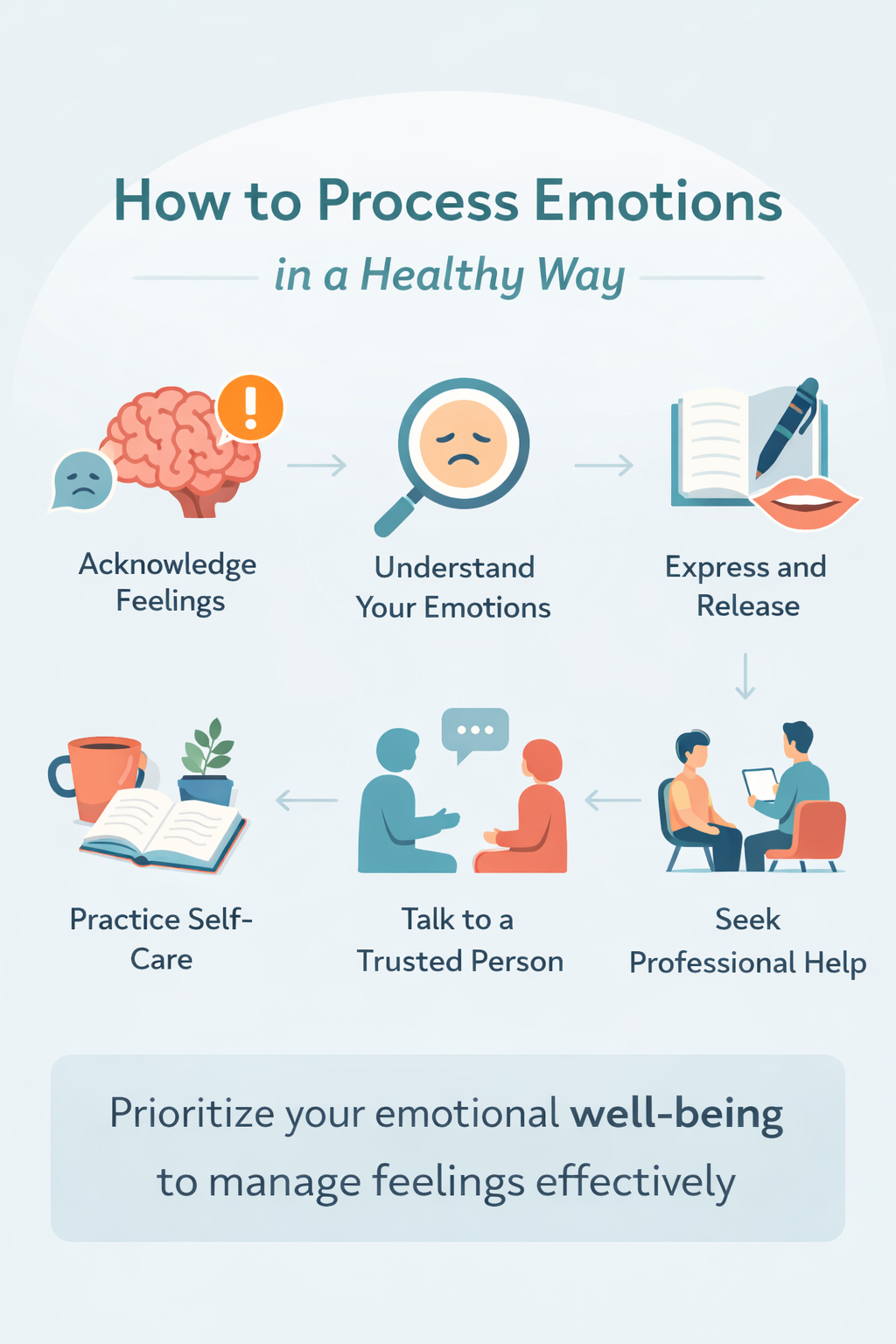
How to Process Emotions in a Healthy Way
A lot of people were never taught how to process emotions in a healthy way. They learned how to ignore them, push them down, joke them away, stay busy, or explode when everything finally became too much. But emotions do not disappear just because they are avoided. They usually show up somewhere else, in stress, irritability, anxiety, burnout, shutdown, or relationship conflict. This article explains how to process emotions in a healthy way, why it matters, what gets in the way, and what it can look like to move through feelings with more honesty, calm, and self-compassion.
Let’s be honest. A lot of us were never really taught what to do with our feelings.
We were taught how to be polite. How to keep going. How to stay productive. How to not make things awkward. Maybe even how to “be strong.” But actually processing emotions in a healthy way? Yeah, not so much.
So what happens instead?
Some people bottle everything up. Some distract themselves nonstop. Some overthink every feeling until they are exhausted. Some shut down. Some lash out. Some tell themselves they are fine when they are obviously not fine. And a whole lot of people bounce between all of the above.
The thing is, emotions do not just vanish because we ignore them. They tend to come out somewhere. In the body. In relationships. In anxiety. In burnout. In irritability. In people-pleasing. In numbness. In that weird sense of being emotionally overloaded but not fully sure why.
That is why learning how to process emotions in a healthy way matters so much.
It is not about becoming overly emotional. It is not about overanalyzing every mood. And it definitely is not about crying on command or saying everything you feel to everyone you know. Healthy emotional processing is really about recognizing what is happening inside you, making space for it without shame, and responding in a way that helps you move through the feeling instead of getting stuck in it.
That sounds simple on paper. In real life, though, it can take practice.
Let’s break it down.
What it means to process emotions in a healthy way
Processing emotions in a healthy way means allowing yourself to notice, understand, feel, and respond to emotions without suppressing them, exploding because of them, or letting them completely run the show.
In other words, it is not about pretending feelings do not exist. It is also not about acting on every emotion the second it appears.
It is about something more balanced.
Healthy emotional processing often includes:
Noticing what you feel
Naming the emotion honestly
Giving yourself permission to feel it
Understanding what may be underneath it
Expressing it in a safe, respectful way
Choosing a response instead of reacting impulsively
That is the goal. Not perfection. Not emotional mastery 24/7. Just a healthier relationship with what is happening inside you.
Why so many people struggle to process emotions
If emotional processing feels hard, awkward, or unnatural, you are definitely not alone.
A lot of people struggle with this because of what they were taught, what they lived through, or what they had to do to cope.
Maybe you grew up in a home where emotions were dismissed.
Maybe vulnerability got mocked.
Maybe sadness was treated like weakness.
Maybe anger was the only feeling anyone was allowed to show.
Maybe nobody modeled what healthy emotional expression looked like.
Maybe you had to stay in survival mode for so long that slowing down to feel anything now feels almost unsafe.
All of that can shape how you handle emotions as an adult.
You may have learned to:
Minimize what you feel
Pretend you are okay when you are not
Stay busy so you do not have to think
Shut down when things get intense
Judge yourself for having emotions at all
Numb out with distractions, food, work, scrolling, or substances
Explode only after holding everything in too long
These are not random flaws. They are usually learned patterns.
And learned patterns can be changed.
What unhealthy emotional processing can look like
Before talking about what helps, it is useful to notice what does not.
Unhealthy emotional processing does not always look dramatic. Sometimes it just looks normal because you have done it for so long.
Here are a few common patterns.
Suppressing everything
This is when you push feelings down, tell yourself they do not matter, and try to move on without actually dealing with them.
It might sound like:
“I’m over it.”
“It’s fine.”
“I don’t care.”
“I just need to get on with it.”
Meanwhile, your body is tense, your patience is thin, and your mind is racing at 2 a.m.
Exploding after bottling things up
Some people do not express emotions gradually. They swallow them, stack them, and stack them some more until one small thing sets everything off.
Then suddenly there are tears, anger, snapping, or total emotional overload.
That does not mean the emotion came out of nowhere. It means it had nowhere to go for too long.
Overthinking instead of feeling
This one is sneaky.
Sometimes people stay in their heads because it feels safer than actually feeling the emotion in their body. So they analyze, explain, justify, and replay everything endlessly without really moving through it.
Thinking about feelings is not the same as processing them.
Numbing and distracting
Scrolling for hours. Working nonstop. Drinking to relax. Sleeping too much. Constant noise. Constant busyness. Constant avoiding.
Distraction can be useful in small doses, but when it becomes the main way you deal with emotions, it usually keeps things stuck.
Taking emotions out on others
When people do not know how to process emotions internally, those feelings often spill outward through irritability, defensiveness, blame, passive-aggression, or emotional withdrawal.
Again, it is not random. It is unprocessed emotion finding an outlet.
Why healthy emotional processing matters
Learning how to process emotions in a healthy way can change a lot more than just your mood.
It can help you:
Feel less overwhelmed by hard emotions
Understand yourself better
Improve communication in relationships
Reduce shame around vulnerability
Respond more calmly under stress
Notice patterns and triggers earlier
Build resilience instead of repression
Feel more connected to yourself and other people
It matters because emotions that are ignored do not disappear. They usually get louder, leak sideways, or live in the body. Processing helps you deal with what is real before it takes over in ways that feel confusing or destructive.
Step 1: Slow down enough to notice what you are feeling
This is where healthy emotional processing begins.
A lot of people move so fast through the day that they do not actually notice how they feel until they are already overwhelmed. So the first step is simply pausing long enough to check in.
Ask yourself:
What am I feeling right now?
Where do I feel it in my body?
What happened right before this feeling showed up?
Is this emotion about the present moment only, or is something older being touched too?
You do not need a perfect answer immediately. The point is to get curious.
Sometimes the first honest answer is just:
“I feel off.”
“I feel heavy.”
“I feel tense.”
“I feel emotionally flooded.”
“I’m more upset than I realized.”
That counts.
Step 2: Name the emotion more specifically
This step helps more than people think.
A lot of us use vague words for everything. Stressed. Fine. Annoyed. Off. Tired.
But getting more specific can create clarity fast.
Maybe you are not just stressed. Maybe you are:
Overwhelmed
Disappointed
Embarrassed
Lonely
Hurt
Anxious
Guilty
Rejected
Frustrated
Jealous
Grieving
Ashamed
Numb
Specific emotions are easier to work with than vague emotional fog.
Sometimes it helps to say:
“I think I’m angry, but underneath that I might actually feel hurt.”
“I’m not just tired. I’m emotionally drained.”
“I’m not just irritated. I feel unseen.”
That level of honesty can be a game changer.
Step 3: Let yourself feel it without immediately judging it
This is where a lot of people get stuck.
They notice the emotion, then instantly start criticizing themselves for having it.
“I shouldn’t feel this way.”
“Why am I so sensitive?”
“This is stupid.”
“I’m overreacting.”
“I need to get it together.”
But judgment tends to make emotions harder to process, not easier.
A healthier approach sounds more like:
“This feeling is real, even if I do not fully understand it yet.”
“I’m allowed to feel this.”
“Having an emotion does not mean I’m weak.”
“I can be compassionate with myself while I figure this out.”
Letting yourself feel does not mean feeding the emotion forever. It means not shaming yourself for being human.
Step 4: Notice what the emotion may be trying to tell you
Emotions often carry information.
Anger may tell you something feels unfair, threatening, or hurtful.
Sadness may point to loss, disappointment, or unmet needs.
Anxiety may signal fear, uncertainty, or a sense that something feels unsafe.
Guilt may show you where your values feel out of alignment.
Loneliness may point to a need for connection.
Not every emotion is perfectly accurate in what it “says,” especially if old wounds are involved. But emotions often point to something worth paying attention to.
Ask yourself:
What might this feeling be reacting to?
What need of mine feels unmet?
What story am I telling myself right now?
Is there something I need to acknowledge, grieve, protect, or communicate?
You are not interrogating yourself here. Just listening.
Step 5: Express the emotion in a healthy way
Feelings need somewhere to go.
Healthy expression is not about dumping everything onto people or reacting impulsively. It is about letting the emotion move through you in a safe, honest way.
That might look like:
Journaling what you feel
Talking to a trusted friend
Crying without apologizing for it
Going for a walk and letting yourself think
Making art or music
Praying or meditating
Taking deep breaths and staying present with your body
Speaking honestly in a respectful conversation
Letting yourself rest if you are emotionally worn out
The right outlet depends on the emotion and the person. But the important part is this: expression helps prevent emotion from getting trapped.
Step 6: Separate feeling from action
This step is huge.
You are allowed to feel whatever you feel. That does not mean every emotion needs to become an action immediately.
For example:
You can feel angry without saying something cruel
You can feel hurt without shutting someone out completely
You can feel anxious without assuming the worst is true
You can feel sad without deciding you will always feel this way
Healthy emotional processing makes room for the feeling while helping you choose your response carefully.
A good question here is:
“What would help me respond to this feeling, instead of reacting from it?”
That one question can save a lot of damage.
Step 7: Give the emotion time to move
Sometimes people think processing emotions means one journal entry, one conversation, one cry, and done.
Not always.
Some emotions move quickly. Others need more time. Grief, disappointment, betrayal, shame, or deep sadness may come in waves. Processing does not mean the feeling vanishes immediately. It means you keep making space for it in healthy ways instead of stuffing it down or letting it control everything.
Healing has rhythm. It is not always linear.
So if a feeling returns, it does not necessarily mean you failed to process it. It may simply mean it needs a little more room.
Healthy ways to process emotions in everyday life
Let’s make this practical.
If you want to process emotions in a healthier way, here are some habits that can help.
Journal without trying to sound impressive
Write what is real, not what sounds smart. Even a few honest lines can help:
“I’m more hurt than I want to admit.”
“I feel overwhelmed and I don’t know what I need.”
“I think I’m angry, but underneath it is fear.”
Messy honesty works better than polished avoidance.
Talk to someone safe
A good conversation can help you untangle emotions you cannot sort alone. The key is choosing someone who listens with care rather than minimizing or hijacking the moment.
Move your body
Emotions often live in the body. Walking, stretching, exercising, shaking out tension, or simply breathing deeply can help emotion move instead of staying stuck.
Reduce constant distraction
If every quiet moment is filled with your phone, noise, or busyness, you may never hear what your inner world is trying to say. A little space matters.
Practice naming feelings in real time
Try saying:
“I feel disappointed.”
“I’m anxious right now.”
“That brought up shame for me.”
“I’m feeling defensive.”
Naming emotions while they are happening makes them less mysterious.
Use calming tools when emotions feel intense
Grounding matters. Try:
Slow breathing
Cold water on your hands
Naming five things you can see
Sitting with both feet on the floor
Taking a short pause before responding
These tools do not erase feelings. They help you stay present enough to process them safely.
What healthy emotional processing is not
Let’s clear up a few myths.
Healthy emotional processing is not:
Oversharing everything with everyone
Blaming your emotions for harmful behavior
Staying stuck in the same feeling forever
Making every problem about your mood
Avoiding accountability because you are emotional
Acting on every feeling instantly
Healthy processing is about honesty and responsibility together.
That balance matters.
How to process difficult emotions like anger, sadness, and anxiety
Some emotions feel harder than others, so here is a quick breakdown.
Anger
Anger often covers hurt, fear, shame, or frustration. Let yourself notice the anger without acting destructively. Ask what boundary, wound, or unmet need may be underneath it.
Sadness
Sadness often needs softness, not speed. Cry if you need to. Rest. Write. Talk. Let yourself grieve what hurts without rushing to “fix” it immediately.
Anxiety
Anxiety can make everything feel urgent. Slow your body first. Breathe. Ground yourself. Ask what feels threatened, uncertain, or out of control. Then deal with what is real instead of only what fear is predicting.
Shame
Shame often says, “There is something wrong with me.” Healthy processing helps shift that toward, “I am struggling, but that does not make me worthless.” Shame usually heals best with compassion and safe connection.
When emotions feel too big to process alone
Sometimes emotions are not just everyday hard. Sometimes they feel overwhelming, constant, or tied to trauma, depression, grief, panic, or deep emotional wounds.
If you feel stuck, flooded, numb for long periods, unable to function, or caught in patterns that keep hurting you, support can really help.
Talking to a therapist, counselor, or mental health professional is not weakness. It is often one of the healthiest ways to learn emotional processing skills in a safe, supported way.
You do not have to figure everything out by yourself.
A better relationship with your emotions
A lot of people think the goal is to stop feeling so much.
But maybe the real goal is something better: learning how to feel without being ruled by every emotion, and learning how to listen to yourself without fear.
That kind of emotional health changes things.
It helps you become more honest.
More grounded.
More compassionate with yourself.
More thoughtful in relationships.
More able to move through life without constantly fighting your inner world.
That is powerful stuff.
FAQ
What does it mean to process emotions in a healthy way?
It means noticing, naming, feeling, understanding, and expressing emotions without suppressing them, exploding because of them, or acting on them impulsively.
Why do I struggle to process my emotions?
Many people were never taught how to handle emotions in a healthy way. Childhood experiences, trauma, emotional invalidation, and survival habits can all make emotional processing harder.
Is crying the only way to process emotions?
No. Crying can help, but healthy emotional processing can also include journaling, talking, movement, reflection, breathing, therapy, or creative expression.
What happens when you do not process emotions?
Unprocessed emotions can build up and show up as stress, anxiety, irritability, shutdown, overthinking, relationship problems, burnout, or physical tension.
How can I process emotions without overreacting?
Pause, name the emotion, calm your body, explore what is underneath the feeling, and choose a response instead of reacting impulsively from the emotion.
Is it bad to distract myself from emotions sometimes?
Not always. Short-term distraction can be useful, but if distraction is your main way of coping, it can keep emotions stuck instead of helping you work through them.
When should I get professional help with emotions?
If your emotions feel overwhelming, constant, tied to trauma, or are interfering with daily life and relationships, a therapist or counselor can help you process them in a healthier way.
Final thoughts
Learning how to process emotions in a healthy way can feel unfamiliar at first, especially if you were taught to ignore, hide, or power through what you feel.
But emotions are not the enemy. They are not proof that you are weak, dramatic, too sensitive, or falling apart. They are signals. They are part of being human. And when you learn how to listen to them without getting lost in them, life starts to feel a little less chaotic inside.
So no, healthy emotional processing is not about being perfectly calm all the time.
It is about noticing what is real.
Making space for it.
Expressing it wisely.
And responding with more honesty and care.
That is where emotional growth begins.

What It Means to Choose Life
Choosing life is not always a grand, dramatic moment. Sometimes it is quiet. Sometimes it is shaky. Sometimes it looks like getting through one more morning, telling the truth about your pain, or deciding not to give up on yourself today. This letter-style blog explores what it means to choose life with honesty, compassion, and hope for anyone walking through heavy seasons.
Dear You,
I do not know what kind of day you are having as you read this.
Maybe you are doing okay, just tired in the ordinary kind of way. Maybe you are carrying something heavy and have not found the words for it yet. Maybe you are trying your best to keep going while smiling in front of people who have no idea how hard that actually is. Or maybe, if we are being really honest, life has felt heavier than you know how to explain.
Wherever this finds you, I want to say something gently and clearly:
Choosing life does not always look loud.
It does not always come with confidence, clarity, or a big inspiring breakthrough. Sometimes choosing life looks small. Sometimes it looks messy. Sometimes it looks like surviving a day you did not think you had the strength to make it through. Sometimes it looks like asking for help. Sometimes it looks like getting out of bed. Sometimes it looks like crying in your car, washing your face, and trying again. Sometimes it looks like saying, “I do not know how to do this, but I am still here.”
And honestly, that still counts.
A lot of people think choosing life has to feel powerful. Like you wake up one morning full of hope, completely certain that everything will get better. But that is not always how it works. Sometimes choosing life is a whisper, not a speech. Sometimes it is not optimism. Sometimes it is just refusal. A quiet, trembling refusal to let pain write the final sentence.
That matters more than people realize.
Choosing life means believing your story is not over
There are moments in life when pain gets so loud that it tries to convince you it is permanent. It tries to make today feel like forever. It tries to shrink your future until you cannot imagine anything beyond the hurt you are in right now.
That is one of pain’s cruelest tricks.
Because the truth is, your current moment is not the whole map. It may be real. It may be brutal. It may be exhausting. But it is not all there is. A painful chapter is still a chapter. It is not the entire book.
Choosing life means refusing to let one season define your whole story.
It means leaving room for things you cannot yet see.
For healing you have not yet felt.
For people you have not yet met.
For peace you have not yet experienced.
For laughter that has not returned yet, but will.
For meaning that pain cannot erase.
You do not have to know exactly how life gets better in order to choose not to give up on it today.
Choosing life can look very ordinary
This is something I wish more people understood.
Choosing life is not always made of dramatic moments. Sometimes it is incredibly ordinary. Quiet, even. Hidden from everybody else.
It can look like:
Taking your medication
Going to therapy
Answering one text
Drinking water
Going for a short walk
Telling someone, “I’m not doing well”
Resting instead of pretending you are fine
Making it through one more night
Canceling the thing you cannot handle
Asking for prayer, help, or company
Eating something small
Choosing not to isolate completely
Letting yourself be cared for
None of that may look impressive from the outside.
But sometimes those tiny acts are the very shape of courage.
Sometimes choosing life means doing the next gentle thing instead of figuring out the next ten years. Sometimes it means bringing your focus all the way down to this moment, this breath, this hour, this day.
There is something deeply human about that.
Choosing life does not mean you always feel hopeful
This is important.
A lot of people think if they are still struggling, then they must not be choosing life “well enough.” But choosing life does not mean you suddenly stop feeling grief, depression, fear, emptiness, or exhaustion. It does not mean you always feel motivated. It does not mean your faith never shakes. It does not mean you never feel tired of carrying what you carry.
It means you keep reaching, even imperfectly.
It means you let hope be small if it needs to be.
It means you hold on even if your hands are shaking.
It means you tell the truth instead of disappearing behind “I’m fine.”
It means you allow support in, even if part of you wants to push it away.
Hope does not have to be loud to be real.
Sometimes hope is just, “Let me get through today.”
And on some days, that is holy work.
Choosing life means asking for help when you need it
Let’s talk about this part plainly, because it matters.
Choosing life sometimes means admitting that you cannot carry everything by yourself.
That is not weakness. That is wisdom.
You were never meant to survive every hard season alone, locked inside your own head, trying to outlast pain without support. Human beings need each other. We need presence. We need care. We need people who can sit with us, listen to us, remind us we matter, and help us find the next right step when we cannot see it clearly on our own.
So if life feels unbearably heavy, choosing life may look like:
telling a friend the truth
calling a therapist
texting someone safe
asking your family to stay close
seeing a doctor
reaching out to a pastor, mentor, or counselor
contacting a crisis line
saying, “I need help”
Those words can be hard to say. I know. For a lot of people, asking for help feels scarier than suffering silently. But silence can be so lonely. And pain grows differently in isolation.
There is strength in being honest about what hurts.
Choosing life means giving yourself permission to heal slowly
Healing is rarely neat.
It does not move in a straight line. It does not always come on schedule. It does not respond well to shame. You do not wake up one day and become “fixed.” More often, healing happens in layers. In conversations. In safe people. In rest. In setbacks you learn from. In boundaries. In grief. In honesty. In tiny signs of progress that are easy to miss if you only look for dramatic change.
Choosing life means giving yourself permission to heal at a human pace.
Not a social media pace.
Not a pressure-filled pace.
Not a “you should be over this by now” pace.
A human pace.
That means some days you will feel stronger than others. Some days you will make progress. Some days you will just maintain. Some days you will need more help than you thought you would. None of that means you are failing.
It means you are living.
Choosing life means letting pain be real without letting it become your identity
Pain can become so consuming that it starts to feel like your whole self. It can make you forget who you are outside of what you have suffered.
But you are more than your hardest season.
You are more than the grief.
More than the diagnosis.
More than the depression.
More than the trauma.
More than the anxiety.
More than the mistakes.
More than the story someone else wrote over you.
Pain may be part of your experience, yes. But it is not the sum of your worth.
Choosing life means remembering, even if only faintly at first, that there is still a self inside you worth protecting. Worth caring for. Worth fighting for. Worth staying for.
Choosing life means allowing love to reach you
This part can be harder than it sounds.
When people are hurting deeply, love can feel complicated. Sometimes it feels undeserved. Sometimes it feels unfamiliar. Sometimes it feels dangerous because you have learned not to trust softness. Sometimes it feels easier to shut down than to let people see how much you are actually carrying.
But choosing life often means softening enough to let care reach you.
Letting someone sit with you.
Letting someone bring you food.
Letting someone check in.
Letting someone pray for you.
Letting someone know the truth.
Letting someone remind you that you matter.
You do not have to earn support by being easy, cheerful, or low-maintenance. You do not have to be fully okay before you are allowed to be loved well.
That kind of love can become a bridge back to yourself.
Choosing life is sometimes a daily decision
Maybe that is the part nobody says enough.
Sometimes choosing life is not one big decision you make once. Sometimes it is a daily decision. Sometimes hourly. Sometimes moment by moment.
It is made in ordinary rooms.
In exhausted minds.
In tearful prayers.
In therapy offices.
In text messages.
In mornings you did not want to wake up for.
In evenings you somehow made it through.
It can feel repetitive. Unseen. Uncelebrated.
But every time you choose to stay, to reach, to breathe, to tell the truth, to keep going, something meaningful is happening. Even if nobody else sees it. Even if all you did today was not give up.
That is not nothing.
That is a form of bravery many people never fully understand from the outside.
Choosing life also means choosing truth
Sometimes the most life-giving thing a person can do is stop pretending.
Stop pretending you are okay when you are drowning.
Stop pretending you do not need rest.
Stop pretending you are not hurting.
Stop pretending you can keep carrying this alone.
Choosing life means choosing truth over image.
It means saying, “This is hard.”
It means admitting, “I am not okay.”
It means being willing to let reality be real so that support can be real too.
There is something freeing about that, even when it is painful.
Because healing grows better in honesty than in hiding.
Choosing life means there are still things worth staying for
Maybe right now you cannot feel all of them. Maybe you cannot list them easily. Maybe the future feels blurry. That is okay.
Sometimes the reasons to stay are huge.
Sometimes they are very small.
A person.
A promise.
A child.
A friend.
A sunrise.
A song.
A dog waiting at the door.
A prayer you are not done praying.
A version of yourself you have not met yet.
The possibility that life can still surprise you kindly.
You do not need a perfect, poetic answer to why you are staying. Sometimes one reason is enough for today.
And tomorrow, maybe there will be another one.
If you are tired, choosing life can begin very quietly
So let me say this carefully.
If you are exhausted, if you are discouraged, if life has felt unbearably hard, choosing life may begin with something very small tonight.
Maybe it begins with not disappearing.
Maybe it begins with sending one text.
Maybe it begins with opening the curtains tomorrow morning.
Maybe it begins with telling someone you trust, “I need you.”
Maybe it begins with calling for help.
Maybe it begins with deciding, “I will not make a permanent decision from a painful moment.”
Sometimes the next right thing is not dramatic. It is simply staying long enough for help to reach you.
Please do not underestimate how meaningful that is.
A final word
So what does it mean to choose life?
It means saying yes to the possibility that this pain is not the end of you.
It means staying when it would feel easier to disappear.
It means letting hope be fragile and still calling it hope.
It means asking for help when pride wants silence.
It means honoring the small brave things no one else may notice.
It means believing that your existence still matters, even on the days you cannot feel that truth strongly.
Choosing life does not require perfection.
It requires honesty.
It requires courage.
It requires staying.
And if all you can do right now is choose the next breath, the next hour, the next call, the next sunrise, then start there.
That still counts.
With tenderness,
Someone rooting for you
FAQ
What does it mean to choose life?
Choosing life means deciding to keep going, seek support, and make room for hope and healing even in painful or uncertain seasons.
Is choosing life always a big dramatic moment?
No. Often it looks quiet and ordinary, like asking for help, getting through the day, resting, being honest about pain, or taking one small next step.
Can someone choose life and still struggle emotionally?
Yes. Choosing life does not mean you never feel depressed, anxious, overwhelmed, or tired. It means you keep reaching for support and staying present even while struggling.
Why is asking for help part of choosing life?
Because support matters. Reaching out to trusted people, professionals, or crisis resources can be a life-giving step when things feel too heavy to carry alone.
What are small ways to choose life every day?
Small ways include telling the truth about how you feel, going to therapy, resting, eating, taking medication, answering a text, walking outside, and staying connected to safe people.
What if I do not feel hopeful right now?
Hope does not have to feel big to be real. Sometimes choosing life starts with simply deciding to make it through today and letting that be enough for now.
Final thoughts
Choosing life is not always flashy. It is often quiet, raw, and deeply personal. It can look like endurance, honesty, softness, reaching out, or simply refusing to let pain have the final word.
And that matters.
Because sometimes the bravest thing a person can do is stay.
If you might act on thoughts of suicide or self-harm, call emergency services now. If you are in the U.S. or Canada, call or text 988 right now. If you are elsewhere, contact your local emergency number or nearest crisis hotline immediately.

Loving Someone With Depression: What Helps and What Hurts
Loving someone with depression can feel heartbreaking, confusing, and deeply personal. You may care so much and still feel unsure what to say, what to do, or how to help without making things worse. Depression can affect energy, communication, affection, motivation, and the overall tone of a relationship. This article explores what truly helps when you love someone with depression, what tends to hurt even when it is well meant, and how to stay compassionate without losing yourself in the process.
Loving someone with depression is not always simple.
You can care deeply about a person and still feel confused by what is happening. You can want to help and still say the wrong thing. You can be patient and loving and still feel hurt, tired, or shut out. That is part of what makes this so hard. Depression does not just affect the person going through it. It often affects the relationship around them too.
One day, the person you love may seem quiet, distant, or emotionally flat. Another day, they may seem irritable, exhausted, overwhelmed, or completely checked out. They may not have the energy to talk, make plans, show affection, or explain what is going on inside. Meanwhile, you may be standing there wondering whether they need space, support, encouragement, or simply someone to sit beside them without trying to fix anything.
Honestly, that uncertainty can wear on a person.
If you have ever loved someone with depression, you probably know the feeling. You want to help. You want to stay close. You want to be understanding. But you may also feel helpless, rejected, lonely, or scared of doing the wrong thing.
That does not make you selfish. It makes you human.
The good news is this: there are ways to support someone with depression that genuinely help. And there are also some common mistakes that, while usually well meant, can make the person feel more ashamed, more alone, or more misunderstood.
Let’s talk about both.
What depression can look like in a relationship
Before getting into what helps and what hurts, it is important to understand one thing: depression does not always look the way people expect it to look.
It is not always crying. It is not always dramatic sadness. Sometimes it looks like silence. Sometimes it looks like irritability. Sometimes it looks like emotional numbness, low energy, canceled plans, less interest in intimacy, poor concentration, or a general sense of heaviness.
In a relationship, depression may show up as:
Pulling away emotionally
Not texting back the way they normally would
Struggling to make decisions
Sleeping more or less than usual
Losing interest in activities they used to enjoy
Seeming flat, disconnected, or hard to reach
Having less patience
Avoiding conversations
Feeling guilty for being “a burden”
Wanting love but not knowing how to receive it
This matters because if you misunderstand depression as laziness, coldness, lack of effort, or lack of love, it can create a lot of pain on both sides.
A depressed person may already feel ashamed. If they also feel judged, they may withdraw even more.
What helps when you love someone with depression
Support does not need to be perfect to matter. In fact, the most helpful things are often simple, steady, and grounded.
Be present without trying to control everything
One of the most powerful things you can offer is presence.
Not pressure. Not a lecture. Not a rescue mission. Just presence.
That may look like sitting with them quietly, checking in without demanding a big conversation, or reminding them that you are there even if they do not know what to say. When someone is depressed, they often do not need a performance. They need safety.
Helpful phrases might be:
“I’m here with you.”
“You do not have to go through this alone.”
“I care about you.”
“You do not need to have the right words.”
That kind of support feels steady instead of overwhelming.
Listen more than you advise
This is a big one.
When someone you love is hurting, it is natural to want to fix it. You may want to offer solutions, encourage action, or point out what they should try next. But depression is not usually solved by a quick tip or a motivational speech.
Sometimes the most helpful thing you can do is listen.
Really listen.
Let them talk if they want to. Let them be messy. Let them say things that are hard to hear without rushing to clean it up too quickly. People often feel more supported when they feel understood, not managed.
Helpful responses sound like:
“That sounds really heavy.”
“I’m glad you told me.”
“That makes sense.”
“Do you want me to listen, or help you think through next steps?”
That last one is gold, by the way. It helps you support them without guessing wrong.
Check in consistently
A lot of people show up in the big emotional moment, then disappear.
Real support is often quieter than that. It is the follow-up text. The check-in the next day. The reminder that the person is still on your mind even after the hard conversation ends.
That may sound like:
“How are you doing today?”
“I’ve been thinking about you.”
“No pressure to respond. Just wanted to check in.”
“I’m here if today feels heavy.”
Consistency matters because depression can make people feel invisible. Small check-ins can push back against that isolation in a real way.
Help with practical things
Depression is emotional, yes, but it also affects everyday functioning. Tasks that seem small to other people can feel huge when someone is depressed.
Practical support can be deeply helpful.
That might look like:
Bringing them food
Helping with chores
Sitting with them while they make a phone call
Going with them to an appointment
Helping break a big task into smaller steps
Reminding them to rest, hydrate, or eat
This kind of help says, “You do not have to do all of this alone.”
And sometimes that message lands more than words do.
Encourage professional support gently
Love matters, but sometimes love alone is not enough. Depression can require more support than a partner, friend, or family member can provide by themselves.
Encouraging professional help can be one of the most loving things you do, especially if you do it without shame.
That might sound like:
“You deserve support.”
“You do not have to carry this alone.”
“Would it help if I helped you look into therapy or counseling?”
“I can help you take the first step if that feels hard.”
This feels very different from making the person feel like they are a problem that needs to be handed off.
Make room for small moments of connection
When someone is depressed, grand gestures may feel like too much. But small moments of closeness can still matter a lot.
That might mean:
Watching a show together
Taking a short walk
Sitting in the same room quietly
Sending a thoughtful message
Holding hands
Sharing a meal
Saying “I love you” without needing much back
Depression can make connection harder to reach, but not impossible. Sometimes small, gentle moments are what keep the relationship from feeling completely swallowed by the illness.
What hurts when you love someone with depression
A lot of hurtful responses are not cruel on purpose. They are usually rooted in discomfort, fear, helplessness, or misunderstanding. Still, they can do real damage.
Trying to force positivity
This one happens all the time.
People say things like:
“Just think positive.”
“You have so much to be grateful for.”
“It could be worse.”
“Look on the bright side.”
Even when these comments are meant to help, they often make depression feel smaller, simpler, or easier to fix than it really is. The person may feel dismissed instead of comforted.
Hope is helpful. Forced positivity usually is not.
Taking everything personally
This one is tricky, because depression in a relationship can feel personal.
If someone becomes withdrawn, less affectionate, low energy, or hard to reach, it can hurt. Of course it can. But not every symptom is a rejection of you.
Sometimes distance is about depression, not about love.
That does not mean your feelings do not matter. They do. But interpreting every withdrawn moment as “they do not care about me” can create extra pain and conflict on top of what is already hard.
Acting like they should just try harder
Depression is not laziness. It is not a lack of character. It is not fixed by willpower alone.
So when someone hears:
“You just need to get out more.”
“You’re not even trying.”
“You need to snap out of it.”
“You just have to push through.”
It can create shame fast.
A depressed person may already feel guilty for struggling. Messages like these usually make that worse, not better.
Turning every conversation into a lesson or solution
Advice has its place. But when every hard moment turns into a lecture, people stop feeling safe to open up.
Sometimes they do not need a plan right away. Sometimes they need empathy first.
When you rush into solutions too quickly, the person may hear, “Your feelings are a problem to solve,” instead of, “I’m with you in this.”
Making them feel like a burden
Few things cut deeper than this.
A person with depression may already worry they are too much, too heavy, too difficult, or too broken. If your words, tone, or frustration confirm that fear, even indirectly, it can make them withdraw more.
Comments like:
“You’re exhausting.”
“This is always about your mood.”
“I can’t deal with this.”
“You’re bringing everyone down.”
can stick hard.
Even if you are tired, and even if your feelings are real, there are healthier ways to express overwhelm without making the other person feel like their existence is the problem.
Over-helping to the point of control
Support is helpful. Control is not.
Sometimes people get so focused on helping that they start monitoring everything, taking over every choice, or acting more like a manager than a partner. That can leave the depressed person feeling powerless, infantilized, or like they have become a project instead of a person.
Helping works best when it protects dignity.
How to communicate without causing more shame
This part matters a lot.
Depression already carries shame for many people. They may feel weak, guilty, broken, lazy, unlovable, or frustrated with themselves. So communication that adds more blame usually backfires.
Here are a few better ways to talk.
Instead of saying:
“You never talk to me anymore.”
Try:
“I miss feeling close to you, and I want to understand how to support you.”
Instead of saying:
“You’re pushing me away.”
Try:
“I know you may be overwhelmed, but I want you to know I’m here.”
Instead of saying:
“You need to do something about this.”
Try:
“You deserve support, and I’d like to help you find it.”
Instead of saying:
“What’s wrong with you lately?”
Try:
“You do not seem like yourself, and I care about what’s going on.”
Notice the difference? The second version opens a door. The first one often slams it shut.
Loving someone with depression does not mean ignoring your own needs
This is where a lot of people quietly struggle.
If you love someone with depression, you may feel guilty for being tired. Guilty for feeling lonely. Guilty for wanting more connection. Guilty for needing support too.
But your needs do not disappear just because someone you love is hurting.
You are still allowed to feel:
Sad
Confused
Frustrated
Tired
Overwhelmed
Lonely
In need of support
That does not mean you love them less. It means this is affecting you too.
Healthy love does not require self-erasure.
What caring for yourself can look like
If you are supporting someone with depression, self-care is not selfish. It is necessary.
That may mean:
Talking to a therapist or counselor
Leaning on trusted friends or family
Taking breaks without guilt
Setting limits around disrespectful behavior
Keeping your own routines and responsibilities
Making time for rest and joy
Being honest about what you can and cannot carry
You are not responsible for single-handedly saving another person’s mental health. You can love them deeply and still need boundaries, rest, and outside support.
That balance is healthy.
When depression is affecting the whole relationship
Sometimes depression becomes so central that the relationship starts revolving around it completely. Conversations narrow. Connection shrinks. Resentment builds. Both people feel exhausted.
When that happens, it may be time for more support.
That could mean:
Individual therapy
Couples counseling
Medical support
More honest conversations about needs and limits
A clearer plan for handling hard days
Getting extra help does not mean the relationship is failing. It often means both people are finally taking the strain seriously instead of trying to white-knuckle their way through it.
When safety matters more than anything else
If the person you love talks about wanting to die, seems hopeless, mentions self-harm, or appears at risk of harming themselves, take it seriously.
Do not brush it off. Do not assume they are being dramatic. Do not leave it to chance.
Seek immediate help from a licensed mental health professional, local crisis service, emergency services, or a crisis hotline in your area. Stay with them if there is immediate danger.
Support matters, but safety comes first.
What real love can look like during depression
Real love during depression is often less about big words and more about steady presence.
It can look like:
Staying calm when things feel heavy
Listening without judgment
Offering practical support
Encouraging help without shaming
Protecting your own mental health too
Not confusing symptoms with lack of love
Choosing patience without losing honesty
It is not about being perfect. It is not about having all the answers. It is about showing up in ways that are kind, grounded, and sustainable.
That kind of love can make a real difference.
FAQ
How do I support someone I love who has depression?
Support them with patience, steady check-ins, nonjudgmental listening, and practical help when needed. Encourage professional support gently and avoid trying to force positivity or quick fixes.
What should I not say to someone with depression?
Avoid saying things like “just think positive,” “snap out of it,” “other people have it worse,” or anything that makes their struggle sound simple, exaggerated, or inconvenient.
Is it normal to feel tired when loving someone with depression?
Yes. Supporting someone through depression can be emotionally heavy. Your feelings matter too, and it is healthy to seek support and set boundaries when needed.
Can depression make someone seem distant in a relationship?
Absolutely. Depression can affect energy, communication, affection, motivation, and emotional availability. Distance does not always mean lack of love.
Should I encourage therapy if someone I love is depressed?
Yes, but do it gently and respectfully. Encourage support without making the person feel judged, broken, or like a burden.
How do I know when the situation is serious?
If the person seems hopeless, talks about death or self-harm, becomes highly withdrawn, or seems unsafe, seek immediate professional or crisis support.
Can a relationship survive depression?
Yes. Many relationships can survive and even grow through depression when both people approach it with honesty, support, boundaries, and willingness to get help when needed.
Final thoughts
Loving someone with depression can feel tender, frustrating, heartbreaking, and deeply meaningful all at once.
You may not always know the perfect thing to say. You may not always get it right. You may have days when you feel strong and patient, and other days when you feel completely worn out. That does not mean you are failing. It means this is hard.
What helps most is usually not dramatic.
It is steady love.
Gentle honesty.
Listening without judgment.
Support without control.
Encouragement without shame.
And enough self-respect to care for your own heart too.
Because loving someone with depression is not about rescuing them.
It is about showing up in ways that are compassionate, clear, and human, while remembering that both people in the relationship matter.

How Couples Can Stay Connected During Depression
Depression can make love feel harder to reach. One partner may feel tired, numb, withdrawn, or overwhelmed, while the other may feel confused, shut out, or unsure how to help. Even strong relationships can feel strained when depression enters the picture. But depression does not have to mean the end of emotional closeness. This article explores how couples can stay connected during depression, why disconnection happens, and what support, communication, and care can look like in real life.
Depression can change the tone of a relationship in ways that are hard to explain until you have lived through it.
One person may feel emotionally flat, exhausted, irritable, or like they are moving through mud all day. The other may feel helpless, lonely, rejected, or confused about why things suddenly feel so distant. Even small things, like replying to a text, planning dinner, having a conversation, or showing affection, can start to feel heavier than usual.
And that is the hard part. Depression does not just affect one person. It often affects the relationship too.
That does not mean the love is gone. It does not mean the relationship is failing. It usually means both people are trying to navigate something painful without always having the language, energy, or tools to do it smoothly.
Honestly, this is where a lot of couples get stuck. One partner may start withdrawing because they are depressed. The other partner may interpret that withdrawal as disinterest, rejection, or emotional abandonment. Then hurt builds on both sides. One person feels unseen in their pain. The other feels shut out and alone. And just like that, depression starts creating distance where closeness used to live.
But here is the good news: couples can stay connected during depression. It may not look perfect. It may not feel easy. But connection is still possible, even in a hard season.
Let’s talk about what that really looks like.
How depression affects relationships
Depression can touch almost every part of a relationship.
It can affect mood, energy, communication, sex, patience, emotional availability, motivation, and daily routines. A person dealing with depression may not have the same capacity they normally do. They may want to connect but feel too drained. They may care deeply but struggle to show it. They may pull away not because they do not love their partner, but because they are overwhelmed, numb, or trying to survive the day.
That can be deeply confusing for the other partner.
They may wonder:
“Did I do something wrong?”
“Why are they shutting me out?”
“Why do they seem so distant?”
“Why does everything feel so heavy lately?”
“How do I help without making things worse?”
Those questions are normal. Depression can make everyday relationship moments feel loaded. What used to feel simple may now take more effort, more communication, and more grace.
Common ways depression can affect a relationship include:
Less communication
Emotional withdrawal
Increased irritability
Lower energy for quality time
Less interest in intimacy
Trouble making decisions
More misunderstandings
Feelings of guilt, helplessness, or resentment
A growing sense of emotional distance
When couples do not understand that depression may be shaping these patterns, they can easily start blaming each other instead of recognizing the real issue.
Why couples often feel disconnected during depression
Disconnection during depression does not usually happen because people stop caring. It often happens because both partners are hurting in different ways at the same time.
The depressed partner may feel like this:
“I don’t have anything left to give.”
“I don’t know how to explain what’s wrong.”
“I feel like a burden.”
“I know I’m distant, but I can’t seem to stop.”
“I’m trying, but everything feels hard.”
The other partner may feel like this:
“I miss you.”
“I don’t know how to reach you.”
“I want to help, but I feel helpless.”
“I’m trying not to take this personally, but it hurts.”
“I feel alone too.”
See the problem? Both people may be carrying pain, but if they stop talking openly, each person can start making painful assumptions about the other.
That is why staying connected during depression often starts with one important shift: seeing depression as something the couple is facing together, not a character flaw in one partner and not a relationship failure in the other.
Depression can look like distance, not lack of love
This point matters so much.
A depressed partner may seem quiet, detached, unmotivated, or emotionally unavailable. They may stop initiating affection. They may have a harder time talking. They may not laugh as much. They may not seem excited about things they used to enjoy.
That can absolutely hurt. But it is important not to assume it automatically means they care less.
Depression often reduces access to energy, pleasure, focus, and emotional expression. In other words, someone can still love you and still have trouble showing up in the ways they normally would.
That does not erase the impact on the relationship. It just helps explain it more accurately.
Sometimes the most helpful shift a couple can make is this:
Instead of asking, “Why are you being like this?”
Try asking, “How is depression affecting us right now, and how can we face it together?”
That question changes the whole tone.
Honest communication matters more than perfect communication
When depression is in the room, communication may feel awkward, slow, or messy. That is okay. The goal is not perfect conversations. The goal is more honest ones.
A depressed partner may not always have the energy for a deep talk. But even small moments of honesty can help protect connection.
That might sound like:
“I’m having a rough day, and I know I seem distant.”
“I love you. I’m just really low right now.”
“I don’t know what I need, but I don’t want to shut you out.”
“I’m overwhelmed and struggling to talk clearly.”
The supporting partner can also be honest:
“I know you’re struggling, and I care about you.”
“I miss feeling close to you.”
“I’m trying not to take the distance personally, but it’s hard.”
“I want to support you without pushing too much.”
Those kinds of statements create room for truth without blame. And really, that is the sweet spot.
Do not make every conversation about fixing it
When someone you love is depressed, the urge to fix things can be strong. Totally understandable. You want to help. You want to make it lighter. You want the person back. You want the relationship to feel normal again.
But depression usually does not respond well to pressure, lectures, or constant solutions.
Sometimes the best support is not:
“Here’s what you need to do.”
“You just need to think more positively.”
“Let’s fix this right now.”
“Why can’t you just try harder?”
Oof. That kind of response often makes things worse.
A more supportive approach sounds like:
“I’m here with you.”
“That sounds really hard.”
“You do not have to explain everything perfectly.”
“Would it help to talk, or would you rather just sit together?”
Support is not the same as fixing. A partner can be loving, steady, and helpful without acting like a mechanic for someone else’s emotions.
Stay connected in small ways
This is one of the most practical ways couples can protect their bond during depression.
When energy is low, big romantic gestures may feel impossible. So instead of waiting for a huge breakthrough moment, focus on small, steady acts of connection.
That might look like:
Sitting together quietly on the couch
Sending a kind text during the day
Holding hands for a minute
Sharing a short walk
Watching a show together
Checking in with one honest question
Bringing them water, food, or tea
Saying “I love you” even on hard days
These things may seem simple, but they matter. A lot.
When depression is making everything feel heavy, small moments of care can say, “We are still here. We are still us. We are still connected.”
Learn the difference between support and over-functioning
This one is huge.
Supporting a depressed partner is caring. Trying to carry everything for them, manage all their emotions, ignore your own needs, and become their only source of stability is something else entirely.
That can lead to burnout fast.
Sometimes the non-depressed partner starts over-functioning. They take over every responsibility, monitor every mood, suppress every frustration, and feel guilty for having needs of their own. From the outside, it may look loving. But inside, it can feel exhausting and lonely.
Healthy support means:
Being caring without becoming controlling
Helping without treating your partner like a child
Staying compassionate without disappearing yourself
Encouraging help without becoming the only help
That balance matters because relationships suffer when one person becomes the permanent caretaker and the other becomes the permanent crisis.
The partner who is supporting also needs support
This does not get said enough.
If you are loving someone through depression, your experience matters too.
You may feel sad, tired, confused, rejected, worried, or emotionally stretched thin. You may feel guilty for even admitting that because your partner is the one depressed. But caring for someone who is struggling can affect your mental and emotional health too.
You are allowed to say:
“This is hard for me too.”
“I care deeply, but I’m feeling drained.”
“I need support as well.”
“I want to stay compassionate without losing myself.”
That is not selfish. That is healthy.
Supporting a partner with depression does not mean you stop being a person with your own needs.
Set gentle, healthy boundaries
Boundaries can actually protect connection, not damage it.
A lot of couples hear “boundaries” and think distance, coldness, or punishment. But healthy boundaries are really about clarity and emotional sustainability.
For example, boundaries may sound like:
“I want to talk about this, but not when we’re both exhausted.”
“I care about what you’re going through, and I also need us to speak respectfully.”
“I can sit with you tonight, but I can’t be the only support you rely on.”
“I need a little time to recharge, and then I can come back more present.”
Boundaries are not rejection. They help both partners stay grounded enough to keep showing up.
Intimacy may need to be redefined for a while
Depression can affect physical closeness, emotional openness, and romantic energy. That can be painful, especially if one partner starts feeling unwanted or disconnected.
But intimacy does not only mean sex or high-energy romance.
During depression, intimacy may need to look different for a season. It might be:
A longer hug
Eye contact during a hard moment
A hand on the back
Sitting close without pressure
A quiet “thank you for staying”
Honest words instead of polished ones
Redefining intimacy can help couples stay emotionally connected even when depression changes the usual rhythm of the relationship.
Avoid taking every symptom personally
This is easier said than done, of course. But it helps.
If your partner is depressed, some of what you are experiencing may be about depression, not about your worth, attractiveness, value, or importance.
That does not mean your feelings are not real. It just means not every distant response is a rejection of you.
Try to separate:
“My partner is struggling to connect right now”
from“My partner does not care about me”
Those are not the same thing.
That distinction can prevent a lot of extra pain and misunderstanding.
Ask what support actually helps
One of the best things couples can do is stop assuming and start asking.
A depressed partner may need different things on different days. Some days they may want company. Some days they may need quiet. Some days they may want help with practical tasks. Some days they may just want to be reminded they are loved without having to perform.
Helpful questions include:
“What feels supportive right now?”
“Do you want comfort, space, or help with something practical?”
“Would it help if I stayed close, or would you rather have some quiet?”
“What makes things feel worse so we can avoid that?”
These questions show care without pressure.
Practical help can protect the relationship too
Depression is emotional, yes, but it also affects everyday functioning. The basics can get really hard.
Supporting a partner may sometimes mean helping with practical things like:
Making meals
Tidying up together
Helping with appointments
Breaking tasks into smaller steps
Running errands
Creating a simple daily structure
This kind of support can reduce stress without turning the relationship into a project. It says, “We are a team, and I’m here to help lighten the load.”
Encourage professional help without shaming
Love matters. Support matters. But sometimes a relationship needs backup.
If depression is affecting day-to-day life, relationships, functioning, or safety, professional help may be an important next step. That could include therapy, couples counseling, medical care, or a combination of support options.
The key is to encourage help without making it sound like blame.
That may sound like:
“You do not have to handle this alone.”
“I think you deserve more support.”
“Would you be open to talking to someone?”
“I’ll help you look into options if that would make it easier.”
That approach feels very different from:
“You need help.”
“I can’t deal with you like this.”
“You’re ruining the relationship.”
One approach builds safety. The other builds shame.
If depression is severe, safety comes first
Sometimes depression goes beyond withdrawal and low energy. If your partner seems hopeless, talks about not wanting to be here, expresses thoughts of self-harm, or seems at risk of harming themselves, this is bigger than regular relationship stress.
Take it seriously.
Reach out for immediate professional support, a local crisis line, emergency services, or a trusted mental health provider right away. Stay with them if there is immediate danger and do not leave the situation to chance.
Connection matters, but safety matters first.
What couples can remember in the middle of it
When depression affects a relationship, it is easy to start panicking and assuming the worst. But a hard season is not always the end of the story.
A few things are worth holding onto:
Depression can create distance without erasing love
Connection can still happen in small, quiet ways
Support works better than pressure
Honesty is more helpful than pretending
Both partners’ feelings matter
Professional help can strengthen the relationship, not threaten it
Sometimes couples think they need to “get back to normal” right away. But what often helps more is learning how to stay kind, clear, and connected in a season that does not feel normal at all.
What staying connected can actually look like
Let’s make this really practical.
Staying connected during depression may look like:
Sending a simple check-in text instead of expecting a long conversation
Saying “I love you” even when the mood is low
Choosing curiosity over blame
Letting hard days be hard without making them a moral failure
Keeping tiny rituals, like coffee together or a nightly check-in
Being honest when you are hurting too
Encouraging outside support
Protecting tenderness wherever you can
It may not look romantic in the movie sense. It may look slower, quieter, and less polished than usual. But it can still be deeply loving.
FAQ
How does depression affect a romantic relationship?
Depression can affect communication, emotional closeness, intimacy, patience, energy, and daily functioning. It may create distance, misunderstandings, and stress for both partners.
Can couples stay connected during depression?
Yes. Couples can stay connected during depression by communicating honestly, offering steady support, staying connected in small ways, setting healthy boundaries, and encouraging professional help when needed.
What should I say to my partner who is depressed?
Helpful things to say include, “I’m here with you,” “You do not have to go through this alone,” “I love you,” and “What feels supportive right now?” The goal is to be calm, caring, and nonjudgmental.
How can I support my depressed partner without burning out?
Support them with compassion, but do not take full responsibility for their mental health. Maintain your own support system, set healthy boundaries, and remember that your needs matter too.
Is it normal to feel lonely when your partner is depressed?
Yes. Many partners feel lonely, confused, or rejected when depression affects the relationship. Those feelings are real and deserve care too.
Should couples go to therapy if one partner is depressed?
It can be very helpful. Individual therapy, couples counseling, or both can provide tools for communication, support, and coping during depression.
What if my partner’s depression seems severe?
If they seem hopeless, unsafe, or are talking about self-harm or suicide, seek immediate professional or crisis support right away.
Final thoughts
Depression can make couples feel far apart, even when love is still very much there.
That is what makes it so painful. One person may be trying to survive their own mind. The other may be trying to love them through it without losing the relationship in the process. Both can feel tired. Both can feel hurt. Both can feel scared.
But disconnection does not have to be the final word.
Couples can stay connected during depression by being honest, staying gentle, protecting small moments of closeness, and remembering that support is not the same thing as fixing. Love during depression may look quieter. It may look slower. It may look less polished than usual. But it can still be real, strong, and deeply meaningful.
Sometimes staying connected is not about grand gestures.
Sometimes it is just about saying,
“I know this is hard, and I’m still here.”

Why Suicide Rates Are Increasing—and What It Means for Men, Youth, and Families
When suicide rates rise, the impact is never just statistical. It reaches into homes, schools, friendships, workplaces, and entire communities. It changes families forever. For men, young people, and the people who love them, the issue can feel both deeply personal and painfully hard to talk about. This article takes a compassionate, conversational look at why suicide may be affecting more people, what pressures are weighing on men and youth, how families are impacted, and why prevention starts with paying attention, having honest conversations, and making support easier to reach.
This is one of those topics nobody really wants to have to write about, but a whole lot of people need to read about.
Because when suicide starts touching more lives, it is not just a “mental health issue” in some abstract, distant sense. It becomes a family issue. A community issue. A school issue. A men’s health issue. A youth issue. A human issue.
And honestly, that is what makes it so heartbreaking.
Behind every headline, every report, every concern people raise, there are real human beings carrying pain that may not be obvious from the outside. There are men telling everyone they are fine while quietly falling apart. There are young people smiling online while feeling isolated in real life. There are families looking back, trying to understand what they missed, what they could have said, what they wish they had known.
So when we ask, why are suicide rates increasing, and what does it mean for men, youth, and families? the answer is not one simple thing. It is usually a mix of pressure, pain, silence, disconnection, untreated mental health struggles, and systems that do not always make help easy to get.
This article breaks that down in a clear, compassionate way, without turning real suffering into a list of cold talking points. Because this conversation deserves more care than that.
Why this conversation matters so much
Suicide is not caused by one single bad day or one single reason. It is often connected to emotional pain that has built over time, sometimes quietly, sometimes invisibly.
That is part of what makes it so hard for families and loved ones. People often expect severe struggle to look obvious. They expect someone to clearly say, “I am not okay.” But many people do not. Some hide it. Some minimize it. Some do not even fully understand how overwhelmed they have become. Others are afraid of being judged, dismissed, or treated like a burden.
So the conversation matters because awareness matters.
It matters for the dad who has been carrying stress, shame, and exhaustion in silence.
It matters for the teenage boy who feels pressure to stay tough no matter what.
It matters for the college student who looks functional but feels emotionally numb.
It matters for the family who senses something is off but does not know how to start the conversation.
It matters for the friend who keeps hearing “I’m fine” and wondering whether that is really true.
The more we understand what can drive suicide risk, the more likely we are to notice suffering earlier and respond with care instead of confusion.
Why suicide may be affecting more people
There is rarely one neat answer here. Suicide risk tends to rise when emotional pain, hopelessness, and disconnection grow while support, coping, and access to care lag behind.
A lot of people are carrying more than they let on.
Some are dealing with chronic stress that never really shuts off. Some are facing depression, anxiety, trauma, grief, loneliness, bullying, financial strain, relationship loss, identity struggles, or emotional exhaustion. Others may be dealing with several of these at once.
And for many people, the pressure does not just come from one area of life. It comes from everywhere, all at once.
That might look like:
Financial pressure at home
Academic or work pressure
Social comparison and online stress
Relationship pain or family conflict
Isolation or disconnection
Unprocessed trauma
Shame around asking for help
Limited access to mental health support
A feeling that life is getting heavier, not lighter
When pain builds and people do not feel safe, supported, or hopeful, the risk can rise.
That does not mean every stressed or struggling person is suicidal. Not at all. But it does mean we should stop treating emotional suffering like a private weakness people are supposed to just “push through.”
What this means for men
This part matters deeply, because many men struggle in ways people do not always recognize.
A lot of men grow up with messages like these:
Be strong
Do not cry
Handle it yourself
Stay in control
Do not talk about feelings
Do not be weak
At first glance, those messages can look like toughness. But over time, they can become emotional isolation.
Many men learn to hide pain instead of naming it. They may talk about stress, anger, pressure, or being tired, but not about fear, sadness, hopelessness, shame, or emotional overwhelm. They may keep functioning on the outside while internally feeling trapped, empty, or exhausted.
That can make it much harder to notice when a man is really struggling.
Instead of openly saying he feels depressed, he may become irritable.
Instead of saying he feels hopeless, he may withdraw.
Instead of saying he needs help, he may work more, drink more, shut down more, or insist he is fine.
That is why men’s mental health deserves special attention in this conversation. Too often, pain gets filtered through silence, anger, or emotional shutdown instead of vulnerability.
And sadly, silence can be deadly.
Why emotional suppression can make things worse for men
A man who has been taught to suppress emotion may not even realize how much he is carrying until he hits a breaking point.
He may tell himself:
“I should be able to handle this.”
“Other people have it worse.”
“I don’t want to be a burden.”
“I just need to push through.”
“Nobody would understand anyway.”
Those thoughts can keep a man from reaching out long after he needs support.
The danger is not only the suffering itself. It is the suffering plus isolation. It is pain with no place to go. It is shame layered on top of depression. It is the belief that needing help means failing.
That is why emotional suppression is not strength. It may look controlled from the outside, but it often leaves men alone with pain that keeps growing in the dark.
What this means for youth
Young people are carrying a lot right now, and not all of it is visible.
From the outside, a teen or young adult may look okay. They may still show up to class, reply in group chats, post online, laugh with friends, and keep going through the motions. But underneath that, they may be dealing with pressure that feels constant and overwhelming.
That pressure can come from:
School performance
Family expectations
Social pressure
Bullying or exclusion
Identity struggles
Loneliness
Body image stress
Fear about the future
Constant comparison online
Relationship heartbreak
Feeling misunderstood or unseen
For some youth, there is also the pressure to appear okay all the time. To stay funny, successful, attractive, productive, easygoing, and emotionally manageable. That is a heavy load for a young nervous system.
And because many young people are still learning how to understand and express what they feel, they may not always have the words to say, “I am in real trouble emotionally.”
Sometimes it comes out as irritability. Sometimes withdrawal. Sometimes numbness. Sometimes acting like nothing matters. Sometimes perfectionism. Sometimes total exhaustion.
So when we talk about youth and suicide, we have to talk about emotional pain that is often hidden behind normal-looking behavior.
Why families are affected so deeply
Families often live with two painful questions at once:
“What was happening?”
and
“How did we not know?”
That is one of the cruelest parts of this issue. People can love someone deeply and still not fully see what they are carrying. Not because they do not care, but because emotional pain can be hidden so well.
A family member may notice someone seems quieter, angrier, more tired, or more distant, but may assume it is stress, hormones, work, school, or just a phase. And sometimes it is. But sometimes it is more.
Suicide risk affects families long before a crisis point too.
It can affect how people communicate.
It can increase tension and fear.
It can leave loved ones walking on eggshells.
It can create confusion, guilt, and helplessness.
It can make people feel like they are losing someone emotionally before they understand why.
And when a family has experienced suicide loss or serious suicidal crisis, the impact can be life-changing. Grief, trauma, regret, anger, heartbreak, and unanswered questions can stay with people for a very long time.
That is why families need more than advice to “be supportive.” They need real understanding, honest tools, and permission to talk about mental health before things reach an emergency.
Common warning signs people may miss
One of the hardest truths here is that warning signs are not always dramatic. Sometimes they are subtle. Sometimes they build slowly. Sometimes they are brushed off because the person still seems functional.
Some signs that may signal deeper emotional distress include:
Pulling away from friends or family
Talking like they are a burden
Sudden hopelessness or emotional numbness
Big changes in mood, sleep, or appetite
Increased anger or irritability
Giving up on things they used to care about
Seeming exhausted all the time
Acting like they do not matter
Saying things that suggest life feels pointless
Suddenly seeming calm after a period of intense distress
Taking unusual risks or acting recklessly
Struggling to imagine a future
Not every sign means the same thing, and none of these signs automatically confirm suicidal intent. But they are reasons to pause, pay attention, and check in.
Because it is always better to take emotional pain seriously than to dismiss it and hope for the best.
Why “I’m fine” can be misleading
This phrase deserves its own section because so many people use it to hide what they are really feeling.
“I’m fine” can mean:
“I don’t want to worry you.”
“I don’t have the energy to explain.”
“I’m used to carrying this alone.”
“I don’t think you’ll understand.”
“I’m trying to hold it together.”
This is especially common with men and young people who fear judgment, feel pressure to stay strong, or are not sure how to talk about emotional pain.
So if someone says they are fine, but their energy, behavior, or body language tells a different story, it is okay to trust what you are noticing.
Not in a dramatic way. Not in a pushy way. Just in a caring, steady way.
What prevention actually looks like
A lot of people hear “suicide prevention” and think it only refers to crisis hotlines or emergency situations. Those things matter, of course. But prevention often starts much earlier than that.
It starts in everyday moments.
It starts when a parent notices their child is not acting like themselves.
It starts when a friend follows up instead of moving on.
It starts when a man is told that asking for help is strength, not weakness.
It starts when schools treat emotional well-being as seriously as performance.
It starts when families create space for honesty instead of only expecting toughness.
It starts when someone says, “You do not have to carry this alone.”
In practical terms, prevention can look like:
Taking emotional pain seriously
Talking openly about mental health
Reducing shame around therapy and support
Checking in consistently, not just once
Creating safer environments for honest conversation
Encouraging professional help early
Teaching coping skills and emotional language
Helping people feel connected, not isolated
Prevention is not about perfection. It is about paying attention sooner.
How to talk to someone you are worried about
A lot of people are scared to say the wrong thing, so they end up saying nothing.
That fear is understandable. But gentle, direct care is usually far better than silence.
You do not need a perfect speech. You just need honesty and calm.
You can say things like:
“You do not seem like yourself lately.”
“I care about you, and I’ve noticed you seem really weighed down.”
“You do not have to go through this alone.”
“I’m here to listen, not judge.”
“I want to help you find support.”
Try not to rush in with lectures, guilt, or instant solutions. Most people in deep pain do not need a speech. They need safety, patience, and someone who can stay grounded.
And if you are seriously concerned, encourage immediate support from a trusted mental health professional, local crisis service, emergency service, or crisis hotline in your area.
What men need more of
Men do not need more messages about “toughing it out.” They need more permission to be human.
They need more room to say:
“I’m not okay.”
“I’m overwhelmed.”
“I feel trapped.”
“I need help.”
“I don’t want to do this alone anymore.”
They need friendships where emotional honesty is not awkward or mocked. They need families that respond to vulnerability with respect. They need workplaces and communities that stop treating burnout and emotional collapse like personal failure.
And they need to hear, again and again, that pain does not make them weak.
Silence is not strength.
Isolation is not resilience.
Pretending is not healing.
What youth need more of
Young people need adults who do more than ask about grades, behavior, or performance. They need adults who ask how they are doing underneath all of that.
They need:
Emotional safety
Real listening
Less shame
Less pressure to be perfect
More help naming what they feel
More support when life becomes overwhelming
Easier access to counseling and care
More reminders that struggle is not failure
A young person does not need to “have it all together” to deserve support. They do not need to wait until things are severe to matter. They do not need to prove how much they are hurting before adults take them seriously.
That shift alone could help many families.
What families can do now
Families do not need to become perfect mental health experts overnight. But there are meaningful things they can do.
Make honesty easier
Try to create conversations where emotions are not treated like inconvenience or weakness.
Watch for patterns, not just moments
One bad day is one thing. Ongoing withdrawal, hopelessness, rage, numbness, or major personality shifts deserve attention.
Respond calmly
If someone opens up, try not to panic, shame, or minimize. Calm care builds safety.
Check in again
A single conversation is not always enough. Follow-up matters.
Normalize help
Therapy, counseling, support groups, and crisis resources should not be treated like last-resort shameful options. They are part of care.
Take your gut seriously
If something feels off, it is okay to lean in gently rather than waiting for certainty.
A more honest way forward
If suicide is affecting more men, more youth, and more families, then the answer cannot just be “people need to cope better.” That is far too shallow for a pain this deep.
The answer has to include:
More emotional honesty
Less stigma
Earlier support
Better access to mental health care
More connected communities
More listening
More willingness to take suffering seriously
Because people often do not need to be told to try harder. They need to feel less alone.
And families do not need more guilt. They need more tools, more awareness, and more permission to talk about what hurts before it becomes unbearable.
FAQ
Why might suicide be affecting more people?
There is rarely one cause. Suicide risk can rise when emotional pain, hopelessness, stress, isolation, untreated mental health struggles, and barriers to support all build at the same time.
Why are men especially affected by suicide risk?
Many men are taught to suppress emotion, avoid vulnerability, and handle pain alone. That can make it harder to recognize distress early and harder to ask for help.
Why are young people vulnerable to suicide risk?
Youth may face intense pressure from school, relationships, identity struggles, family expectations, social comparison, and loneliness. They may also struggle to express what they are feeling clearly.
What warning signs should families watch for?
Warning signs can include withdrawal, hopelessness, emotional numbness, irritability, changes in sleep or behavior, loss of interest, reckless behavior, and comments suggesting life feels pointless or burdensome.
How can families help prevent suicide?
Families can help by creating emotionally safe conversations, checking in consistently, taking distress seriously, encouraging support early, and reducing shame around therapy and mental health care.
Is asking about suicide dangerous?
No. Asking calmly and directly when you are concerned does not “plant the idea.” It can help someone feel seen and may open the door to getting support.
What should I do if I am worried about someone right now?
Stay with them if there is immediate danger, involve trusted support, and contact a local crisis line, emergency service, or licensed mental health professional right away.
Final thoughts
Why are suicide rates increasing, and what does it mean for men, youth, and families?
It means too many people are hurting quietly.
It means too many men have learned to suffer in silence.
It means too many young people are carrying pressure they do not know how to name.
It means too many families are trying to love people through pain they cannot always see.
But it also means this conversation matters more than ever.
Because awareness can save lives.
Because honest support can interrupt isolation.
Because asking better questions can open doors.
Because taking pain seriously, early, and compassionately can make a real difference.
No blog post can solve something this heavy by itself. But it can help make one thing clearer:
People need more than pressure to keep going.
They need connection.
They need care.
They need safety.
They need support that says, clearly and without shame, you do not have to carry this alone.

How Trauma Shows Up in Everyday Life (Even When You Don’t Realize It)
Trauma does not always show up as a big, obvious memory you can point to. Sometimes it looks like overreacting to small things, shutting down during conflict, feeling tired all the time, staying busy so you do not have to feel, or saying “I’m fine” when you are anything but fine. A lot of people live with trauma responses without even realizing that is what they are dealing with. This article takes a personal, conversational look at how trauma can quietly shape everyday life, why it often goes unnoticed, and how healing can begin with awareness, gentleness, and support.
Trauma is one of those words people often misunderstand.
A lot of folks hear the word and immediately think of one huge, dramatic event. Something extreme. Something obvious. Something that clearly “counts.” But trauma is not always loud like that. Sometimes it is. Sometimes it is tied to a specific event. But other times, it is quieter, messier, and harder to name.
Sometimes trauma looks like always being on edge and not knowing why.
Sometimes it looks like saying yes when you want to say no.
Sometimes it looks like shutting down during conflict, overthinking every text, feeling weirdly guilty for resting, or getting so irritated over something small that even you are like, “Okay, why did that hit me so hard?”
That is the thing. Trauma does not always announce itself clearly. It can show up in everyday life in ways that seem normal, familiar, or just part of your personality. You might think, “This is just how I am.” But in some cases, it is not your personality at all. It is a survival response that stayed active long after the danger passed.
And honestly, that realization can be both painful and freeing.
Painful, because it means some of your struggles may come from things that hurt you more deeply than you realized. Freeing, because it means you are not broken. Your mind and body may have simply learned certain ways to protect you.
Let’s talk about how trauma really shows up in daily life, especially in the subtle ways people often miss.
What trauma actually is
Before getting into the everyday signs, it helps to clear something up.
Trauma is not just about what happened to you. It is also about what happened inside you as a result.
In simple terms, trauma is what can happen when an experience or pattern of experiences overwhelms your ability to cope. That might come from abuse, neglect, violence, a toxic relationship, grief, chronic stress, bullying, medical trauma, childhood instability, emotional abandonment, or living for years in environments where you never felt safe.
And no, it does not have to “look bad enough” by someone else’s standards to affect you.
That part matters.
A lot of people downplay their experiences because someone else had it worse. But trauma is not a competition. The nervous system does not work like that. What overwhelmed you, hurt you, or changed the way you move through life matters.
Why trauma often goes unnoticed
This is such a big part of the conversation.
Many people do not realize trauma is affecting them because trauma responses can become normal over time. If you have lived in survival mode long enough, survival mode starts to feel like your personality.
You may think:
“I’m just an anxious person.”
“I’ve always been bad at relationships.”
“I just overthink everything.”
“I’m just independent.”
“I don’t like being vulnerable.”
“I’m a people-pleaser, that’s all.”
“I’m fine, I just get stressed easily.”
But sometimes those patterns are not random. Sometimes they are connected to old pain, old fear, old unpredictability, or old emotional wounds that your system never got to fully process.
That is why trauma can be so sneaky. It hides inside habits, reactions, and beliefs that feel familiar.
Trauma can show up as always being “on”
Have you ever felt like you cannot really relax?
Like even during rest, your body is still bracing a little? Like your brain is always scanning, planning, anticipating, fixing, or preparing for the next problem before it even arrives?
That can be a trauma response.
When someone has lived through experiences that felt unsafe, chaotic, or unpredictable, their nervous system can get stuck in high alert. So even when life looks calm on the outside, the body may not fully believe it.
This can show up as:
Trouble falling asleep or staying asleep
Feeling guilty when you rest
Being jumpy or easily startled
Constant overthinking
Always expecting something to go wrong
Feeling tense for “no reason”
Struggling to enjoy the present moment
From the outside, it may look like you are just driven or responsible. But internally, it can feel exhausting. Like your body never fully clocks out.
Trauma can look like people-pleasing
This one hits home for a lot of people.
People-pleasing is often seen as being nice, helpful, easygoing, or selfless. And sure, sometimes it can look like that. But sometimes people-pleasing is actually about safety.
If you learned early on that conflict was dangerous, that love had to be earned, or that other people’s moods controlled the room, you may have gotten really good at keeping everyone happy. Not because you are naturally low-maintenance, but because upsetting people felt risky.
So trauma can show up as:
Saying yes when you want to say no
Feeling responsible for everyone else’s feelings
Avoiding conflict at all costs
Apologizing constantly
Overexplaining yourself
Needing people to be okay with you in order to feel okay
Whew. That is a heavy way to live.
And the hard part is, people often praise this behavior. They call you sweet, easy, caring, thoughtful. Meanwhile, you may be exhausted, resentful, and quietly disconnected from your own needs.
Trauma can show up as emotional numbness
Not all trauma responses are dramatic. Sometimes trauma looks like feeling... nothing much at all.
You may not cry easily. You may struggle to connect with your own feelings. You may know something is wrong, but feel weirdly flat about it. Or maybe you go through life functioning, smiling, working, showing up, and still feel emotionally disconnected underneath it all.
That numbness can be a form of protection.
When emotions once felt too overwhelming, too unsafe, or too unsupported, your system may have learned to turn the volume down. So instead of feeling everything intensely, you feel very little at all.
This can look like:
Feeling detached from yourself
Having trouble identifying emotions
Feeling “fine” but never deeply okay
Going through the motions without much joy
Struggling to connect in relationships
Feeling numb during painful events
A lot of people judge themselves for this. They think they are cold, uncaring, or broken. But emotional numbness is often not a lack of feeling. It is a protective shutdown.
Trauma can show up as overreacting to “small” things
You know those moments when something tiny happens and your reaction feels way bigger than the situation?
A late reply. A change in tone. Someone seeming disappointed. A minor disagreement. Being corrected. Feeling ignored. A canceled plan. A messy room. A sound, smell, or phrase that instantly throws you off.
And suddenly your body is on fire. Or your heart drops. Or you want to cry, disappear, lash out, or shut down completely.
That is not always about the present moment.
Sometimes it is your nervous system reacting to something older. Something familiar. Something the current moment reminded your body of, even if your mind did not connect the dots right away.
This is one reason trauma can feel confusing. You are not just reacting to what is happening now. You may also be reacting to what your body learned to expect long ago.
Trauma can look like overthinking everything
Overthinking is often treated like a bad habit, but sometimes it is actually a survival skill that stayed too long.
If you grew up needing to read the room, predict people’s moods, avoid mistakes, or stay one step ahead of chaos, your brain may have learned that hyper-awareness equals safety.
So now you might:
Replay conversations in your head
Analyze people’s tone and facial expressions
Assume the worst before it happens
Struggle to make decisions
Need constant reassurance
Mentally prepare for every possible outcome
From the outside, it can look like anxiety or perfectionism. And sometimes it is. But trauma can absolutely fuel that constant mental scanning too.
It is like your brain is trying to protect you by never letting its guard down. The problem is, living like that is draining.
Trauma can show up in relationships
This is a big one. Trauma often shows itself most clearly in close relationships.
Why? Because relationships involve trust, vulnerability, communication, disappointment, and emotional risk. In other words, they tend to poke right at the places where old wounds still live.
Trauma can show up in relationships as:
Pulling away when things get too close
Feeling terrified of rejection
Expecting people to leave
Needing constant reassurance
Struggling to trust kindness
Shutting down during conflict
Becoming defensive very quickly
Feeling triggered by normal misunderstandings
Choosing emotionally unavailable people
Confusing chaos with connection
This does not mean you are doomed in love or friendship. Not even close. But it may mean your nervous system is still trying to protect you from pain it remembers all too well.
Sometimes people think, “I just keep ruining relationships,” when the deeper truth is, “I never learned what safe connection felt like.”
That is a very different story.
Trauma can look like perfectionism
Perfectionism is not always about high standards. Sometimes it is about protection.
If you learned that mistakes led to criticism, rejection, punishment, humiliation, or instability, you may have become deeply invested in getting everything “right.” Not because you love excellence, but because perfection felt safer than failure.
That can show up as:
Fear of making mistakes
Harsh self-criticism
Procrastination from fear of failing
Needing everything to be just right
Feeling like your worth depends on performance
Struggling to relax unless everything is done
Underneath perfectionism, there is often fear. Fear of being judged. Fear of not being enough. Fear of losing approval. Fear of being exposed.
So yes, trauma can absolutely wear a perfectionist mask.
Trauma can show up as irritability and anger
Not everybody responds to pain by becoming soft or obviously sad. Sometimes pain comes out sharp.
Trauma can show up as:
Snapping over little things
Feeling constantly irritated
Getting overwhelmed quickly
Becoming defensive when you feel misunderstood
Feeling rage that seems bigger than the moment
Struggling to calm down once triggered
A lot of people feel ashamed of this. Especially if they are trying hard to be kind, calm, or emotionally mature. But anger is often a protective emotion. It can show up when a person feels unsafe, powerless, unseen, or emotionally overloaded.
Sometimes underneath anger is grief. Sometimes it is fear. Sometimes it is years of carrying too much without enough support.
Trauma can make rest feel unsafe
This one does not get talked about enough.
For some people, slowing down feels incredibly uncomfortable. Not because they love being busy, but because being still brings up everything they have been outrunning.
So trauma can look like:
Overworking
Staying constantly busy
Filling every quiet moment with noise
Scrolling endlessly to avoid your thoughts
Feeling uneasy during downtime
Becoming restless when life gets calm
When your body is used to survival mode, peace can feel unfamiliar. And weirdly enough, unfamiliar can feel unsafe.
That is such a frustrating part of trauma. The very things that would help, like rest, slowness, stillness, softness, can feel hard to tolerate at first.
Trauma can show up in the body too
Trauma is not just emotional. It often lives in the body.
You may notice:
Tight shoulders or jaw
Headaches
Stomach issues
Chronic fatigue
Trouble sleeping
Racing heart
Feeling frozen or heavy
Shallow breathing
Getting sick more often under stress
Of course, physical symptoms can have many causes, and it is important not to assume every symptom is trauma. But trauma absolutely can affect the body. The nervous system and the body are deeply connected. What the mind tries to push away, the body often still carries.
What healing can start to look like
Here is the good news: noticing trauma responses is not the end of the story. It is often the beginning of healing.
And healing does not have to look dramatic to be real.
Sometimes healing looks like pausing before you automatically say yes.
Sometimes it looks like noticing that your body is tense and gently asking, “What feels unsafe right now?”
Sometimes it looks like crying over something that seems small, only to realize it is connected to something much bigger.
Sometimes it looks like resting without earning it.
Sometimes it looks like going to therapy.
Sometimes it looks like learning that being triggered does not make you weak, and having needs does not make you too much.
Healing often begins with awareness and self-compassion, not perfection.
A few gentle ways to begin
If this blog is hitting a little close to home, here are a few starting points that may help.
Start paying attention to patterns
Notice when your reactions feel bigger than the moment. Notice what happens in your body during stress. Notice what kinds of situations make you shut down, people-please, lash out, or disappear emotionally.
Patterns tell stories.
Get curious instead of judgmental
Instead of saying, “Why am I like this?” try asking, “What might this response be protecting me from?”
That tiny shift can change everything.
Learn your triggers
You do not have to obsess over them, but understanding your triggers can help you make more sense of your responses. A trigger is not a sign of failure. It is information.
Practice small moments of safety
Healing is not only about digging up pain. It is also about helping your mind and body experience safety in the present. That might mean deep breathing, grounding exercises, supportive relationships, therapy, rest, boundaries, or simply reminding yourself, “I am here now, and this moment is different.”
Reach out for support
You do not have to figure this out alone. Trauma work can be tender, layered, and exhausting. Having a therapist, counselor, or trusted support person can make a big difference.
When professional support may help
There is no shame in needing help with trauma. Truly.
If you find that old pain is affecting your daily life, relationships, self-worth, sleep, work, or ability to function, professional support may be a really helpful next step.
Support may be especially important if you feel:
Constantly on edge
Deeply disconnected from yourself
Stuck in painful relationship patterns
Overwhelmed by triggers
Numb for long periods
Controlled by anxiety, shame, or fear
Like your past keeps showing up in your present
A trauma-informed therapist can help you understand your patterns, build emotional safety, and process what your system has been holding.
A softer way to understand yourself
Maybe one of the most healing things a person can realize is this:
Some of your hardest patterns may have once been the ways you survived.
Your shutdown was not random.
Your people-pleasing was not stupidity.
Your hyper-independence was not coldness.
Your anger was not just “too much.”
Your numbness was not failure.
Your overthinking was not weakness.
These things may have been your system’s best attempt to protect you.
That does not mean they still serve you now. But it does mean you deserve compassion while learning new ways to live.
FAQ
What are signs that trauma is affecting everyday life?
Common signs include overthinking, emotional numbness, people-pleasing, irritability, trouble relaxing, perfectionism, relationship struggles, hypervigilance, and feeling triggered by situations that seem small on the surface.
Can trauma show up years later?
Yes. Trauma can show up long after the original event or experience, especially when someone did not feel safe enough to process it at the time.
Is trauma always caused by one major event?
No. Trauma can come from one major event, but it can also develop through ongoing stress, childhood instability, emotional neglect, toxic relationships, bullying, or repeated experiences of feeling unsafe.
Why do I feel like I am overreacting?
You may not be overreacting as much as you are having a trauma response. Sometimes the present situation activates an older wound, and your body reacts as if the old danger is happening again.
Can trauma affect relationships?
Absolutely. Trauma can affect trust, communication, emotional closeness, boundaries, conflict responses, and the kinds of relationships a person feels drawn to or afraid of.
What does healing from trauma look like?
Healing can include awareness, therapy, nervous system support, safer relationships, boundaries, self-compassion, rest, and learning how to respond to triggers with more understanding and care.
Do I need therapy if I think trauma is affecting me?
Not everyone’s path looks the same, but therapy can be very helpful, especially if trauma responses are affecting your daily life, relationships, self-esteem, or ability to feel safe and grounded.
Final thoughts
Trauma does not always show up as a memory you can clearly point to. Sometimes it shows up as a pattern. A reaction. A fear. A shutdown. A constant tightness in your chest. A need to stay busy. A habit of shrinking yourself. A tendency to expect pain even in places where love is trying to reach you.
And when you do not realize that is what is happening, it is easy to blame yourself.
But maybe the story is not that you are broken.
Maybe the story is that your mind and body learned how to survive, and now they need support learning that survival is not the only mode available anymore.
That is where healing begins.
Not in shame.
Not in pretending.
Not in beating yourself up for every response you do not understand.
But in awareness.
In gentleness.
In honesty.
In support.
And in slowly learning that you deserve to feel safe in your own life.

Why Asking for Help Is a Strength, Not a Weakness
A lot of people are taught to believe that handling everything alone is a sign of strength. They grow up thinking they should push through, stay quiet, and figure things out without needing anyone else. But that idea can do more harm than good. The truth is, asking for help is not a weakness. It is often a sign of courage, self-awareness, and emotional maturity. This article explores why so many people struggle to ask for help, how that mindset can affect mental health and relationships, and why reaching out is one of the strongest things a person can do.
A lot of people have been sold the same idea for years: strong people handle things on their own.
They do not need support. They do not ask too many questions. They do not admit when they are overwhelmed. They push through, stay productive, and figure it out without leaning on anybody else.
On the surface, that sounds admirable. It sounds independent, tough, and capable.
But let’s be real. It is also exhausting.
Trying to carry everything alone can wear people down in ways they do not always notice right away. Stress builds. Problems get heavier. Emotions pile up. Confidence drops. And because they have convinced themselves that asking for help is weakness, they keep struggling in silence.
That is where the problem begins.
The truth is, asking for help is a strength, not a weakness. It takes courage to be honest about what you need. It takes self-awareness to recognize your limits. It takes maturity to reach out instead of pretending everything is fine. And in many cases, asking for support is exactly what helps people move forward in healthier, smarter, and more sustainable ways.
This matters in school, work, relationships, parenting, mental health, and everyday life. Nobody can carry every burden perfectly by themselves. Human beings are not built for that. We are built for connection, support, and shared problem-solving.
So let’s take a closer look at why asking for help feels so hard, why people often avoid it, and why reaching out is one of the strongest moves a person can make.
Why people struggle to ask for help
Before talking about why asking for help is a strength, it helps to understand why so many people avoid doing it in the first place.
For some, it is pride. For others, it is fear. And for many, it is simply what they were taught.
The fear of looking weak
One of the biggest reasons people avoid asking for help is that they do not want to look incapable. They worry that reaching out will make them seem needy, dependent, lazy, or not good enough.
They may think:
“I should be able to handle this.”
“Other people seem fine, so why am I struggling?”
“If I ask for help, people will think less of me.”
“I do not want to be a burden.”
Those thoughts can be powerful. They make people hide their struggles instead of addressing them.
The pressure to be self-sufficient
A lot of people are praised for being independent from an early age. While independence can be a good thing, it can get twisted into something unhealthy. People start believing that needing help means failing.
They may be told things like:
“Figure it out.”
“Be strong.”
“Do not rely on anyone.”
“Handle your own problems.”
“You have to toughen up.”
Over time, these messages can make support feel like something shameful instead of something human.
Past experiences of being dismissed
Some people do not ask for help because they have tried before and got hurt.
Maybe they were ignored. Maybe they were judged. Maybe someone made fun of them, minimized their feelings, or acted like their struggle was not serious enough to matter. Those experiences stick.
When support has felt unsafe in the past, people often learn to stop reaching for it.
Not knowing what they need
Sometimes people are overwhelmed but cannot fully explain why. They know they are not okay, but they do not have the words for it yet. That can make asking for help feel awkward or impossible.
So instead of saying, “I need support,” they stay quiet and hope the feeling passes.
Why asking for help actually takes strength
Now here is the part that deserves more attention.
Asking for help is not weakness. In many situations, it is one of the clearest signs of strength.
It takes courage to be honest
It is not easy to admit when something feels too heavy. It is not easy to say, “I’m struggling,” “I do not know what to do,” or “I need support.”
Being honest like that requires courage.
A person who asks for help is not avoiding reality. They are facing it. They are telling the truth about where they are instead of hiding behind pride or silence.
That is strength.
It shows self-awareness
Strong people are not the ones who pretend to have no limits. Strong people are the ones who can recognize when they need support and respond wisely.
Self-awareness means knowing when something is becoming too much. It means understanding that ignoring a problem does not make it disappear. It means noticing when stress, confusion, pressure, or emotional pain are starting to affect your well-being.
That kind of awareness is powerful.
It leads to growth
People grow faster when they are willing to learn, ask questions, and receive support.
Think about it. Whether someone is learning a skill, going through a crisis, dealing with mental health struggles, or trying to solve a problem, support often helps them move forward more effectively than isolation does.
Asking for help opens the door to guidance, clarity, connection, and better solutions.
That is not weakness. That is smart.
It protects mental and emotional health
Trying to do everything alone can seriously affect mental health. It can increase anxiety, stress, shame, burnout, and emotional isolation. It can make people feel trapped in their own thoughts.
Asking for help interrupts that cycle.
It reminds people that they do not have to carry everything on their own. It creates space for relief, perspective, and care. Sometimes that support comes from a friend. Sometimes from a family member, teacher, mentor, coworker, or therapist. No matter where it comes from, support can make hard things feel more manageable.
That is a healthy kind of strength.
The myth that strong people do everything alone
This myth causes a lot of damage.
Somehow, many people have been taught that strength means never needing anyone. But that idea falls apart pretty quickly in real life.
The strongest people in any field still rely on others.
Athletes have coaches.
Students have teachers.
Leaders have advisors.
Parents lean on support systems.
Business owners ask for guidance.
Patients see doctors.
People in grief need comfort.
People under pressure need rest, perspective, and encouragement.
Needing help is not a character flaw. It is part of being human.
In fact, refusing help just to maintain the image of strength can sometimes be the weaker choice, because it is based on fear rather than honesty.
Real strength is not pretending you never need support. Real strength is knowing when to reach for it.
How refusing help can make things worse
A lot of people think avoiding help protects their pride. But more often than not, it just makes the problem bigger.
Stress builds up
When people keep everything inside, stress does not disappear. It grows. What could have been handled earlier becomes harder to manage later.
Problems take longer to solve
Trying to do everything alone can slow progress. A little guidance early on can prevent a lot of struggle down the road.
Relationships feel distant
When people never share what they are carrying, their relationships can become surface-level. Others may not know how to support them because they never get let in.
Mental health suffers
Emotional isolation can increase feelings of sadness, anxiety, shame, helplessness, or burnout. Silence can be heavy.
People miss out on real support
There are moments when encouragement, advice, comfort, or professional care can make a huge difference. But people who never ask often miss out on the help that could actually ease the load.
What asking for help can look like in real life
Not every request for help has to be dramatic. Sometimes it is simple and quiet.
Asking for help can look like:
Telling a friend you are having a hard week
Asking a teacher to explain something again
Reaching out to a manager when your workload is too much
Telling a partner you feel overwhelmed
Asking a family member for practical support
Contacting a counselor or therapist
Saying, “I do not know how to handle this by myself”
Asking someone to sit with you during a difficult moment
These moments may look small from the outside, but they can be deeply powerful.
Why asking for help improves relationships
A lot of people assume asking for help makes them a burden. But in healthy relationships, vulnerability can actually strengthen connection.
When people are honest about what they need, it creates room for trust. It allows others to show up. It deepens emotional closeness. It reminds both people that the relationship is not built only for easy times.
Of course, not everyone responds well. Some people are not safe, supportive, or emotionally mature enough to help in a healthy way. But the answer is not to stop asking forever. The answer is to learn who is trustworthy and to choose support wisely.
Healthy relationships are not about perfect independence. They are about mutual care.
Asking for help in mental health matters
This topic becomes even more important when mental health is involved.
A person dealing with anxiety, depression, burnout, trauma, grief, emotional exhaustion, or overwhelming stress may already feel ashamed or alone. If they also believe that asking for help is weakness, they may delay support far longer than they should.
That delay can make things much harder.
Reaching out for mental health support is not giving up. It is taking your well-being seriously.
That support might mean:
Talking to a trusted friend
Opening up to a parent or partner
Visiting a counselor
Seeing a doctor
Joining a support group
Asking for accommodations at school or work
These are not signs that a person is broken. They are signs that a person is trying to heal.
Why men, students, and high achievers often struggle with this most
Some groups feel this pressure especially strongly.
Men
Many men are taught that strength means silence, independence, and emotional control. That can make asking for help feel like failure, even when they are overwhelmed.
Students
Students often feel pressure to prove themselves, keep up, and avoid looking like they are falling behind. So instead of asking for help, they panic quietly.
High achievers
People who are used to being competent often struggle the most with asking for support. They may tie their worth to performance and fear that needing help will damage their image.
But needing help does not erase ability. It simply means a person is human.
How to get more comfortable asking for help
For people who are not used to it, asking for help can feel really uncomfortable at first. That is okay. It is a skill, and skills can be learned.
Start small
You do not have to begin with your deepest struggle. Start with something manageable. Ask a question. Admit confusion. Share a small truth.
Use simple language
You do not need a perfect speech. You can say:
“I’m having a hard time.”
“I could use some support.”
“Can you help me think this through?”
“I’m more overwhelmed than I realized.”
“I do not want to handle this alone.”
Simple works.
Choose safe people
Not everyone earns access to your vulnerability. Reach out to people who are kind, respectful, and trustworthy.
Let go of perfection
You do not need to explain everything perfectly before you ask for help. Sometimes clarity comes through the conversation itself.
Remind yourself what strength really is
Strength is not silence.
Strength is not pretending.
Strength is not carrying pain just to prove you can.
Strength is honesty.
Strength is wisdom.
Strength is knowing when support would help.
What to say when someone asks you for help
This matters too.
If someone reaches out to you, how you respond can make a huge difference. A helpful response sounds like:
“I’m glad you told me.”
“You do not have to do this alone.”
“That sounds like a lot.”
“How can I support you?”
“Thank you for trusting me with that.”
What does not help is minimizing, lecturing, or acting annoyed. If people are met with judgment when they reach out, they may not try again.
Support should make people feel safer, not smaller.
When professional help is the right next step
Sometimes friends and family can offer meaningful support. Other times, a person needs more specialized help.
If someone feels deeply overwhelmed, anxious, hopeless, emotionally stuck, or unable to function well in daily life, professional support may be the healthiest next step.
That can include therapy, counseling, medical care, academic support, workplace support, or other services depending on the need.
Asking for professional help is still asking for help. And yes, it is still a strength.
In fact, it may be one of the strongest choices a person can make.
A healthier way to define strength
Maybe the real problem is not that people ask for help. Maybe the problem is that too many people have been taught the wrong definition of strength.
Strength is not emotional isolation.
Strength is not suffering in silence.
Strength is not refusing support out of pride.
Strength is not pretending everything is okay when it is not.
A healthier definition of strength looks more like this:
Knowing your limits
Being honest about what is hard
Reaching out before things get worse
Letting people support you
Taking care of your mental and emotional health
Choosing growth over image
That kind of strength is not loud, but it is real.
FAQ
Why is asking for help considered a strength?
Because it takes courage, self-awareness, and honesty to admit when support is needed. It shows maturity and a willingness to take healthy action.
Why do people think asking for help is weakness?
Many people are taught to value extreme independence and to see vulnerability as failure. Past experiences of judgment or dismissal can also make support feel unsafe.
Can asking for help improve mental health?
Yes. Reaching out can reduce emotional isolation, lower stress, provide guidance, and connect people to the support they need to cope in healthier ways.
Does asking for help mean someone is incapable?
Not at all. It means they recognize that support can help them handle a challenge more effectively. Even highly capable people need help sometimes.
What are examples of asking for help?
Examples include talking to a friend, asking a teacher for clarification, telling a partner you feel overwhelmed, reaching out to a counselor, or requesting support at work.
Is asking for professional help a strength too?
Yes. Seeking therapy, counseling, or medical support is a responsible and courageous step when someone needs more help than they can manage alone.
How can I get better at asking for help?
Start small, use simple language, choose trustworthy people, and remind yourself that needing support is human, not shameful.
Final thoughts
Why is asking for help a strength, not a weakness?
Because it takes real courage to stop pretending. Because self-awareness is stronger than denial. Because growth happens faster when people are honest about what they need. Because mental health matters more than pride. Because no one is meant to carry everything alone.
Asking for help does not make a person less capable. It often makes them more resilient, more connected, and more able to move forward.
That is not weakness.
That is wisdom.
That is courage.
That is strength.

The Link Between Stress, Anger, and Mental Health in Men
Stress and anger are often treated as separate issues, but for many men, they are closely connected. When stress builds and emotions go unspoken, anger can become the most visible sign that something deeper is going on. This blog will explore how stress affects men’s mental health, why anger often becomes the emotion that shows up first, what warning signs to notice, and what healthier coping can look like.
A lot of men are told to deal with stress by keeping it moving.
Work harder. Stay busy. Push through. Do not complain. Do not overthink it. Handle your responsibilities and keep your emotions under control.
On the surface, that mindset can look strong. It can look disciplined, dependable, even admirable. But underneath it, something else is often happening. Stress starts building. Emotional pressure rises. Mental exhaustion sets in. And because many men have been taught not to talk openly about what they feel, that pressure does not always come out as sadness or vulnerability.
A lot of the time, it comes out as anger.
That is one of the most overlooked parts of men’s mental health. People often notice the irritability, the short temper, the snapping, the frustration, or the emotional shutdown. What they do not always notice is the stress, anxiety, disappointment, fear, shame, burnout, or sadness sitting underneath it all.
That is why the connection between stress, anger, and mental health in men deserves real attention. Anger is not always the root problem. Sometimes it is the visible signal of a deeper struggle that has been building for a long time.
And honestly, when that gets missed, men can suffer in silence while everyone around them focuses only on their behavior, not what is driving it.
This article breaks down how stress affects men’s mental health, why anger often becomes the emotion that shows up first, how this pattern impacts daily life and relationships, and what healthier coping can actually look like.
Why this connection matters
Stress, anger, and mental health are not three separate topics sitting in different corners of life. They are often tightly connected.
Chronic stress can wear a person down mentally and physically. Poor mental health can lower emotional resilience and make stress harder to manage. Anger can become the outward expression of internal overload. Then that anger creates conflict, guilt, shame, and more stress, which keeps the cycle going.
For many men, this cycle becomes normal.
They may not say, “I think I’m struggling with my mental health.” They may say, “I’ve just been stressed.” Or, “People keep getting on my nerves.” Or, “I’m just tired.” Or, “I’m fine.”
But if the stress keeps rising and nothing gets processed, it often spills out somewhere.
That is why anger in men should not always be treated as a personality problem or attitude issue. Sometimes it is a clue. Sometimes it is the smoke coming from a fire nobody has named yet.
How stress affects men’s mental health
Stress is a normal part of life. Everybody deals with it. A deadline, a financial problem, a family issue, or a major life change can all create pressure. In small doses, stress can even be useful. It can push people to act, solve problems, and stay focused.
The trouble starts when stress becomes constant.
When a man is under pressure for a long time, whether from work, money, relationships, parenting, expectations, health issues, or internal emotional strain, that stress can begin to affect every part of his life. It can impact sleep, focus, patience, mood, energy, motivation, appetite, and the ability to cope.
Over time, chronic stress can contribute to:
Emotional exhaustion
Anxiety
Irritability
Feeling mentally overloaded
Difficulty relaxing
Low mood or depression
Burnout
Trouble concentrating
Emotional numbness
Increased conflict in relationships
Here is the tricky part though. Men do not always describe these experiences in emotional language. They may not say they feel anxious or depressed. They may say they feel angry, tired, frustrated, restless, or checked out.
So the underlying mental health struggle can go unnoticed.
Why anger often becomes the visible emotion
For a lot of men, anger feels more acceptable than vulnerability.
That pattern often begins early. Boys may grow up hearing messages like:
“Man up.”
“Stop crying.”
“Be tough.”
“Don’t be soft.”
“Handle it.”
“Real men don’t talk about feelings.”
Those messages teach boys and men to suppress emotions that seem vulnerable, like sadness, fear, shame, rejection, grief, loneliness, or insecurity. But emotions do not just vanish because they are unwelcome. They still need somewhere to go.
Anger often becomes that place.
Why? Because anger is one of the few emotions men may feel allowed to express without being judged as weak. It can feel powerful instead of exposed. It can create distance instead of vulnerability. It can cover deeper feelings that seem harder to admit.
So instead of saying:
“I feel hurt.”
“I’m overwhelmed.”
“I’m scared.”
“I’m ashamed.”
“I’m emotionally exhausted.”
A man may show:
Snapping over small things
Being constantly irritated
Shutting down emotionally
Having a short fuse
Becoming controlling or defensive
Staying tense all the time
That does not make the anger harmless. Not at all. But it does mean the anger is often part of a bigger emotional picture.
Anger as a mask for deeper struggles
This is where things get real.
Anger is not always just anger. Sometimes it is stress with nowhere to go. Sometimes it is sadness that feels unsafe to express. Sometimes it is anxiety wrapped in frustration. Sometimes it is shame turning outward. Sometimes it is the pain of feeling trapped, unseen, disrespected, or emotionally buried.
A man may think he just has an anger problem, when really he is dealing with one or more of the following:
Chronic stress
Anxiety
Depression
Burnout
Grief
Trauma
Emotional suppression
Relationship strain
Financial pressure
Fear of failure
If the focus stays only on the anger, the deeper struggle may never get addressed. That is why many men keep cycling through the same pattern. They promise to calm down, try harder, keep quiet for a while, then blow up again when the pressure builds back up.
The issue is not only self-control. The issue is often unprocessed emotional pain.
Common sources of stress for men
Men can face all kinds of pressure, and a lot of it goes unspoken. Depending on their life stage and circumstances, stress may come from many directions at once.
Common sources include:
Work pressure
Many men tie a large part of their identity to work, performance, income, and productivity. Job stress, long hours, unstable employment, toxic work environments, and fear of failure can weigh heavily.
Financial strain
Money stress can hit hard, especially when a man feels responsible for supporting others or maintaining a certain image of stability. Debt, bills, rising costs, and uncertainty can create constant internal pressure.
Relationship struggles
Conflict with a partner, divorce, co-parenting stress, family tension, or feeling emotionally disconnected can all increase stress and emotional reactivity.
Fatherhood and family roles
Being a father or caregiver can be meaningful, but it can also be exhausting. The pressure to provide, protect, and stay emotionally steady can leave little room for personal emotional needs.
Social expectations
A lot of men feel pressure to appear strong, successful, calm, confident, and in control all the time. Keeping up that image can be draining.
Unaddressed emotional pain
Past trauma, grief, rejection, shame, or years of emotional suppression do not disappear just because they are not discussed. They can sit under the surface and intensify stress responses.
When several of these stressors pile up together, anger can become more frequent and more intense.
Signs stress is turning into anger and mental health strain
This shift does not always happen overnight. Often, the signs build gradually. A man may not realize how overwhelmed he has become until his mood, relationships, and body start showing it.
Some warning signs include:
Feeling annoyed most of the time
Reacting strongly to small frustrations
Being impatient with loved ones
Trouble sleeping or relaxing
Constant tension in the body
Headaches, fatigue, or exhaustion
Difficulty focusing
Emotional numbness
Loss of motivation
Withdrawing from people
Using work, screens, food, alcohol, or other distractions to avoid feelings
Saying “I’m fine” while clearly struggling
Feeling like everything is piling up
Exploding after holding things in too long
These signs do not necessarily mean a man has a formal diagnosis, but they do suggest that stress may be affecting mental health in a real way.
How this pattern affects relationships
Stress and anger rarely stay private for long. Even if a man tries to keep everything inside, the effects usually spill into his relationships.
A partner may feel like they are walking on eggshells. Children may notice the irritability. Friends may stop reaching out because he always seems tense or shut down. Coworkers may experience him as harsh or detached. Family members may not know whether to approach him or avoid him.
The man himself may feel misunderstood. He may think, “Nobody sees how much I’m carrying.” But the people around him may be reacting mostly to his anger because that is the only emotion they can see.
This creates a painful loop:
He feels stressed and unsupported.
He becomes more irritable or withdrawn.
Others feel hurt, confused, or distant.
Conflict grows.
He feels even more alone and pressured.
The anger gets worse.
Without awareness, this cycle can damage trust and connection over time.
Why men’s mental health struggles are often missed
One reason this topic is so important is that men’s mental health struggles are not always recognized early.
People often expect mental health issues to look like visible sadness, crying, or openly talking about emotions. But many men show distress differently. They may become:
Angry instead of tearful
Distracted instead of expressive
Numb instead of openly sad
Overworked instead of reflective
Withdrawn instead of vulnerable
Sarcastic instead of honest
That can make it easier for loved ones, coworkers, and even men themselves to miss what is happening.
A man might say he is “just stressed” when he is actually burning out. He might think he has an anger problem when he is really depressed. He might believe he needs more discipline when what he really needs is support, rest, and emotional honesty.
That mismatch can delay help for a long time.
The difference between anger and aggression
It is important to say this clearly: anger itself is not the enemy.
Anger is a normal human emotion. It can signal injustice, frustration, hurt, fear, or crossed boundaries. Feeling angry does not make someone bad or broken.
What matters is how anger is handled.
Healthy anger can be recognized, named, and expressed without causing harm. Unhealthy anger tends to come out through yelling, intimidation, emotional shutdown, cruelty, explosive reactions, or destructive behavior.
So the goal is not to tell men never to feel angry. The goal is to help men understand what their anger may be connected to and learn to respond in healthier ways.
That is a big difference.
Healthier ways men can cope with stress and anger
This is where things can start to shift. Men do not need to become perfect communicators overnight. They do not need to spill every thought to everyone they know. But they do need healthier ways to deal with what they are carrying.
Here are some practical approaches that can help.
1. Learn to name what is really going on
Sometimes anger is the top layer, not the full truth. Pause and ask:
Am I actually angry, or am I overwhelmed?
Am I feeling disrespected, hurt, ashamed, anxious, or exhausted?
What happened right before I reacted?
Naming the deeper feeling can reduce the intensity of the reaction.
2. Take stress seriously before it explodes
A lot of men wait until they are at their breaking point before admitting something is off. It helps to notice stress earlier instead of treating overload as normal.
That might mean recognizing when sleep is slipping, patience is disappearing, tension is constant, or everything feels heavier than usual.
3. Create space to decompress in healthy ways
Stress needs somewhere to go. Helpful outlets may include:
Exercise
Walking
Journaling
Talking with a trusted friend
Therapy
Prayer or meditation
Deep breathing
Taking breaks from constant stimulation
Spending time outdoors
These are not magic fixes, but they can reduce pressure before it turns into emotional fallout.
4. Stop treating emotional honesty like weakness
This one matters a lot. Saying “I’m struggling” is not failure. Saying “I’m overwhelmed” is not weakness. Saying “I need support” is not losing control.
In many cases, emotional honesty is the exact thing that helps men regain stability.
5. Improve communication in relationships
Instead of bottling everything up until it comes out harshly, try saying things earlier and more clearly.
For example:
“I’ve been under a lot of pressure lately.”
“I’m more stressed than I realized.”
“I need a little time to cool down before we talk.”
“I’m not angry at you, I’m overloaded.”
Simple? Yes. Powerful? Absolutely.
6. Watch for unhealthy coping habits
When stress keeps rising, some men turn to alcohol, excessive work, emotional withdrawal, constant scrolling, risky behavior, or emotional shutdown to avoid feeling what is there.
Those habits may numb things temporarily, but they often make mental health worse over time.
How loved ones can support men without making it worse
Support helps, but the way it is offered matters.
Many men shut down when they feel cornered, criticized, or forced to open up before they are ready. That does not mean they do not need support. It means the approach needs care.
Here are a few better ways to help:
Stay calm
If a man is already tense, reacting with more intensity can escalate things quickly. A calm tone creates more emotional safety.
Be direct but kind
Try honest observations instead of accusations.
“You seem really stressed lately.”
“You’ve seemed more on edge than usual.”
“I care about you, and I’m noticing you don’t seem okay.”
Do not shame vulnerability
If he opens up even a little, do not mock it, dismiss it, or turn it into a lecture. That can shut the door fast.
Encourage support without pressure
Sometimes it helps to say:
“You do not have to handle everything by yourself.”
“Talking to someone could really help.”
“I’m here, and I also think extra support might be a good idea.”
Consistency matters more than one perfect conversation.
When professional help is the right next step
Sometimes stress and anger go beyond a rough patch. If a man feels constantly overwhelmed, deeply irritable, hopeless, emotionally numb, unable to function well, or stuck in repeated conflict and shutdown, professional support may be needed.
Therapy can help men:
Understand what is driving their anger
Recognize stress patterns earlier
Process anxiety, depression, trauma, or shame
Learn healthier coping tools
Improve communication
Reduce emotional reactivity
Feel less alone in what they are dealing with
Getting help is not a sign that a man is weak or incapable. It is a sign that he is taking his mental health seriously.
And that is a strong move.
A better way forward
The link between stress, anger, and mental health in men is not random. It is shaped by pressure, emotional suppression, social expectations, and the habit of carrying too much without enough support.
Many men have learned to hide softer emotions and keep functioning no matter what. But stress does not disappear just because it stays unspoken. Mental health does not improve through silence alone. And anger, while real, is often only part of the story.
What helps is something deeper:
More emotional awareness
More honest conversations
Healthier coping skills
Less shame around vulnerability
More support without judgment
Men deserve more than a life of constant pressure, silent stress, and misunderstood anger. They deserve tools, language, and relationships that make it easier to tell the truth about what they are carrying.
That shift can improve not only mental health, but relationships, self-respect, and everyday life too.
FAQ
What is the link between stress and anger in men?
Stress can build emotional and physical pressure over time. When that pressure is not processed well, it often comes out as irritability, frustration, or anger.
Why do some men express mental health struggles through anger?
Many men are taught to suppress vulnerable emotions like sadness, fear, or shame. Anger may feel more acceptable, so it becomes the emotion that shows up on the surface.
Can anger be a sign of anxiety or depression in men?
Yes. In some men, anxiety and depression may appear more as irritability, emotional shutdown, restlessness, or anger rather than obvious sadness.
Is anger always a mental health problem?
No. Anger is a normal human emotion. It becomes a concern when it is frequent, intense, harmful, or masking deeper emotional distress.
What are signs that stress is affecting a man’s mental health?
Common signs include constant irritability, sleep problems, fatigue, withdrawal, emotional numbness, trouble concentrating, tension, and reacting strongly to small problems.
How can men manage stress and anger in healthier ways?
Helpful strategies include exercise, talking to someone trusted, therapy, better sleep, emotional awareness, journaling, breaks from overwork, and learning to name deeper feelings.
When should a man seek professional help?
If stress, anger, or emotional distress are affecting daily life, relationships, work, sleep, or overall functioning, professional support is a smart next step.
Final thoughts
Stress, anger, and mental health in men are deeply connected. What looks like “just anger” may actually be pressure, exhaustion, anxiety, sadness, fear, or pain that has gone unspoken for too long.
That is why this conversation matters.
When we stop treating men’s anger as the whole story and start asking what might be underneath it, we open the door to something better. Better support. Better self-awareness. Better relationships. Better mental health.
Because the real goal is not to tell men to hide anger more politely.
It is to help them live with less buried stress, less emotional isolation, and more honest ways to cope.

Why Emotional Suppression Is Harming Men’s Mental Health
For many men, hiding emotion is often treated like strength. From a young age, they may be told to toughen up, stay quiet, and keep moving no matter what they feel inside. But that habit of pushing emotions down can come with a heavy cost. Emotional suppression can fuel stress, isolation, anger, anxiety, depression, and disconnection in ways that are easy to miss at first. This article explores why emotional suppression is harming men’s mental health, where these patterns come from, what warning signs to notice, and how healthier emotional expression can lead to stronger well-being and relationships.
A lot of men grow up hearing the same message in different forms: be strong, do not cry, keep it together, handle it yourself.
Sometimes it is said directly. Sometimes it shows up through jokes, family expectations, school culture, sports environments, workplace pressure, or social media messages about what a “real man” is supposed to look like. Either way, the lesson lands hard. Many men learn that vulnerability is weakness, emotional honesty is risky, and silence is safer than being seen.
On the outside, this can look like control. Discipline. Toughness. Independence.
But under the surface, emotional suppression often comes at a serious cost.
When emotions are constantly pushed down instead of understood and expressed in healthy ways, they do not just disappear. They tend to build up. They can show up as irritability, numbness, burnout, anxiety, depression, shame, loneliness, or even physical stress. They can damage relationships, make it harder to ask for help, and leave men carrying pain they feel they are not allowed to name.
That is why this conversation matters so much.
Emotional suppression is not just a personality trait or a private coping habit. For many men, it is a learned survival pattern. And while it may help someone get through the day for a while, it can quietly harm mental health over time.
Let’s dig into why that happens, how it shows up, and what needs to change.
What emotional suppression actually means
Emotional suppression is the habit of pushing feelings down, hiding them, or refusing to express them outwardly. It does not necessarily mean a man feels nothing. Quite the opposite, actually. In many cases, he feels a lot, but has learned not to show it.
That can look like:
Swallowing sadness instead of talking about it
Hiding stress behind sarcasm or silence
Turning hurt into anger
Avoiding vulnerable conversations
Pretending everything is fine when it clearly is not
Keeping painful experiences private for fear of judgment
This is where people get mixed up. Emotional suppression is not emotional strength. It is not the same as emotional regulation either.
Healthy emotional regulation means recognizing what you feel, understanding it, and responding in a balanced way. Emotional suppression, on the other hand, skips the awareness and goes straight to shutting things down.
And that shutdown can become automatic.
Why so many men learn to suppress emotions
This pattern does not come out of nowhere. Many men are shaped by cultural messages that reward control and punish vulnerability.
From boyhood, they may hear things like:
“Man up.”
“Stop crying.”
“Be tough.”
“Don’t be soft.”
“Handle it yourself.”
“Real men don’t talk about feelings.”
Those messages can come from parents, peers, teachers, coaches, media, and entire social environments. Even when nobody says the words out loud, boys often notice what gets praised and what gets mocked.
Strength gets rewarded. Tenderness gets questioned. Silence gets normalized.
Over time, many men internalize the idea that emotions should stay hidden, especially emotions like sadness, fear, disappointment, insecurity, or grief. Anger may be the one feeling that feels acceptable because it is often seen as powerful rather than vulnerable. But even anger can become a mask for deeper pain.
By adulthood, some men have had years of training in how not to feel openly.
And that is the problem.
Why suppression can seem helpful at first
Here is the tricky part: emotional suppression can look useful in the short term.
It may help someone get through work. It may help him function during a crisis. It may help him avoid embarrassment in a setting where vulnerability feels unsafe. It may even earn praise from others who mistake emotional distance for maturity.
So yeah, at first glance, suppression can look like it is working.
But short-term coping is not the same as long-term health.
When emotions are constantly ignored instead of processed, they tend to pile up. The body still carries stress. The mind still feels the pressure. The relationships still feel the distance. The feelings do not vanish just because they stay unspoken.
Sooner or later, what is buried often starts leaking out in other ways.
How emotional suppression harms men’s mental health
This is where the impact becomes more serious.
It increases isolation
When men hide what they feel, they often end up feeling deeply alone. Even when they are surrounded by people, they may feel unseen because nobody knows what they are actually carrying.
That kind of emotional isolation can be brutal.
A man may have friends, coworkers, a partner, or family around him, but if every hard feeling stays locked inside, connection starts to feel shallow. He may be physically present yet emotionally cut off.
And that disconnection can feed loneliness fast.
It can fuel anxiety and depression
Pushing emotions down does not remove them. It often adds pressure instead.
Unprocessed stress, grief, shame, fear, or disappointment can build quietly over time. Instead of moving through the emotion, a person gets stuck holding it. That can contribute to anxiety, emotional exhaustion, numbness, hopelessness, and depression.
Sometimes the depression does not even look like sadness at first. It may show up as fatigue, irritability, detachment, lack of motivation, constant distraction, or feeling emotionally flat.
That is one reason men’s mental health struggles are sometimes missed. The pain does not always look the way people expect it to look.
It turns vulnerability into shame
When a man learns that being open is weak, every difficult feeling can start to feel embarrassing. He may judge himself for struggling at all.
Instead of thinking, “I’m having a hard time,” he may think, “What is wrong with me?”
That shame can become a second layer of suffering. Now he is not only stressed or sad. He also feels ashamed for being stressed or sad. That makes it even harder to ask for help.
It increases anger and emotional outbursts
Suppressed emotion has a way of coming out sideways.
A man may not let himself cry, but he may snap at people. He may not admit he feels hurt, but he may become cold, defensive, or explosive. He may not recognize that he is overwhelmed, so it comes out as frustration over small things.
Anger is often one of the more socially accepted emotions for men, which means other feelings may get filtered through it. But underneath the anger, there may be grief, fear, helplessness, rejection, burnout, or sadness.
When the real emotion stays buried, the visible behavior can get harder to control.
It makes help-seeking less likely
Perhaps one of the biggest harms is this: emotional suppression makes it harder for men to reach out when they truly need support.
If a man has been taught to solve everything on his own, asking for help can feel like failure. If he has learned to minimize his feelings, he may convince himself things are “not that bad” even when he is clearly struggling. If he fears judgment, he may stay silent until the pressure becomes overwhelming.
That delay in reaching out can make mental health challenges much harder to manage.
The hidden ways suppression shows up in daily life
Emotional suppression does not always look dramatic. A lot of the time, it shows up in ordinary patterns that people overlook.
It can look like:
Saying “I’m fine” all the time, even when clearly overwhelmed
Avoiding serious conversations
Joking whenever things get personal
Working nonstop to stay distracted
Zoning out instead of addressing stress
Using anger to cover pain
Feeling numb rather than sad
Struggling to name emotions clearly
Pulling away from people when life gets hard
Refusing support even when it is needed
Because these habits can seem normal, they often go unchallenged. A man may think, “This is just how I am.” But in many cases, these are learned defenses, not fixed identity traits.
That distinction matters. What is learned can also be unlearned.
Why relationships suffer when emotions stay buried
Emotional suppression does not only affect the person holding everything in. It also shapes his relationships.
Partners may feel shut out. Friends may assume he does not care. Children may sense distance even if he loves them deeply. Family members may struggle to know what is going on because he never says much beyond surface-level updates.
The result? Misunderstanding.
The man may believe he is protecting others by staying quiet. The people around him may experience that silence as disconnection. They may want honesty, reassurance, softness, or emotional presence, but keep running into walls.
This can create a painful cycle:
He suppresses emotions to stay in control.
Others feel disconnected and ask for more openness.
That request feels uncomfortable or critical.
He shuts down even more.
The distance grows.
Over time, emotional suppression can weaken intimacy, trust, and communication.
The pressure of masculinity and performance
A big part of this issue is performance.
Many men feel pressure to perform competence, stability, control, and strength at all times. They may believe they need to be providers, protectors, problem-solvers, and emotional anchors for everyone else. That can make it incredibly hard to admit when they themselves feel lost, scared, tired, or hurt.
The expectation becomes: keep functioning no matter what.
But that kind of performance can be exhausting. It leaves little room for emotional honesty. It teaches men to value appearing okay over actually being okay.
And honestly, that is a rough deal.
Because human beings are not machines. Men are not machines either. They have emotional needs, limits, fears, and pain just like anyone else. Pretending otherwise does not create resilience. It creates strain.
Why emotional expression is not weakness
This point needs to be said clearly.
Emotional expression is not weakness. It is not softness in the insulting sense. It is not failure. It is not something that makes a man less capable, less respectable, or less strong.
In fact, healthy emotional expression often takes more courage than suppression.
It takes courage to admit you are overwhelmed.
It takes courage to say you are hurt.
It takes courage to ask for help.
It takes courage to face grief instead of hiding from it.
It takes courage to tell the truth about what is happening inside.
That is not weakness. That is emotional honesty. And emotional honesty is a huge part of mental health.
What healthier emotional expression can look like
Not every man needs to become deeply verbal or emotionally intense overnight. Healthier expression does not mean saying everything to everyone all the time. It simply means creating more honest and sustainable ways to process feelings.
That can look like:
Naming emotions more specifically
Talking to one trusted friend instead of nobody
Admitting stress before it becomes a crisis
Journaling private thoughts
Going to therapy or counseling
Taking breaks instead of forcing constant performance
Saying “I’m having a hard time” instead of pretending
Letting grief, sadness, or fear exist without shame
Learning to pause before anger takes over
Small shifts matter. A man does not need perfect emotional fluency to start becoming healthier. He just needs more room to tell the truth.
Signs a man may be struggling with emotional suppression
Here are some common signs worth noticing:
He avoids talking about feelings completely
He seems numb, distant, or emotionally flat
He becomes defensive when asked how he is doing
He uses humor to dodge vulnerability
He gets irritated over small things
He works constantly and never slows down
He withdraws when stressed
He says he is fine but looks exhausted or disconnected
He struggles to identify what he feels beyond anger or stress
He resists support even when clearly overwhelmed
These signs do not automatically mean someone is in crisis. But they can suggest that emotions are being bottled up in unhealthy ways.
How friends, partners, and family can help
Support matters, but it needs to be handled with care.
Trying to force a man to open up usually does not work. It can make him feel cornered or judged. A better approach is creating conditions that feel safe, respectful, and steady.
Here are a few ways to help:
Be calm, not confrontational
A gentle tone works better than pressure. Instead of demanding emotional openness, try making room for it.
Ask real questions
Not just “How are you?” but questions that invite a little more honesty, like:
“What has been weighing on you lately?”
“You seem tired. Want to talk about it?”
“You do not have to handle everything alone.”
Normalize emotion
Let him know struggle is human, not shameful. That can make a huge difference.
Listen without rushing to fix
Sometimes the most helpful thing is simply listening without turning the conversation into advice right away.
Follow up
Consistency builds trust. One conversation might not be enough. Quiet, repeated care often matters most.
What men can start doing differently
If a man recognizes himself in this pattern, that awareness alone is a meaningful first step.
Here are some practical ways to begin shifting out of suppression:
Notice what you feel
Try naming emotions more clearly. Not just “stressed,” but maybe disappointed, anxious, ashamed, lonely, hurt, or exhausted. Getting more specific helps.
Question old beliefs
Ask yourself where you learned that emotion equals weakness. Is that belief actually helping you live well?
Start small
You do not need to tell everyone everything. Start with one honest sentence to one trusted person.
Make room for reflection
Journaling, therapy, long walks, prayer, mindfulness, or quiet thinking can help you understand what you are carrying.
Redefine strength
Real strength is not emotional shutdown. Real strength includes self-awareness, honesty, and the ability to reach for support when needed.
When professional help matters
Sometimes emotional suppression runs so deep that it affects daily functioning, relationships, sleep, mood, work, or physical health. When that happens, professional support can be a powerful next step.
Therapy can help men:
Understand emotional patterns
Process grief, shame, or trauma
Learn healthier ways to cope
Improve communication
Reduce anxiety and depression symptoms
Build emotional awareness without judgment
Getting support is not giving up. It is taking yourself seriously.
And that is a strong move, not a weak one.
A healthier way forward
Men’s mental health does not improve by telling men to “tough it out” more efficiently. It improves when men are given permission, language, and support to be fully human.
That means making room for vulnerability without ridicule. It means teaching boys that feelings are not flaws. It means showing men that honesty is not the opposite of strength. It means creating families, friendships, schools, and workplaces where emotional truth is not punished.
Emotional suppression may look controlled from the outside, but over time, it can quietly wear men down from within.
The better path is not emotional shutdown.
It is emotional honesty with dignity.
It is strength with self-awareness.
It is resilience without silence.
And frankly, more men deserve that.
FAQ
What is emotional suppression?
Emotional suppression is the habit of hiding, ignoring, or pushing down feelings instead of processing and expressing them in healthy ways.
Why do many men suppress emotions?
Many men are taught from a young age that vulnerability is weakness and that strength means staying in control, staying quiet, and handling everything alone.
How does emotional suppression affect mental health?
It can increase isolation, shame, anxiety, depression, irritability, numbness, and difficulty asking for help. It can also strain relationships and worsen stress over time.
Is anger a form of emotional suppression?
Sometimes, yes. Anger can become the more socially acceptable emotion that covers deeper feelings like hurt, fear, grief, or helplessness.
Does emotional expression make men weak?
No. Healthy emotional expression is a sign of self-awareness and courage. It helps men process stress more effectively and build stronger relationships.
What are signs that emotional suppression is becoming harmful?
Common signs include constant emotional shutdown, irritability, withdrawal, numbness, difficulty opening up, saying “I’m fine” all the time, and resisting help despite clear stress.
Can therapy help men with emotional suppression?
Yes. Therapy can help men understand emotional patterns, reduce shame, improve communication, and develop healthier coping skills.
Final thoughts
Why is emotional suppression harming men’s mental health?
Because silence is heavy. Because buried feelings do not disappear. Because being taught to hide pain does not protect mental health, it strains it. Because men who are expected to carry everything alone often end up carrying too much for too long.
The real answer is not more pressure to appear strong. It is a healthier definition of strength altogether.
One that makes room for honesty.
One that allows emotion without shame.
One that reminds men they do not have to suffer quietly to be respected.
That shift matters. And for a whole lot of men, it could be life-changing.
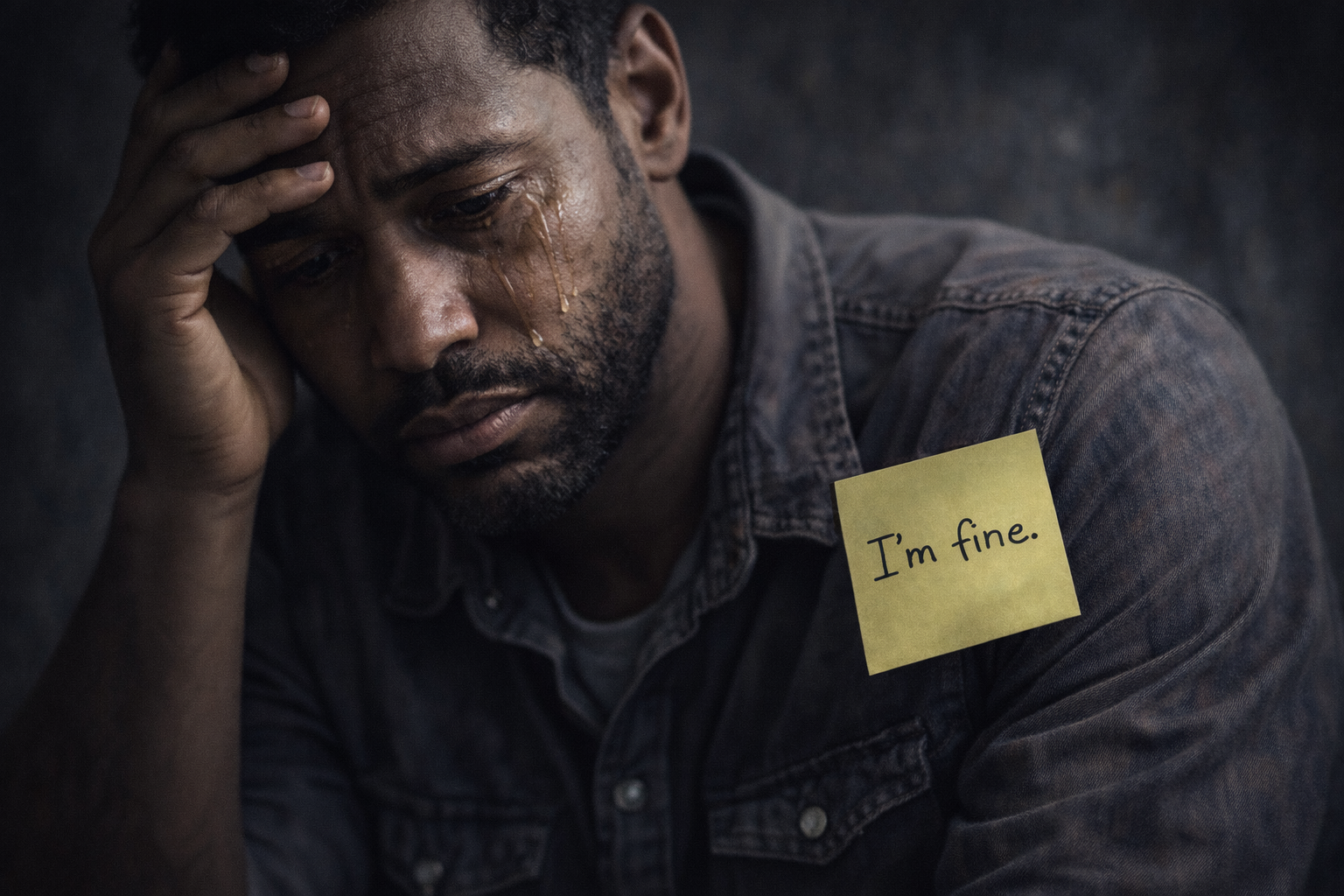
Why “I’m Fine” Doesn’t Always Mean I’m Okay
I’m fine” sounds simple, easy, and harmless. But a lot of the time, it is not the full truth. People often use it to protect themselves, avoid uncomfortable conversations, or hide feelings they do not know how to explain. Behind those two words, there may be stress, sadness, anxiety, burnout, loneliness, or emotional exhaustion. This article explores why “I’m fine” does not always mean someone is okay, what people may really be feeling, how to notice the signs, and how to respond in a way that feels kind, respectful, and supportive.
We hear it all the time.
“How are you?”
“I’m fine.”
It is one of the most common replies in everyday life. It slips into conversations at school, at work, at home, over text, and even in deep relationships. On the surface, it sounds like everything is under control. It sounds neat, quick, and closed. Case finished, right?
Not always.
In fact, “I’m fine” can sometimes mean the exact opposite. It can be a cover for pain, pressure, exhaustion, sadness, anxiety, or emotional overload. It can be the phrase people use when they do not want to be a burden, when they are too tired to explain, or when they are trying to hold themselves together in front of others.
That is what makes this tiny phrase so important. It can sound ordinary, but it often carries a lot more than people realize.
This article takes a closer look at why “I’m fine” does not always mean someone is okay, what can be hiding behind it, how to spot the signs, and how to respond in a way that offers real emotional support instead of just moving on.
Why people say “I’m fine” even when they are not
Let’s be honest. Most people have said “I’m fine” at least once when they were clearly not fine.
Why? Because it is easier.
It is fast. It avoids follow-up questions. It helps people get through the moment without cracking open emotions they may not feel ready to face. Sometimes it is a social reflex. Other times, it is a shield.
Here are some of the biggest reasons people say it.
1. They do not want to feel like a burden
A lot of people worry that sharing how they really feel will make them seem needy, dramatic, or “too much.” So instead of being honest, they shrink the truth down to something manageable.
“I’m fine” becomes a way to avoid feeling guilty for taking up emotional space.
This is especially common in people who are used to being the strong one, the helper, the reliable friend, or the person everyone else leans on. They may struggle to admit that they need support too.
2. They do not know how to explain what they are feeling
Not every emotion comes with a clear label.
Sometimes a person is not exactly sad, not exactly anxious, not exactly angry, but not okay either. They may feel overwhelmed, numb, restless, disconnected, or mentally exhausted. And when feelings are tangled, words do not always come easily.
So instead of trying to unpack the whole mess, they go with the safe answer: “I’m fine.”
3. They do not feel safe opening up
People are more honest when they feel emotionally safe. If they have been dismissed, judged, criticized, or ignored in the past, they may stop telling the truth about how they feel.
If someone has learned that vulnerability gets met with lectures, sarcasm, gossip, or minimization, they may choose silence over honesty every single time.
In those moments, “I’m fine” really means, “I do not feel safe enough to say more.”
4. They are trying to protect themselves
Opening up takes energy. And when someone is already emotionally drained, they may not have the strength to explain everything.
Sometimes “I’m fine” is not a lie in a manipulative sense. It is emotional self-protection. It is a way to hold the line until they can breathe, think, or figure out what they actually need.
5. They have been conditioned to hide their feelings
Some people grow up hearing messages like:
“Stop crying.”
“Be strong.”
“Don’t be so sensitive.”
“Other people have it worse.”
“Just deal with it.”
Over time, those messages teach people to hide what they feel. They learn that emotions should be managed privately and quickly. They learn that struggling should stay invisible.
So even when they are falling apart inside, “I’m fine” can come out automatically.
What “I’m fine” can really mean
This is where things get real. Depending on the situation, “I’m fine” can stand in for many different emotions and experiences.
It might actually mean:
“I’m overwhelmed, and I do not know where to start.”
“I’m exhausted, but I still need to keep functioning.”
“I’m hurt, but I do not want to talk about it right now.”
“I’m anxious, and I’m trying not to show it.”
“I’m sad, but I do not want anyone to worry.”
“I’m struggling, but I do not think you’ll understand.”
“I need support, but I do not know how to ask.”
“I want someone to notice, but I’m scared they will not.”
That is why tone, body language, and timing matter so much. The words may say one thing, but the person may be communicating something else entirely.
The difference between privacy and hidden pain
Now, to be fair, not every “I’m fine” is a cry for help.
Sometimes people really are okay. Sometimes they are just private. Sometimes they are having a hard moment but do not want to talk about it yet. And that is their right.
The goal is not to treat every short answer like an emergency. It is to pay attention with care.
There is a difference between respecting someone’s privacy and ignoring obvious signs of distress. Emotional awareness lives in that middle ground. It means noticing without prying. It means caring without controlling. It means leaving room for honesty without forcing it.
Signs that “I’m fine” may not mean okay
Words matter, sure, but they are not the whole story. People often reveal more through their energy, behavior, and patterns than through their actual sentences.
Here are some signs that “I’m fine” may be covering something deeper.
Their tone does not match their words
If someone says “I’m fine” in a flat voice, shaky tone, or irritated snap, pay attention. A mismatch between words and tone can be a clue that they are not being fully honest, even with themselves.
They suddenly go quiet
Someone who usually talks a lot but becomes withdrawn may be dealing with something heavier than they are saying. Silence can signal stress, sadness, disappointment, or burnout.
They seem emotionally drained
If a person looks exhausted, distracted, numb, or tense, their “I’m fine” may be more about surviving the moment than expressing the truth.
They stop engaging the way they normally do
Maybe they stop replying to messages. Maybe they cancel plans more often. Maybe they seem distant, less interested, or emotionally unavailable. These changes can point to internal struggles.
They brush off concerns too quickly
Sometimes people shut down a caring question before it even has a chance to breathe. They might laugh it off, change the subject, or give a quick “I’m fine, really” that sounds more defensive than reassuring.
Their behavior says otherwise
A person may say they are okay while sleeping poorly, skipping meals, falling behind, becoming unusually irritable, or losing interest in things they normally enjoy. Behavior often tells the truth that words are trying to hide.
Why this matters in relationships
Whether it is friendship, family, romance, or mentoring, relationships grow stronger when people feel safe being honest. But when “I’m fine” becomes a wall instead of a simple response, it can create distance.
That distance is not always intentional. Sometimes it grows because one person is hurting quietly while the other person assumes everything is okay. That is why emotional attentiveness matters so much.
People do not always need you to solve their problems. Often, they just need to know someone noticed.
A caring response can turn a surface-level moment into a safe one. And that can change everything.
How to respond when someone says “I’m fine”
This part matters a lot. If you sense that someone is not okay, your response can either open the door or shut it completely.
Here are better ways to respond.
Stay gentle, not intense
If you come in too hard with pressure, people may pull back even more. Try warmth instead of interrogation.
You could say:
“Okay. I’m here if you want to talk.”
“You do not have to explain anything right now, but I care.”
“You seem a little off. Want to tell me more?”
“No pressure, but I’m happy to listen.”
That kind of response gives them space without leaving them alone in it.
Notice what you are seeing
Sometimes naming what you observe, kindly and calmly, can help.
For example:
“You’re saying you’re fine, but you seem really tired.”
“You do not have to pretend with me.”
“I noticed you’ve been quieter than usual.”
This can help a person feel seen rather than cornered.
Do not force the conversation
Not everyone is ready to open up in the moment. Pressuring them can backfire. Support works better when it leaves room for choice.
Try saying:
“You can talk now or later.”
“We do not have to get into it right this second.”
“I’ll check in again soon.”
That communicates care and consistency.
Avoid minimizing language
This is a big one. If someone hints that they are not okay, do not respond with:
“It’s probably nothing.”
“Everyone gets stressed.”
“Just think positive.”
“At least it’s not worse.”
Even if you mean well, that kind of language can make people retreat.
Ask what they need
Not everyone wants the same kind of support. Some want to talk. Some want distraction. Some want help with next steps. Some just want quiet company.
A simple question can help a lot:
“Do you want me to listen, help, or just sit with you?”
That is a caring, respectful way to support someone without assuming.
Why students often say “I’m fine” when they are overwhelmed
Students do this all the time.
On the outside, they may seem to be keeping up. Going to class. Turning things in. Smiling in group chats. Showing up. But underneath that surface, they may be dealing with enormous pressure.
Students often say “I’m fine” when they are carrying:
Academic stress
Fear of failure
Burnout
Family pressure
Money worries
Social anxiety
Loneliness
Uncertainty about the future
Mental and emotional exhaustion
Why hide it? Because many students feel like they are supposed to keep going no matter what. They may worry that opening up will sound like weakness or excuse-making. They may not want to disappoint parents, teachers, or themselves.
That is why emotional support for students matters so much. Asking how they are really doing, without immediately jumping to grades or performance, can create space for honesty.
Why adults do it too
This is not just a student thing. Adults do it constantly.
Parents say they are fine because they are focused on everyone else. Professionals say they are fine because work culture rewards composure. Caregivers say they are fine because they feel they have no room to fall apart. Friends say they are fine because they do not want to “dump” their feelings.
In many cases, “I’m fine” becomes a coping habit.
The trouble is, habits like that can slowly increase emotional isolation. When people get used to hiding what they feel, they may begin to feel unseen even in close relationships. Over time, that can deepen stress, sadness, and disconnection.
How to create a space where honesty feels easier
If you want people in your life to feel safe saying more than “I’m fine,” the goal is not to force vulnerability. The goal is to build trust.
Here are a few ways to do that.
Be consistent
People open up more when they know your care is not random. A one-time check-in is nice. Ongoing care is what builds safety.
Listen without rushing
If someone starts sharing, do not leap in with advice right away. Let them talk. Let the moment breathe.
Keep their dignity intact
Do not make them feel dramatic, weak, or broken for struggling. Respect matters.
Follow up
If someone has had a hard day, week, or season, circle back. That quiet consistency tells them they matter.
Be emotionally calm
A calm presence makes it easier for others to be honest. If your reaction is too intense, panicked, or judgmental, they may shut down.
What not to say
When someone says “I’m fine” but seems clearly off, a few responses tend to make things worse.
Avoid things like:
“You always say that.”
“Stop being dramatic.”
“Well, what’s your problem then?”
“You should be grateful.”
“Everyone has issues.”
“You need to toughen up.”
Yikes. Even when frustration is real, those responses usually shut the door hard.
A better response is one that leaves room for honesty while respecting boundaries.
When “I’m fine” may signal a deeper need for help
Sometimes “I’m fine” is just a short-term cover. Other times, it may be part of a larger pattern of distress.
If someone seems deeply withdrawn, hopeless, unable to function, unusually numb, or consistently overwhelmed for a long period, it may be a sign that they need more than casual support. In that case, emotional support can include encouraging professional help.
That can sound like:
“You do not have to carry this by yourself.”
“I think you deserve support.”
“Would it help if we looked for someone to talk to together?”
This is still kindness. Still care. Still support. It is just support with a healthier next step.
Real emotional support starts with paying attention
At the end of the day, “I’m fine” is not always about dishonesty. Often, it is about self-protection, exhaustion, uncertainty, or fear. It is a phrase people use when they do not know how to say what is really going on, or when they are not sure it is safe to try.
That is why paying attention matters.
Real emotional support is not about prying every feeling loose. It is about noticing, staying kind, and making space for honesty when the person is ready. Sometimes the most helpful thing you can say is not something dramatic at all. It is simply:
“I’m here.”
And honestly, that can mean more than people ever say out loud.
FAQ
Why do people say “I’m fine” when they are not okay?
People often say “I’m fine” to avoid feeling like a burden, protect themselves emotionally, skip uncomfortable conversations, or hide feelings they do not yet know how to explain.
Does “I’m fine” always mean something is wrong?
No. Sometimes it is just a normal response. But if the person’s tone, behavior, or mood does not match their words, it may be worth checking in with care.
How should I respond when someone says “I’m fine”?
Respond gently. Let them know you care, avoid pushing too hard, and leave the door open for a later conversation. Saying “I’m here if you want to talk” can be very supportive.
What are signs that someone is not really okay?
Common signs include withdrawal, irritability, emotional flatness, unusual fatigue, canceled plans, changes in eating or sleeping, and a tone of voice that does not match their words.
Why do students often hide how they feel?
Students may fear being judged, disappointing others, or appearing weak. They often face pressure around grades, money, family expectations, and the future, which can make it hard to open up honestly.
Is it wrong to respect someone’s privacy?
Not at all. Respecting privacy is important. The key is to stay caring and observant without forcing someone to talk before they are ready.
When should professional help be considered?
If someone seems hopeless, unsafe, deeply withdrawn, or unable to function over time, professional support may be the best next step.
Final thoughts
“I’m fine” may be one of the simplest phrases in the world, but it is not always a simple truth.
Sometimes it means, “I’m overwhelmed.”
Sometimes it means, “I’m tired of explaining.”
Sometimes it means, “Please notice.”
And sometimes it means, “I want help, but I do not know how to ask.”
That is why compassion matters so much.
When we learn to look beyond automatic answers, we become better friends, better listeners, better parents, better partners, and better humans. We stop taking every reply at face value and start paying attention to what people may be carrying quietly.
Because sometimes the kindest thing you can do is recognize that “I’m fine” does not always mean “I’m okay.”
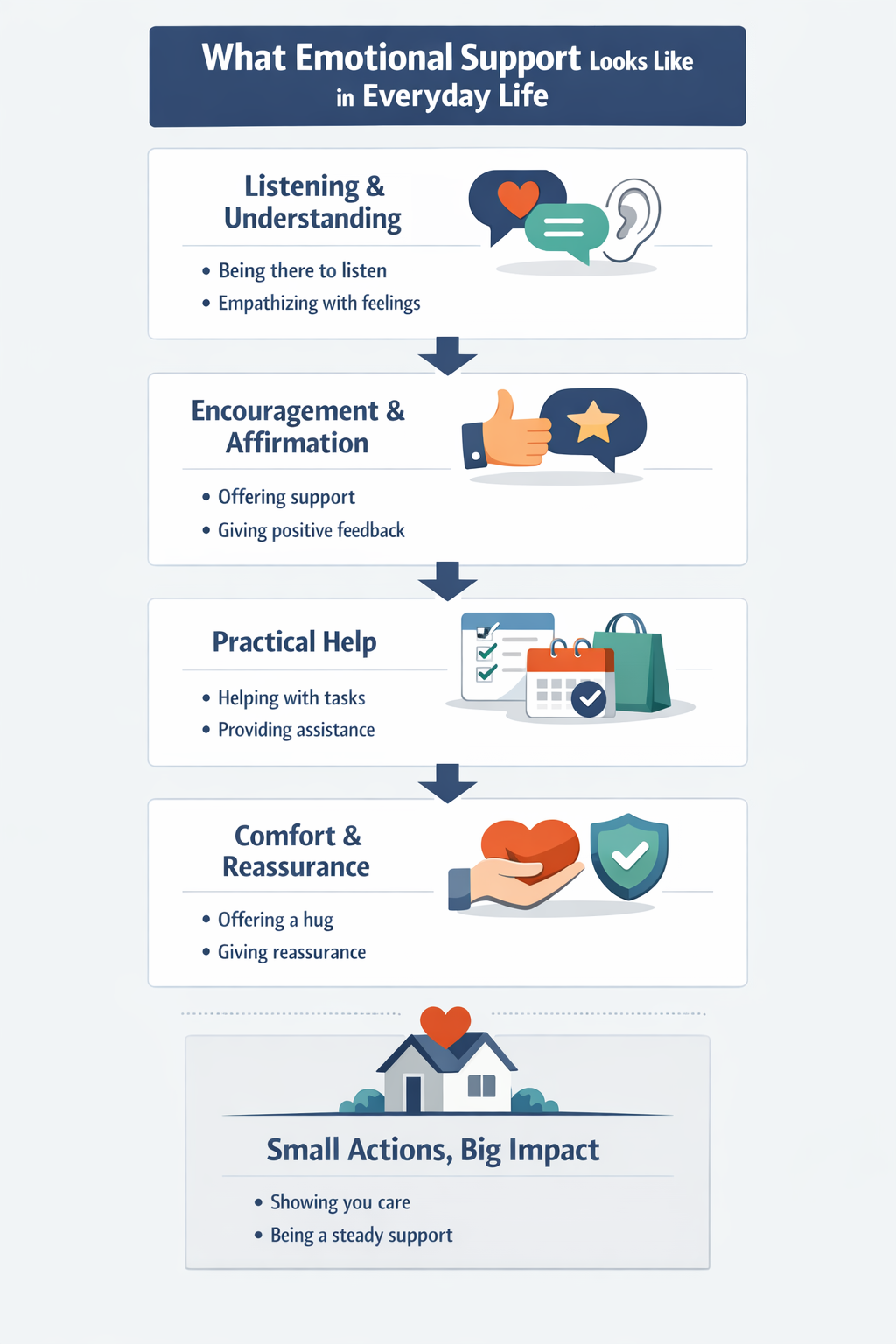
What Emotional Support Actually Looks Like in Everyday Life
Emotional support is not about having the perfect words ready at the perfect time. More often than not, it is about making someone feel safe, heard, and less alone. Real support can be quiet, steady, and simple, yet it can make a huge difference during stressful, painful, or uncertain moments. This guide explains what emotional support really means, how it looks in real life, what gets mistaken for support, and how to show up for people in ways that truly help
When people hear the phrase emotional support, they often picture long heart-to-heart conversations, dramatic breakthroughs, or someone saying exactly the right thing at exactly the right time. But honestly, that is not usually how it works.
Real emotional support is often much quieter than that.
It is the friend who checks in after a rough day. It is the parent who listens without rushing to lecture. It is the classmate who sits beside you when your stress is through the roof. It is the partner who stays calm when everything feels like too much. It is not always flashy, but it is deeply meaningful.
At its core, emotional support is about helping someone feel seen, respected, and less alone. It is not about fixing every problem. It is not about being perfect. And it definitely is not about having some magic script.
In this article, we will look at what emotional support really means, why people misunderstand it, what it looks like in daily life, and how to offer it in a way that feels genuine and helpful.
What emotional support really means
Emotional support means responding to someone’s feelings with care, patience, and respect. It is about noticing that someone is carrying something heavy and helping them feel like they do not have to carry it completely alone. That idea is at the heart of the source material you shared, which emphasizes safety, calm, validation, and steady presence over dramatic words or rushed solutions.
In simple terms, emotional support often includes:
Listening without judgment
Noticing when someone is struggling
Offering comfort without taking control
Staying present even when you cannot solve the problem
Helping someone feel less isolated
That is what makes emotional support so powerful. It tells a person, in one way or another, “You matter, and I’m here with you.”
And really, that message can land harder than any grand speech ever could.
Why people misunderstand emotional support
A lot of folks think support has to be dramatic to count.
They think they need the perfect advice. They think they need to “fix” the situation fast. They think they have to say something brilliant, wise, or life-changing. Because of that, many people freeze up. They worry about saying the wrong thing, so they say very little. Or they jump into problem-solving mode because silence feels uncomfortable.
But emotional support is not a performance.
Most of the time, support is quiet, consistent, and grounded. It is less about being impressive and more about being present. That is where people get tripped up. They confuse support with rescue. They confuse empathy with advice. They confuse caring with control.
Here is the truth: many people are not looking for a fix right away. They are looking for relief. They are looking for connection. They are looking for someone who can sit with them in a hard moment without making them feel weak, broken, or like a burden.
That kind of support does not always come wrapped in fancy language. In fact, some of the most helpful phrases are incredibly simple.
Listening to understand, not to reply
This is one of the clearest examples of real emotional support.
When someone opens up, they usually do not need you to rehearse your next response while they are still talking. They need you to listen. Really listen. That means giving them your attention, letting them finish, and not immediately turning the conversation back to yourself.
Supportive listening looks like this:
You do not interrupt with a personal story every few seconds
You do not rush in with advice before understanding what they mean
You do not minimize the emotion because it makes you uncomfortable
You let the other person be messy, uncertain, and human
Helpful responses can be surprisingly simple:
“That sounds really hard.”
“I’m glad you told me.”
“That makes sense.”
“Do you want me to listen, or help you think it through?”
Those kinds of responses help people feel heard rather than brushed off. And that feeling matters. A lot.
Checking in without waiting to be asked
Another big sign of emotional support is consistency.
Sometimes the most meaningful thing you can do is follow up. People often remember who checked in after the hard conversation was over. They remember who sent the message the next day. They remember who did not disappear once the moment became less dramatic.
A short check-in can make a huge difference:
“How are you doing today?”
“I’ve been thinking about you.”
“How did that appointment go?”
“No pressure to respond. Just wanted to check in.”
This kind of support feels steady. It tells someone, “You are still on my mind.” That simple reassurance can reduce the loneliness people feel when they are struggling.
And let’s be real, many people find it hard to ask for help. A proactive message can open the door without forcing anything.
Staying calm when someone feels overwhelmed
People often borrow calm from the people around them. When someone is anxious, upset, discouraged, or emotionally overloaded, your presence matters more than you might think.
If you respond with panic, urgency, or frustration, their stress can rise even more. But if you stay grounded, lower your voice, and slow the moment down, you can help them feel safer.
Emotional support in these moments may look like:
Speaking gently and clearly
Not overwhelming them with too many questions
Helping them focus on one thing at a time
Sitting quietly beside them
Reminding them to breathe or pause
A calm presence can be incredibly supportive. You do not need the perfect answer. Sometimes the greatest gift is simply being the steady person in a chaotic moment.
Offering practical help with small next steps
Here is something people do not always realize: emotional support is not only emotional. It can be practical too.
When someone feels overwhelmed, even simple tasks can seem massive. Writing one email, making one call, or figuring out one next step can feel like climbing a mountain in flip-flops. That is where practical support comes in.
This can look like:
Helping them make a short to-do list
Sitting with them while they send an important message
Going with them to an appointment
Helping them find a counselor, advisor, or support service
Reminding them to eat, rest, drink water, or take a break
Practical help does not replace empathy. It works alongside it. It says, “You do not have to do all of this alone.” And when a person is stressed out, that can make life feel far more manageable.
Respecting feelings instead of minimizing them
One of the biggest mistakes people make is trying to comfort others by shrinking their feelings.
You have probably heard phrases like these before:
“It’s not that bad.”
“At least…”
“Just stay positive.”
“Other people have it worse.”
“You’ll be fine.”
Usually, people mean well when they say those things. They want to help. They want to make the pain go away. But instead of comforting, those phrases often make someone feel dismissed.
Real emotional support sounds different. It sounds like:
“I can see why this feels heavy.”
“You do not have to pretend you’re okay.”
“This matters.”
“We can take this one step at a time.”
“I’m here.”
Validation does not make emotions worse. It makes them easier to carry. When people feel understood, they often calm down more naturally than when they feel corrected or dismissed.
Giving space when space is needed
Support does not always mean talking more.
Sometimes the most supportive thing you can do is respect someone’s need for quiet, rest, or a little breathing room. Emotional support is not about pushing people to open up on your timeline. It is about staying available while honoring their pace.
That may look like saying:
“You do not have to talk right now.”
“Take your time.”
“I’m here when you’re ready.”
“No pressure. Just know I care.”
This matters because people process emotions differently. Some need to talk immediately. Others need time to sort through what they are feeling first. Respecting that difference shows maturity and care.
What emotional support does not look like
Sometimes it helps to get crystal clear about what support is not.
Emotional support does not mean:
Forcing advice on someone who did not ask for it
Telling them how they should feel
Turning their pain into a lesson too quickly
Making them feel weak for struggling
Pushing them to “get over it”
Taking over every decision in the name of helping
Making their moment about your discomfort or opinions
Support should help a person feel safer and stronger, not smaller.
That is an important distinction. There is a big difference between helping and controlling. Real support leaves room for dignity.
Why emotional support matters so much
Human beings cope better when they feel connected. That is just the truth of it.
When people feel emotionally supported, they often experience less stress, less isolation, and more clarity. They are more likely to take healthy next steps. They are more likely to reach out again. They are more likely to trust the relationship.
Support matters because hard times can distort how people see themselves. Stress can make people feel like they are failing. Anxiety can make them feel alone. Sadness can make everything seem heavier. Emotional support interrupts that spiral by reminding them they are not carrying the whole load by themselves.
For families, friendships, classrooms, workplaces, and relationships, emotional support helps build trust. People remember who made them feel safe when life got rough.
What emotional support looks like for students
Students, in particular, often carry invisible pressure.
They may be dealing with academic stress, family expectations, financial worries, friendship problems, loneliness, burnout, fear about the future, or the constant pressure to perform. From the outside, they might look fine. On the inside, though, they may be struggling hard.
Emotional support for students often looks like:
Asking how they are really doing
Listening without turning everything into grades or performance
Helping them break large problems into small steps
Reminding them that struggle does not equal failure
Encouraging them to use campus or school support services
Noticing changes in mood, energy, or behavior
Students do not always need someone to solve everything. Many times, they just need someone to help them breathe, think more clearly, and feel less alone in the pressure.
That can be a parent, teacher, mentor, advisor, sibling, or friend. The role matters less than the consistency.
How to give real emotional support
You do not need special training to be emotionally supportive. You do not need perfect language either. What you need most is care, attention, and patience.
Here are a few practical ways to do it well.
1. Be present
Put the distractions away for a minute. Make eye contact if appropriate. Listen fully. Give the person the sense that they are worth your time and attention.
2. Be steady
Do not panic because they are upset. You can be calm without being cold. A steady tone and grounded presence go a long way.
3. Be curious
Ask what they need instead of assuming. You can say, “Do you want me to listen, help problem-solve, or just sit with you?”
That one question can save a lot of misunderstanding.
4. Be respectful
Let them keep their dignity. Avoid treating them like they are helpless or incapable. Support should empower, not infantilize.
5. Be consistent
Check in after the first conversation. Follow-through matters. One supportive moment is good. Consistent support is even better.
When emotional support should include professional help
Friends, family members, partners, teachers, and mentors can provide meaningful support. But sometimes a person needs more than informal care.
If someone seems deeply withdrawn, hopeless, unsafe, unable to function, or overwhelmed for a long stretch of time, professional help may be the right next step. That does not mean you have failed them. Quite the opposite. Helping someone connect with appropriate care is often one of the most supportive things you can do.
That conversation can sound like this:
“You do not have to handle this alone.”
“I think you deserve more support than I can give by myself.”
“Let’s look for the right help together.”
That is still emotional support. It is just support with direction.
Common mistakes people make when trying to help
Even caring people can miss the mark sometimes. It happens. Here are a few common mistakes to watch out for:
Giving advice too fast
Jumping straight into solutions can make people feel unheard. Often, they need empathy before strategy.
Comparing experiences
Saying, “That happened to me too,” is not always wrong, but it can shift the focus away from the person who is hurting.
Using toxic positivity
A little hope is helpful. Forced positivity is not. Telling someone to “just look on the bright side” can feel dismissive.
Making promises you cannot keep
Do not say, “Everything will be okay,” if you cannot know that. Better to say, “I’m here with you.”
Taking over
Helping is great. Controlling is not. Support should not strip someone of choice or voice.
Real-life examples of emotional support
Sometimes examples make everything click. Here are a few simple scenarios.
A friend after a breakup
Instead of saying, “You’ll find someone better,” you say, “I know this hurts. Want me to come over and just hang out?”
A student overwhelmed by exams
Instead of saying, “You need to manage your time better,” you say, “Let’s figure out one thing you need to do first.”
A parent noticing their child is withdrawn
Instead of pushing with, “What is wrong with you lately?” they say, “You seem like you’ve had a lot on your mind. I’m here if you want to talk.”
A coworker under pressure
Instead of pretending not to notice, you say, “You’ve had a lot going on. Is there anything I can take off your plate today?”
These moments may seem small, but they are often the things people remember.
A better way forward
Emotional support is not about saying something impressive. It is about being a safe, steady person when someone’s world feels heavy. It is about listening well, checking in, respecting feelings, staying calm, and helping with small next steps when needed. The source text you provided captures that beautifully by showing that support is often simple, practical, and deeply human.
And that is the real takeaway here: support does not have to be loud to be powerful.
In many cases, the best thing you can offer is your presence, your patience, and your willingness to stay.
FAQ
What is emotional support?
Emotional support is the care, comfort, and reassurance that helps someone feel heard, understood, and less alone during difficult moments.
What are examples of emotional support?
Examples include listening without judgment, checking in after a hard day, validating feelings, offering a calm presence, and helping with practical next steps.
What does real emotional support look like?
Real emotional support looks like consistency, empathy, patience, and respect. It is often quiet and steady rather than dramatic or overly verbal.
Why is emotional support important?
It helps reduce stress, builds trust, lowers feelings of isolation, and makes it easier for people to cope with challenges in healthy ways.
Is emotional support the same as solving someone’s problems?
No. Emotional support is about being present and helpful without taking over. It helps someone feel supported, not controlled.
How can I emotionally support a student?
Ask how they are really doing, listen without judgment, avoid making everything about performance, and help them break big worries into smaller steps.
When should emotional support include professional help?
If someone seems hopeless, unsafe, deeply withdrawn, or unable to function for an extended period, professional support may be needed. Encouraging them to find the right help is part of caring well.
Final thoughts
At the end of the day, emotional support is not about getting every word right. It is about helping someone feel safe enough to be honest, supported enough to keep going, and valued enough to know they do not have to face everything alone.
That is what emotional support actually looks like.
It is listening without interrupting. It is checking in after the storm. It is staying calm when someone else feels overwhelmed. It is making space for real feelings instead of trying to sweep them away. It is offering one small next step when everything feels too big.
Quiet? Yes.
Simple? Often.
Powerful? Absolutely.

The Silent Impact of Grief on Families
Grief doesn’t just visit one heart. It settles into homes, shifts family roles, changes conversations, and leaves an ache that shows up in ways people don’t always notice right away. This article explores the grief and family impact that often goes unspoken, how grief affects families emotionally and relationally, and what healthy coping with loss as a family can truly look like over time.
Grief has a strange way of entering a home without knocking. One day, life has a rhythm. Then loss happens, and suddenly the same kitchen feels quieter, the same table feels heavier, and even ordinary moments seem different. Not because the walls changed, but because the people inside them did.
That’s the part many people don’t talk about enough.
When someone dies or a major loss shakes a family, the pain doesn’t stay neatly tucked inside one person. It ripples outward. It touches routines, relationships, finances, parenting, communication, sleep, celebrations, and even the future people imagined together. The silent impact of grief on families can be deep, confusing, and long-lasting. Yet for something so common, it’s often misunderstood.
People tend to ask one grieving person, “How are you doing?” But families are systems. When one part hurts, all the other parts feel it too. A parent may become emotionally distant without meaning to. A child may act out instead of speaking up. Siblings may grieve in completely different ways and start misunderstanding each other. A spouse may look “strong” on the outside while quietly carrying exhaustion, fear, and loneliness.
That’s why understanding grief and family impact matters so much. Loss doesn’t just break hearts. It can reshape the entire emotional climate of a home.
Still, grief isn’t only a story of pain. It can also become a path toward deeper compassion, stronger honesty, and renewed connection, though not overnight and not without effort. Families can learn how to survive loss together. More than that, they can learn how to care for one another through it.
In this article, we’ll explore how grief affects families, why people under the same roof often grieve so differently, and practical ways of coping with loss as a family without pretending everything is okay when it isn’t.
Grief Rarely Looks the Same for Everyone
One of the biggest reasons grief causes tension at home is simple: no two people grieve in the exact same way.
That can be hard for families to accept. After all, if everyone loved the same person, shouldn’t they all respond similarly? Not really.
One person may cry often and want to talk about the loss every day. Another may go silent and throw themselves into work, chores, or caregiving. One child may ask constant questions. Another may not mention the loss at all. One family member may want to keep every photo and memory item out in the open. Another may find those same items unbearable.
None of these responses automatically mean someone loved less. They simply reveal that grief is personal.
This is where the real grief and family impact begins to show. People may judge each other’s pain without realizing it.
A few common thoughts sound like this:
“Why are they acting so normal already?”
“Why won’t anyone talk about what happened?”
“Why am I the only one falling apart?”
“Why do I have to be the strong one?”
“Why are they angry all the time?”
These questions often come from hurt, not cruelty. But if they go unspoken, they can create distance.
Families don’t just grieve the person or situation they lost. Sometimes, they also grieve the version of each other they expected to lean on. That realization can sting. You assume grief will pull everyone closer, but sometimes it exposes emotional gaps that were already there or creates new ones no one knows how to bridge.
That doesn’t mean the family is failing. It means they are human.
How Grief Affects Families Emotionally
When people think about grief, they often imagine sadness first. Of course, sadness is part of it. But in families, grief often wears many faces.
It may look like irritability.
It may look like numbness.
It may look like overprotectiveness.
It may look like withdrawal.
It may look like conflict over tiny things that aren’t actually tiny at all.
That’s one of the most overlooked truths about how grief affects families. The pain itself may not always show up as tears. Sometimes it appears as tension in the room, shorter patience, emotional confusion, or a sense that everyone is speaking different emotional languages.
A grieving family may experience:
Increased emotional sensitivity
Small comments can suddenly feel huge. A harmless misunderstanding may trigger tears or anger because people are already emotionally stretched thin.
Guilt
Family members may feel guilty for what they said, what they didn’t say, what they noticed too late, or even for moments when they laugh again. Grief has a way of making people second-guess themselves.
Anxiety
After loss, the world can feel less safe. Parents may worry more. Children may cling more. Family members may fear another loss is around the corner.
Emotional exhaustion
Grief is tiring. It affects sleep, focus, and energy. A family may begin to function on emotional fumes, which makes healthy communication much harder.
Loneliness inside togetherness
This one hurts the most. A family can be in the same house, love each other deeply, and still feel profoundly alone because each person is carrying grief in private.
That’s why compassion matters so much. Behind silence, anger, forgetfulness, and withdrawal, there is often pain asking to be seen.
The Way Loss Changes Family Roles
Loss doesn’t only affect emotions. It often shifts roles inside the home.
Sometimes the change is obvious. A parent dies, and the surviving adult now carries everything alone. A grandparent who used to hold the family together is gone, and suddenly holidays feel disorganized and hollow. A sibling passes away, and the emotional balance in the home is altered in ways no one expected.
Other times the change is quieter.
The “funny one” becomes serious.
The “strong one” starts cracking.
The child who never helped suddenly becomes a caretaker.
The parent who always handled everything can barely get through the day.
This role reshuffling is a major part of how grief affects families. People are not only mourning the loss itself. They are also adapting to the practical and emotional vacuum it leaves behind.
In many families, one person begins overfunctioning. They make the calls, handle the meals, support everyone else, and try to keep the house running. On the outside, they seem dependable. On the inside, they may be drowning.
Another person may underfunction. They may avoid responsibilities, go numb, stay distracted, or check out emotionally. This doesn’t always mean they don’t care. It may mean they are overwhelmed beyond words.
Both responses deserve attention.
Grief can make families unintentionally unfair to each other. The dependable person gets praised but not supported. The struggling person gets criticized but not understood. Over time, resentment can grow unless the family acknowledges what’s happening.
Why Communication Often Breaks Down After Loss
Loss can make people want two opposite things at once: to be understood and to hide.
That tension is one reason grieving families often stop communicating well. Everyone is hurting, but not everyone knows how to say it. Some are afraid of making things worse. Some don’t want to cry in front of others. Some think staying quiet is the same thing as staying strong.
It isn’t.
A lack of communication can quietly deepen the grief and family impact in several ways:
Important needs go unspoken
Assumptions replace honest conversations
Conflict increases
Children fill in emotional blanks with fear
Family members feel rejected even when no rejection was intended
For example, a parent may stop talking because they are trying not to burden their children. But the children may interpret that silence as emotional distance. A spouse may avoid mentioning the person who died because they think their partner needs space. The partner may take that as indifference. A teenager may spend more time alone, not because they do not care, but because they do not know how to express what they feel.
See the pattern? Silence gets misunderstood.
Healthy grieving doesn’t mean talking all the time. It means making room for truth. Sometimes that truth sounds like, “I don’t know what to say, but I miss them too.” Sometimes it sounds like, “I’m angry and I don’t know why.” Sometimes it sounds like, “I need quiet today, but I still want to be close.”
Even simple honesty can soften a home that’s been hardened by loss.
How Grief Affects Children and Teens in the Family
Children grieve, but they don’t always grieve the way adults expect.
Some children ask direct questions. Others become clingy, irritable, or unusually quiet. Some keep playing and laughing, which can confuse adults who mistake playfulness for a lack of pain. But children often move in and out of grief. They feel it in waves, then return to normal activity because that is how they regulate.
Teens may grieve even more quietly. They might withdraw, become more sarcastic, struggle in school, or act like they don’t care when they care deeply.
This matters because coping with loss as a family requires paying attention to grief in all age groups, not just the adults.
Children and teens need:
Clear, age-appropriate honesty
Reassurance that their feelings are allowed
Consistent routines when possible
Repeated opportunities to talk, not pressure to talk
Permission to remember, cry, laugh, and ask hard questions
They also need adults to model healthy grieving. Not perfect grieving, just honest grieving. When children see that sadness can be spoken, comfort can be offered, and love can remain present even in pain, they learn that grief is survivable.
That lesson is priceless.
Helpful resources like the National Alliance for Children’s Grief can support families who are navigating loss with children and teens.
The Physical and Mental Toll of Family Grief
Grief isn’t just emotional. It often settles into the body too.
A grieving family may notice:
sleep problems
headaches
appetite changes
trouble focusing
lowered patience
memory issues
increased anxiety or depression
This physical side of loss is often ignored because families are busy surviving day to day. But it’s part of the whole picture of how grief affects families. When several people in one household are dealing with stress, sadness, and fatigue at the same time, the entire home can feel strained.
That strain may show up as:
more arguments
less energy for daily tasks
missed appointments or forgotten responsibilities
social withdrawal
feeling emotionally flat or disconnected
Sometimes families assume they just need more time. And yes, time matters. But support matters too.
When grief begins affecting daily functioning for a long period, counseling, grief groups, or family therapy can be incredibly helpful. Support is not a sign that a family is broken. It’s a sign that the loss mattered and healing deserves care.
Organizations like GriefShare and Mental Health America offer guidance and support that many families find helpful.
The Hidden Impact on Marriage and Partnerships
When grief enters a home, marriages and partnerships often feel the pressure too.
One partner may want to talk. The other may cope through silence. One may need closeness. The other may need space. One may become more emotional. The other may focus on tasks and logistics.
Neither approach is automatically wrong, but the mismatch can hurt.
This is one of the most painful sides of grief and family impact because couples often expect each other to be the safest place during loss. When that support feels off, even unintentionally, disappointment can turn into resentment.
Common struggles include:
feeling emotionally abandoned
conflict over parenting after loss
different mourning timelines
reduced intimacy
exhaustion from practical responsibilities
arguments that are really about grief, not the surface issue
Here’s the hard truth: grief can either isolate partners or deepen their connection. The difference often lies in whether they make room for each other’s style of grieving.
That may sound like:
“I know we’re grieving differently, but I don’t want us to drift.”
“I need you near me, even if we’re quiet.”
“I’m not shutting you out. I’m just overwhelmed.”
“We may not fix this pain, but we can carry it together.”
Sometimes couples need help learning how to say those things. That’s okay. Grief counseling and family therapy can provide language when pain has stolen it.
Coping With Loss as a Family in Healthy Ways
There is no perfect roadmap for coping with loss as a family, but there are practices that genuinely help.
The goal is not to erase grief. It is to create enough honesty, safety, and support that no one has to carry it completely alone.
1. Let people grieve differently
This is huge. Families need to stop measuring love by emotional style. Some cry. Some clean. Some talk. Some sit in silence. Make room for difference without assuming difference equals disconnection.
2. Name what’s real
Even simple words help. Say the name of the person who died. Acknowledge anniversaries. Admit when the day feels heavy. Grief grows heavier when everyone pretends not to see it.
3. Keep communication gentle and direct
Try sentences like:
“How is today feeling for you?”
“Do you want company or quiet?”
“I miss them too.”
“I’m not okay today.”
“I don’t know how to help, but I want to.”
These aren’t fancy, but they open doors.
4. Protect basic routines
Routine won’t remove pain, but it offers stability. Meals, bedtimes, school schedules, walks, and family check-ins can help restore a sense of safety, especially for children.
5. Create remembrance rituals
Light a candle. Cook their favorite meal. Look at photos together. Write letters. Visit a meaningful place. Share stories at birthdays or holidays. Remembrance can be healing when it becomes shared rather than avoided.
6. Ask for outside support
Families are often strongest when they stop trying to do grief all by themselves. A counselor, grief support group, faith leader, or trusted mentor can help bring relief and perspective.
7. Watch for signs that someone is stuck in crisis
Grief is not a problem to solve, but severe hopelessness, substance misuse, panic, extreme isolation, or inability to function are signs that professional support is needed.
8. Allow joy without guilt
This one can feel complicated. Families often feel disloyal the first time they laugh again. But joy is not betrayal. Smiling again does not mean the loss mattered less. It means love is still alive in the room.
What Healing Can Look Like After Family Loss
Healing doesn’t mean going back to the way things were.
That version of life is gone, and pretending otherwise usually delays real healing. Instead, families gradually learn how to move forward with the loss included in their story.
That may look like:
speaking more honestly than before
becoming more patient with each other
honoring memories without collapsing every time
rebuilding traditions
learning how to support each other in new ways
asking for help sooner
appreciating ordinary moments more deeply
Sometimes healing is dramatic. Often, it’s quiet.
It’s the parent who finally says, “I’m struggling.”
It’s the child who asks a question they’ve held inside for months.
It’s the spouse who reaches for a hand instead of turning away.
It’s the family that cries together on an anniversary, then eats dinner together anyway.
That’s healing too.
Not neat. Not polished. But real.
When Families Need More Than Time
Time matters, yes. But time alone doesn’t always heal what silence keeps buried.
A family may need extra support when:
conflict keeps escalating
communication has nearly stopped
one member is carrying everyone emotionally
children are showing prolonged behavioral changes
everyday responsibilities feel impossible for too long
the home feels emotionally frozen
In these cases, family counseling can be especially valuable because the issue isn’t just individual grief. It’s the interaction between everyone’s grief.
That interaction is where so much pain, and so much healing, lives.
Final Thoughts
The silent impact of grief on families is real. It changes how people talk, how they parent, how they love, how they cope, and how they imagine tomorrow. It can pull people apart in subtle ways long before anyone realizes what’s happening. But it can also become an invitation, however unwanted, to soften, speak, and support each other more intentionally.
If your family is grieving, don’t judge yourselves too quickly. Grief is messy. It stirs up old wounds, exposes different coping styles, and leaves people exhausted in ways they don’t always know how to explain. That doesn’t mean your family is broken. It means your loss mattered.
Understanding grief and family impact is the first step. Learning how grief affects families creates empathy. And practicing healthy ways of coping with loss as a family makes it possible to grieve with more connection and less isolation.
No family walks through loss perfectly. But families can walk through it honestly. And sometimes, in the middle of all that heartbreak, honesty becomes the beginning of healing.
FAQs
How does grief affect families differently than individuals?
Grief affects individuals internally, but families experience it both personally and relationally. One person’s pain can influence communication, routines, emotional safety, parenting, and the overall atmosphere in the home. That’s why the grief and family impact is often broader than people expect.
Why do family members grieve so differently?
People grieve based on personality, age, past experiences, emotional habits, relationship to the loss, and support systems. Different grieving styles do not mean one person cared more than another.
What are healthy ways of coping with loss as a family?
Healthy strategies include honest communication, respecting different grieving styles, maintaining routines, remembering the loved one together, seeking counseling when needed, and making space for both sorrow and joy.
Can grief cause family conflict?
Yes, absolutely. Grief can increase emotional sensitivity, miscommunication, irritability, and unmet needs. Many conflicts during loss are rooted in pain rather than the issue people are arguing about on the surface.
How can parents help children process grief?
Parents can help by being honest in age-appropriate ways, inviting questions, maintaining routines, validating emotions, and modeling that grief can be expressed safely. Children do better when they know they don’t have to hide their feelings.
When should a grieving family seek professional help?
A family should consider professional support when grief is severely affecting daily life, communication has broken down, conflict is ongoing, children are showing major changes, or one or more family members seem stuck in hopelessness, isolation, or emotional crisis.

How to Support Your Child Mental Health: 11 Powerful Parenting Strategies That Truly Work
Children face more emotional pressure than many adults realize. Between school demands, friendships, family changes, social media, and everyday stress, it’s easy for kids and teens to feel overwhelmed. This guide explains how to support your child mental health through better communication, healthy routines, emotional awareness, and practical parenting strategies that truly make a difference.
Supporting your child’s mental health isn’t about being a perfect parent. It’s about being present, paying attention, and responding with care when your child needs you most. Some days, that may look like listening without interrupting. Other days, it may mean setting boundaries, creating routines, or reaching out for professional help.
The good news? Small, steady actions can have a powerful impact.
When parents understand how emotions work, recognize warning signs early, and create a safe home environment, children are far more likely to grow into resilient, confident, and emotionally healthy individuals. In this article, we’ll walk through what parenting and mental health really look like in everyday life, along with practical ways to support kids at every stage. This article is based on the topic structure and material you shared .
Introduction to Parenting and Mental Health
Parenting and mental health are deeply connected. A child’s emotional well-being is shaped by many things, including genetics, school, friendships, life experiences, and personality. But home life plays a huge role. The way parents respond to stress, show affection, manage conflict, and communicate feelings all leave a lasting imprint.
Children don’t always have the words to explain what they’re feeling. Sometimes anxiety comes out as stomachaches. Sadness may look like anger. Stress may show up as withdrawal, clinginess, or sleep issues. That’s why parents need more than just love. They need awareness, patience, and practical tools.
Why Children’s Mental Health Matters
Mental health affects how children think, feel, learn, behave, and connect with others. When a child feels emotionally supported, they’re better able to handle disappointment, solve problems, build friendships, and develop self-confidence.
On the flip side, when mental health struggles go unnoticed or unsupported, they can spill into every area of life. School performance may drop. Relationships may suffer. Everyday challenges can start feeling much bigger than they really are.
Supporting mental health early doesn’t just help with today’s struggles. It can shape a child’s future in meaningful ways.
The Parent’s Role in Emotional Development
Parents are a child’s first teachers when it comes to emotions. Long before children understand words like “anxiety,” “frustration,” or “self-regulation,” they’re learning from how adults around them react.
When parents stay calm during stress, validate feelings, and model healthy coping, children learn to do the same. When parents dismiss feelings or respond harshly, children may start hiding emotions or feeling ashamed of them.
That doesn’t mean you need to get it right every time. Not even close. It means your everyday patterns matter.
Understanding Your Child’s Emotional Needs
Every child is different, and that’s where things can get a bit tricky. What works beautifully for one child may not work at all for another.
Developmental Stages and Mental Health
Children’s emotional needs change as they grow.
Young children usually need:
Predictable routines
Comfort and reassurance
Help naming feelings
Simple coping tools
School-age children often need:
Encouragement
Problem-solving support
Help navigating friendships
A balance of independence and guidance
Teenagers usually need:
Respect for their growing autonomy
Nonjudgmental conversations
Emotional safety
Support managing academic and social pressure
A toddler meltdown, a quiet 10-year-old, and a moody teenager may all be struggling emotionally, but the support they need won’t look the same.
Recognizing Individual Differences
Some children are naturally expressive. Others keep everything inside. Some seem emotionally steady until they suddenly hit a wall. Others react strongly to even small stressors.
Temperament matters. So do life experiences, neurodiversity, trauma history, family dynamics, and social environment.
The key is to know your child well enough to spot when something feels off. A child who suddenly becomes withdrawn, unusually angry, or overly anxious may be signaling a deeper emotional need.
Common Mental Health Challenges in Children
Children don’t need to have a diagnosis to need support. Sometimes they’re simply going through a difficult period. Other times, their struggles may need closer attention.
Anxiety and Stress in Kids
Anxiety is one of the most common mental health challenges in children and teens. It can show up in ways parents don’t always expect.
Instead of saying “I’m anxious,” a child might:
Avoid school
Complain of headaches or stomachaches
Ask for constant reassurance
Get upset over small changes
Struggle to sleep
Seem irritable or restless
School pressure, friendship issues, family conflict, transitions, and uncertainty can all contribute to anxiety.
Depression and Mood Changes
Depression in children doesn’t always look like sadness. Sometimes it looks like boredom, anger, fatigue, loss of interest, or shutting down.
Possible signs include:
Low energy
Changes in sleep or appetite
Loss of interest in favorite activities
Frequent negative self-talk
Hopelessness
Ongoing sadness or irritability
When these patterns persist, they shouldn’t be brushed aside as “just a phase.”
Behavioral and Social Issues
Behavior is often communication in disguise. A child acting out may be overwhelmed, lonely, frustrated, or struggling to cope.
Watch for:
Frequent outbursts
Aggression
Trouble making friends
Withdrawal from social activities
Defiance that suddenly increases
Difficulty focusing
Not every behavior issue is a mental health issue, but behavior changes can be an important clue.
Signs Your Child May Need Support
Parents often sense when something’s wrong before they can explain why. Trust that instinct.
Emotional Warning Signs
Look for signs such as:
Frequent worry or fear
Persistent sadness
Low self-esteem
Sudden mood swings
Feeling overwhelmed easily
Increased sensitivity
These signs may be subtle at first, but they can build over time.
Behavioral Red Flags
Behavioral changes may include:
Avoiding school or social events
Sleeping much more or less than usual
Eating changes
Irritability or anger
Loss of motivation
Withdrawing from family
Trouble concentrating
A one-off bad day is normal. Patterns that stick around deserve attention.
Building Strong Communication
If there’s one parenting skill that can change everything, it’s communication.
Children are much more likely to ask for help when they believe they’ll be heard, not judged.
Creating a Safe Space to Talk
A safe emotional space doesn’t happen by accident. It’s built through tone, timing, and trust.
To create it:
Stay calm when your child opens up
Avoid rushing to fix everything immediately
Don’t minimize feelings
Choose curiosity over criticism
Let them know all emotions are okay
Sometimes a child doesn’t need a solution right away. They need to know their feelings make sense.
Instead of saying, “You’re fine,” try saying, “That sounds really hard.”
That one shift can open the door to a much deeper conversation.
Active Listening Techniques
Active listening sounds simple, but wow, it takes practice.
Try these:
Make eye contact when appropriate
Put down distractions
Let your child finish speaking
Reflect back what you hear
Ask gentle follow-up questions
For example:
“It sounds like you felt left out today.”
“You seem really frustrated about school lately.”
“Tell me more about what happened.”
When kids feel understood, they’re more likely to keep talking.
Creating a Supportive Home Environment
Home should be the place where children feel safest to be themselves. That doesn’t mean it has to be peaceful every second. Real homes are messy, noisy, and sometimes chaotic. Still, the overall emotional climate matters.
Establishing Routines
Routines help children feel secure because they make life more predictable. Predictability lowers stress, especially for anxious children.
Helpful routines include:
Consistent bedtimes
Regular mealtimes
Homework structure
Family connection time
Reasonable morning and evening rhythms
Routines don’t have to be rigid. They just need to be dependable enough that children know what to expect.
Encouraging Positive Habits
Healthy habits support mental health more than many people realize.
Focus on:
Sleep
Nutritious meals
Physical activity
Outdoor time
Downtime without screens
Creative play or hobbies
These basics may sound simple, but they form the foundation of emotional well-being. When kids are overtired, overstimulated, or constantly rushed, emotional regulation becomes much harder.
11 Powerful Parenting Strategies That Truly Work
Here’s the heart of it. If you’re wondering how to support your child mental health in real, everyday ways, these strategies can help.
1. Validate Feelings Without Judgment
Don’t rush to correct, dismiss, or explain away your child’s emotions. Let them feel what they feel.
2. Keep Communication Open
Make talking a regular part of family life, not something saved only for crises.
3. Create Predictable Routines
Consistency helps children feel secure and grounded.
4. Teach Healthy Coping Skills
Deep breathing, journaling, movement, drawing, music, and quiet breaks can all help.
5. Watch for Changes in Behavior
A shift in mood, sleep, appetite, school engagement, or social habits may be meaningful.
6. Reduce Pressure Where Possible
Children can feel overwhelmed by academics, sports, social expectations, and even perfectionism at home.
7. Encourage Rest and Play
Kids need more than productivity. They need joy, movement, imagination, and downtime.
8. Set Digital Boundaries
Too much screen time can fuel stress, comparison, and sleep problems.
9. Work with Teachers and Caregivers
You don’t have to do this alone. School staff often notice patterns parents may not see at home.
10. Seek Help Early
Reaching out for professional support is a strength, not a failure.
11. Model Emotional Health
Children learn a lot from how you handle stress, apologize, regulate emotions, and care for yourself.
Helping Teens with Anxiety
Helping teens with anxiety often requires a different approach than helping younger children. Teens usually want support, but they may not want it to feel intrusive.
They’re juggling school demands, friendships, identity questions, future pressure, and sometimes social media overload too. No wonder they get overwhelmed.
Practical Coping Strategies
Support anxious teens by encouraging:
Deep breathing exercises
Journaling
Regular sleep
Physical activity
Time away from screens
Breaking big tasks into smaller steps
Limiting caffeine if it worsens symptoms
Also, remind them that anxiety isn’t weakness. It’s a signal, and signals can be managed.
When to Seek Professional Help
It may be time to seek professional support when anxiety:
Interferes with school
Affects sleep regularly
Causes panic or physical symptoms
Leads to avoidance of daily activities
Persists for weeks or months
Makes your child seem hopeless or overwhelmed
A pediatrician, therapist, counselor, or child mental health specialist can help guide next steps.
The Role of Schools and Community
Parents matter enormously, but they aren’t the only support system a child needs.
Working with Teachers
Teachers can offer insight into:
Academic performance
Peer interactions
Classroom behavior
Attention and concentration
Stress responses
If you’re concerned, regular communication with school staff can help identify patterns early.
Community Support Systems
Community support might include:
School counselors
Youth mentors
Support groups
Faith communities
Sports coaches
Local parenting resources
Sometimes a child opens up more easily to a trusted adult outside the home, and that can still be part of healthy support.
Healthy Technology and Social Media Use
Technology isn’t going anywhere, so the goal isn’t total avoidance. It’s balance.
Setting Digital Boundaries
Healthy digital habits might include:
Device-free meals
No phones at bedtime
Time limits for recreational use
Monitoring age-appropriate content
Talking about online behavior and emotions
Screens can be fun and useful, but too much exposure can affect sleep, mood, focus, and self-esteem.
Encouraging Offline Activities
Offline life still matters. A lot.
Encourage:
Outdoor play
Reading
Sports
Music
Art
Family games
In-person friendships
These activities build confidence, reduce stress, and give children a fuller sense of identity beyond a screen.
Self-Care for Parents
Here’s something many parents forget: your mental health affects your child too.
Managing Parental Stress
Parenting under stress can make patience harder, reactions quicker, and connection more strained. That doesn’t make you a bad parent. It makes you human.
Still, caring for yourself helps you care for your child better.
Try to protect:
Rest
Supportive relationships
Breaks when possible
Emotional outlets
Professional support if needed
Modeling Healthy Behavior
Children watch what parents do far more than they listen to what parents say.
When you:
Apologize after overreacting
Talk openly about feelings
Take breaks to calm down
Ask for help when needed
Practice healthy coping
…you teach your child that emotional care is normal and important.
Expert Advice and Resources
Reliable information matters, especially when emotions are involved. Trusted organizations can help parents understand warning signs, treatment options, and practical support strategies.
For helpful guidance, visit:
Centers for Disease Control and Prevention: https://www.cdc.gov/childrensmentalhealth/
American Academy of Child and Adolescent Psychiatry: https://www.aacap.org
National Institute of Mental Health: https://www.nimh.nih.gov
These resources offer evidence-based information for families navigating children’s mental health concerns.
FAQs
1. How can I support my child mental health every day?
You can support your child daily by listening without judgment, creating routines, encouraging healthy habits, and checking in emotionally on a regular basis.
2. What are early signs of anxiety in children?
Common early signs include excessive worry, irritability, clinginess, sleep issues, school avoidance, and physical complaints like headaches or stomachaches.
3. How does parenting affect mental health?
Parenting influences emotional development through communication, attachment, boundaries, routines, and modeling. Supportive parenting can strengthen a child’s resilience and confidence.
4. When should I seek professional help for my child?
Seek help when symptoms persist, worsen, interfere with daily life, or make your child unable to function well at home, school, or socially.
5. How can I help my teen manage stress?
Help by encouraging rest, movement, healthy routines, smaller task steps, emotional expression, and professional support when necessary.
6. Can family routines really improve mental health?
Yes, they can. Predictable routines help children feel safe, reduce stress, and make daily life more manageable.
Final Thoughts
Learning how to support your child mental health is one of the most important parts of parenting. And truth be told, it’s not always easy. Kids don’t come with an emotional instruction manual, and every stage brings new challenges.
Still, your presence matters more than perfection ever will.
When you listen closely, respond with empathy, build routines, notice warning signs, and stay open to getting help when needed, you give your child something incredibly valuable: the feeling that they do not have to face hard things alone.
That sense of safety can change everything.
Parenting and mental health go hand in hand. The more supported a child feels at home, the stronger their foundation becomes for handling stress, building relationships, and growing into a healthy, capable adult. So start with the small things. A conversation. A routine. A moment of patience. A little extra attention.
Those small things add up, and they truly work.
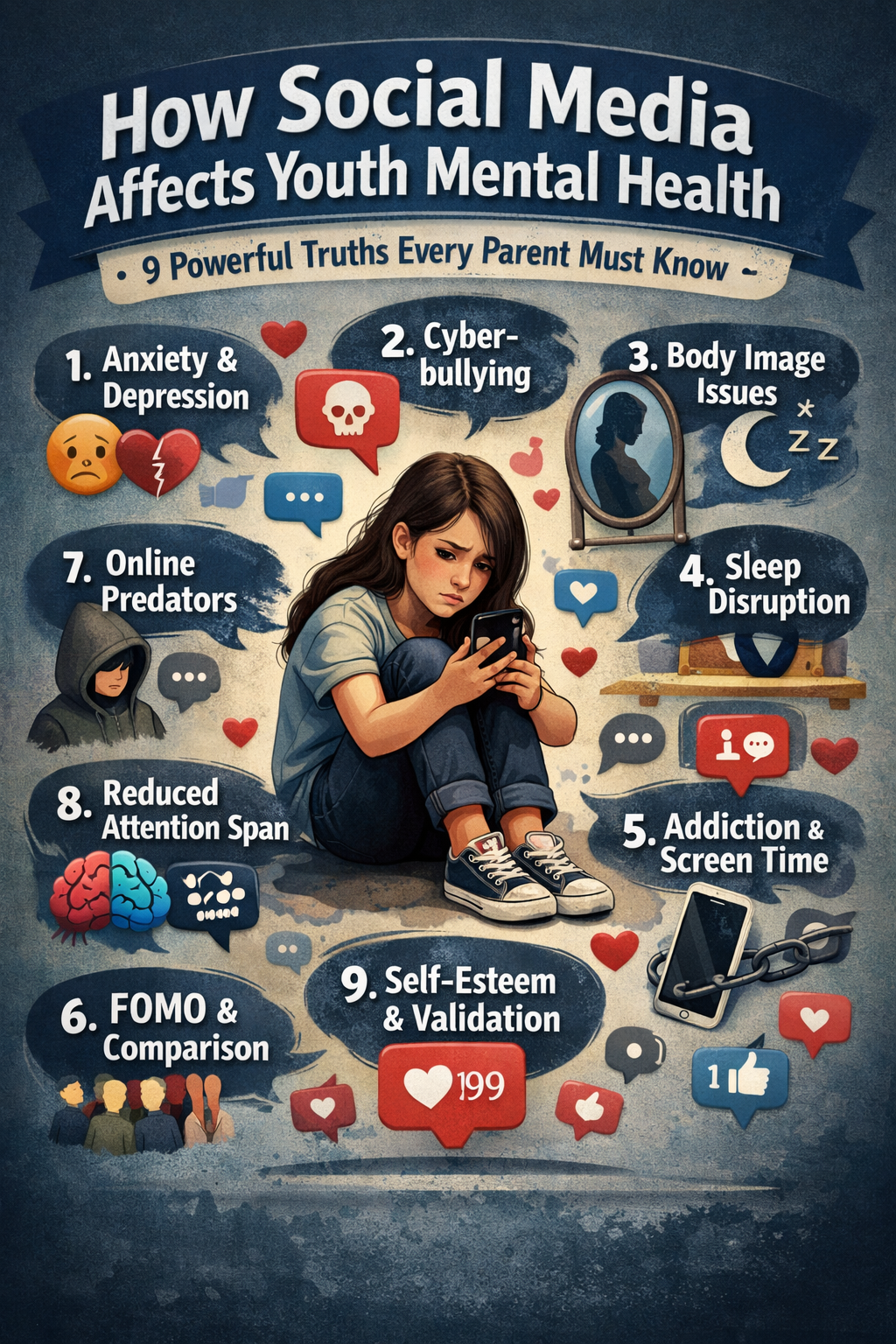
How Social Media Affects Youth Mental Health: 9 Powerful Truths Every Parent Must Know
Social media is woven into everyday life for young people. It can help teens connect, learn, and express themselves, but it can also fuel anxiety, poor sleep, cyberbullying, and constant comparison. Understanding both the benefits and the risks is essential for parents who want to support their children in a digital world.
Social media isn’t just where teens hang out anymore. It’s where they build friendships, share opinions, explore identity, and, sometimes, quietly struggle. For many parents, that’s the tricky part. Social media can be fun, creative, and supportive one minute, then overwhelming, addictive, and harmful the next.
So, how social media affects youth mental health really comes down to one thing: balance. Used wisely, it can open doors to connection and support. Used without limits, it can chip away at confidence, sleep, focus, and emotional well-being.
In this guide, we’ll unpack the real impact of social media on young minds, look at both the positives and negatives, and share practical ways parents can help their teens stay emotionally healthy online. The outline and topic direction are based on the material you shared .
Introduction to Social Media and Mental Health
Social media and mental health are now closely linked, especially for children and teens growing up in a digital-first world. Platforms like Instagram, TikTok, Snapchat, YouTube, and Discord are part of daily life. They shape how young people communicate, how they see themselves, and how they understand the world around them.
That’s a big deal.
While adults often view social media as just entertainment, teens may see it as part of their identity and social survival. A post, a comment, a streak, or a lack of likes can feel far more important to a teenager than it might seem from the outside.
Rise of Social Media Among Youth
Over the past several years, social media use among youth has become almost constant. Many teens check their phones throughout the day, not just for fun, but to keep up socially. Missing a group chat, a trend, or a post can make them feel left out.
This always-on culture means young people are rarely fully unplugged. Their social lives can follow them into the classroom, the dinner table, and even bed at night.
Why This Topic Matters Today
Parents, educators, and mental health professionals are paying closer attention because youth mental health concerns are rising. Anxiety, depression, loneliness, low self-esteem, and stress have become more common talking points in families and schools.
Now, let’s be fair. Social media isn’t the only reason. But it can absolutely intensify these struggles, especially when use becomes excessive or emotionally unhealthy.
Understanding Teen Brain Development
To really understand the effects of social media on youth, we have to start with the teenage brain.
Adolescence is a period of rapid emotional, social, and neurological development. Teens are learning how to regulate emotions, build identity, and handle social pressure. That’s hard enough already. Add a 24/7 digital world into the mix, and things can get messy fast.
Emotional Sensitivity in Adolescence
Teen brains are especially sensitive to peer feedback and social acceptance. In plain English, that means approval matters a lot. A supportive comment can make a teen feel seen. On the flip side, being ignored, excluded, or criticized online can sting deeply.
Because of that, social media interactions often hit teens harder than adults expect.
They may obsess over:
How many likes they got
Who viewed their story
Why someone left them on read
Whether they look “good enough” in photos
What others are doing without them
That emotional sensitivity can make social media feel like a roller coaster.
Dopamine and Digital Addiction
Every notification, like, message, or share can trigger a little burst of dopamine, the brain chemical linked to pleasure and reward. That’s part of why social media can be so hard to put down.
Teens may not be addicted in a clinical sense, but they can develop compulsive habits. Refreshing feeds, checking messages every few minutes, or feeling anxious without a phone nearby are all signs that social media may be taking up too much mental space.
Positive Effects of Social Media on Youth
Here’s the thing: social media isn’t all bad. In fact, when used mindfully, it can play a positive role in a young person’s life.
1. Building Connections and Community
Social media helps teens stay in touch with friends, classmates, and family members. It can also help them find communities built around shared interests, hobbies, or life experiences.
For a teen who feels isolated in real life, that can be huge.
Young people may find support through:
Mental health advocacy pages
Interest-based groups
Safe communities for marginalized identities
Educational creators
Peer support networks
Feeling understood and accepted online can reduce loneliness for some teens.
2. Access to Mental Health Resources
Many young people first encounter mental health education through social media. They may learn about anxiety, stress management, therapy, coping strategies, or emotional wellness from creators and organizations that talk openly about these topics.
That said, not all online advice is accurate, so trusted sources matter. Reputable organizations like the American Psychological Association and NAMI can be helpful starting points.
3. Creative Expression and Identity
Social media gives teens a place to express who they are. Whether through art, music, photography, writing, fashion, or video content, these platforms can support creativity and self-discovery.
For some young people, posting online helps them:
Build confidence
Explore personal interests
Connect with like-minded people
Share their voice
Develop digital skills
When used in healthy ways, social media can be a tool for growth.
Negative Effects of Social Media on Youth
Now for the other side of the coin. This is where parents need to pay close attention.
4. Anxiety and Depression Risks
One of the most discussed concerns is the link between heavy social media use and emotional distress. Constant exposure to curated lives, filtered beauty, achievement posts, and social pressure can leave teens feeling like they’re falling behind.
That can lead to:
Increased anxiety
Persistent sadness
Feeling “not enough”
Emotional exhaustion
Pressure to perform socially
It’s not always dramatic, either. Sometimes the damage builds slowly, almost under the radar.
5. Cyberbullying and Online Harassment
Cyberbullying can be brutal because it doesn’t stop when school ends. Hurtful messages, rumors, exclusion, public shaming, and fake accounts can follow a teen everywhere.
And unlike an in-person comment that fades, online cruelty can be screenshotted, shared, and replayed over and over.
Teens who experience cyberbullying may show:
Fear of checking their phone
Sudden withdrawal
Mood swings
Loss of confidence
Avoidance of school or social activities
This is one of the clearest examples of how social media affects youth mental health in harmful ways.
6. Sleep Disruption and Screen Time Overload
Late-night scrolling is a common habit, but it comes with a cost. Screen use before bed can interfere with sleep quality and shorten sleep duration. Notifications, emotional stimulation, and blue light exposure all play a role.
And when teens don’t sleep well, everything gets harder:
Concentration drops
Stress rises
Mood becomes unstable
School performance suffers
Emotional resilience weakens
Poor sleep and poor mental health often go hand in hand.
Social Comparison and Self-Esteem Issues
Comparison has always existed, but social media cranks it up to eleven.
7. Unrealistic Beauty Standards
Teens are constantly exposed to edited photos, filters, idealized bodies, flawless skin, and “perfect” lifestyles. Even when they know images are altered, it can still affect how they feel about themselves.
This can lead to:
Body dissatisfaction
Negative self-talk
Obsessive appearance checking
Lower self-esteem
Pressure to look a certain way
Girls are often hit especially hard by appearance-based content, but boys are affected too, particularly by fitness, status, and image expectations.
8. Fear of Missing Out (FOMO)
FOMO is real, and wow, it can sneak up fast. When teens see photos or videos of friends hanging out, attending events, or seeming endlessly happy, they may feel left out, even if they were perfectly fine before opening the app.
FOMO can create:
Restlessness
Sadness
Jealousy
Social insecurity
Compulsive checking behavior
That emotional cycle keeps many teens glued to their phones, hoping not to miss the next thing.
The Role of Algorithms in Mental Health
Algorithms are one of the least understood but most powerful parts of social media.
9. Content Personalization Risks
Social platforms are designed to show users more of what keeps them engaged. If a teen interacts with upsetting, appearance-focused, or emotionally heavy content, the platform may continue serving similar posts.
That means one vulnerable moment can lead to a feed full of harmful material.
Echo Chambers and Negative Reinforcement
When teens repeatedly see the same kind of negative content, it can reinforce unhealthy thinking. This may include content centered around hopelessness, social isolation, toxic comparison, or harmful behaviors.
The danger here is subtle. Teens may begin to think, “Everyone feels this way,” or “This is normal,” even when it isn’t.
Warning Signs of Social Media Impact
Parents don’t need to panic every time their child picks up a phone. But they should watch for patterns.
Behavioral Changes in Teens
Pay attention to signs like:
Spending excessive time online
Withdrawing from family or friends
Losing interest in offline activities
Falling grades
Irritability when asked to stop using devices
Secretive behavior around accounts or messages
Emotional Red Flags
Watch for:
Increased sadness or anxiety
Sudden drop in self-confidence
Anger after being online
Obsessing over appearance or popularity
Feeling left out all the time
Trouble sleeping or low energy
Sometimes teens won’t say, “Social media is making me feel bad.” Instead, the signs show up in behavior.
How Parents Can Help
Here’s the good news: parents can make a real difference.
You don’t need to know every app, trend, or meme. You just need a steady, open, supportive presence.
Setting Healthy Boundaries
Healthy boundaries are more effective than harsh crackdowns. Rules work best when they’re consistent, age-appropriate, and explained clearly.
Try strategies like:
Setting screen-free times during meals
Keeping phones out of bedrooms at night
Limiting recreational screen use
Encouraging offline hobbies and face-to-face friendships
Using family discussions instead of one-sided lectures
Teens respond better when they feel respected, not policed.
Encouraging Open Communication
This part matters more than almost anything else. If teens feel judged, they’re less likely to open up. But if they feel heard, they’re more likely to talk about what they’re seeing and experiencing online.
Ask questions like:
“How does social media usually make you feel?”
“Have you ever seen something online that upset you?”
“Do you feel pressure to post or respond right away?”
“What do you do when social media starts feeling stressful?”
Keep the tone calm. Curiosity beats criticism every time.
Tips for Youth to Use Social Media Mindfully
Teens also need practical tools, not just warnings.
Digital Detox Strategies
A digital detox doesn’t have to mean deleting everything forever. Even small breaks can help reset the mind.
Good starting points include:
Taking one screen-free hour each evening
Muting accounts that trigger stress
Turning off nonessential notifications
Logging out during homework time
Taking a weekend break from one app
These small shifts can lower stress surprisingly fast.
Building Healthy Online Habits
Encourage teens to:
Follow accounts that inspire or educate
Unfollow content that causes anxiety or insecurity
Avoid comparing real life to curated posts
Use social media with intention, not out of boredom
Reach out for help if content affects their mood
Mindful use is all about awareness. When teens understand how social media affects youth mental health, they’re more likely to use it wisely.
Expert Recommendations and Research Insights
Mental health experts generally agree on one important point: it’s not just the amount of time spent online that matters, but the quality of the experience.
A teen using social media to connect with supportive friends may have a very different outcome than a teen spending hours doom-scrolling, comparing themselves, or being targeted online.
Professionals often recommend focusing on:
Sleep protection
Emotional awareness
Digital boundaries
Parent-teen communication
Monitoring for harmful content
Seeking professional support when needed
Trusted resources for parents and teens include:
American Psychological Association: https://www.apa.org/topics/social-media-internet/health
National Alliance on Mental Illness: https://www.nami.org
These organizations offer educational material that can help families better understand digital mental health.
FAQs
1. How does social media affect youth mental health?
Social media can help young people feel connected and supported, but it can also increase anxiety, depression, stress, poor sleep, and low self-esteem when use becomes unhealthy.
2. What are the biggest risks of social media for teens?
Some of the biggest risks include cyberbullying, social comparison, exposure to harmful content, sleep disruption, and pressure to appear perfect online.
3. Can social media ever be good for mental health?
Yes, absolutely. Social media can provide community, creativity, learning opportunities, and access to mental health support when used mindfully and in moderation.
4. What are signs that social media is harming a teen?
Warning signs may include irritability, isolation, sadness, anxiety, poor sleep, falling grades, low confidence, and a strong emotional reaction to online activity.
5. How can parents protect their teen’s mental health online?
Parents can help by setting healthy boundaries, talking openly, encouraging breaks, modeling balanced screen habits, and watching for emotional or behavioral changes.
6. Should teens quit social media completely?
Not necessarily. For many teens, the goal isn’t total removal but healthier use. In some cases, a temporary break or deleting a harmful app may be the best move.
Final Thoughts
Social media is here to stay, and let’s be honest, it’s not going anywhere anytime soon. That means the goal isn’t to fear it blindly. The goal is to understand it.
The truth is, how social media affects youth mental health depends on how, why, and how often it’s used. It can create connection, spark creativity, and offer support. But it can also drive anxiety, erode self-worth, disturb sleep, and make everyday life feel like a competition.
For parents, the most powerful tools are awareness, conversation, and consistency. For teens, the key is learning to use social media instead of letting it use them.
When families talk openly, set healthy limits, and stay alert to warning signs, social media can become less of a threat and more of a manageable part of modern life.
And that’s really the heart of it, isn’t it? Not perfection. Just healthier habits, better support, and a little more breathing room in a world that never stops scrolling.